‘I spend less, that’s all that matters’: life in the world’s most electrified countries

The race to electrification has emerged as a key theme of this year’s UN climate summit: increasing the use of electricity – particularly from clean sources – has the potential to improve daily life for people around the world.
The summit’s co-hosts are now trying to get countries to promise to increase their electricity use to 35% of all energy used by 2035. The global figure currently stands at 23%, but some countries are already striding ahead. As 100,000 delegates, negotiators and world leaders thrash out the details in Antalya, Turkey, the Guardian spoke to three people in Norway, Rwanda and China to find out what life looks like in more highly electrified countries.
An office worker in Oslo, Norway
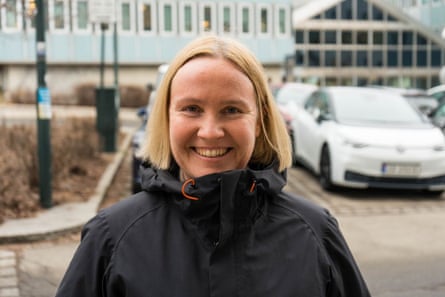
Norway is a world leader in the race to 100% electrification. In September, a record 98.81% of new cars sold were electric, and hydropower produces 90% of all electricity. But with rapidly rising energy demands, including from new datacentres, authorities warn that the country could soon face a power deficit and higher energy prices.
Unni Berge, 47, lives in Oslo with her husband and two teenage sons and works as the head of communications at the Norwegian EV Association. She describes how electricity features in a typical day:
“I use electricity in my three-bedroom flat and I have district heating [where heat is transported around a local network from a centralised source rather than individual boilers to heat homes and buildings]. For electricity we are connected to the Norwegian central grid, which is mainly hydropower.
“I live in a rather energy-efficient flat, so our electricity bills are comparatively low. In October, we spent 730 Norwegian kroner [£57] on electricity for our apartment, and in September it was 500 kroner.
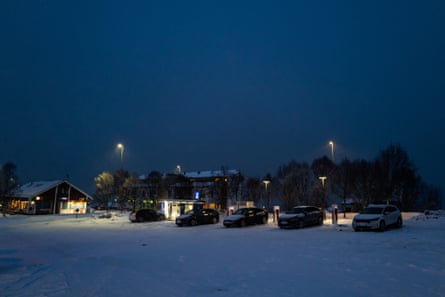
“I go to work by bus. Almost all the buses in Oslo are fully electric. I also have an electric car, but driving in the middle of Oslo for work is not an option because we have a lot of restrictions on cars in the city centre. In my street, the bus comes every fifth minute, so I don’t have to plan. I go outside and a bus comes.
“I mostly use my electric car on weekends. A lot of the trips are driving to sports activities with my two children, who are 18 and 15. I also train a handball team, so I use it to go to a lot of handball matches and tournaments.
“We charge our car with a charging box in our garage where, like most apartment garages in Oslo, we have built a collective charging system. If everyone put their charging on at the same time it would go slow, but in practice that doesn’t happen.
“I have a large battery on my EV so I charge it once every two to three weeks. Of course we pay for the electricity and a system fee, but it’s much cheaper than petrol and diesel.
“In my office, we have district heating, which is quite common in Oslo in larger buildings, then we use electricity for light and computers. Lunch is made in my office in the internal canteen with electricity. At work I use Microsoft Copilot, which is a really helpful tool, but of course there are big questions there – energy demands will get too high if everyone is using AI more.
“I come home and use electricity to make dinner, watch television and go to the cinema. Growing up in a small village on the western coast of Norway, we also used wood for heating as well as electricity. But it is fair to say that electricity is common part of Norwegian life and has been for a long time.
“What has changed is that our transport sector is also now run on a rising amount of electricity: passenger cars, buses and also ferries. That happened quite fast. Heavy goods vehicles are also increasingly electric, so of course that changes the system and society.

“Perhaps because of the war in Ukraine and more extreme weather conditions, people are becoming aware that they are quite dependent on electricity, so in recent years there has been debate on how to prepare for a crisis. In previous power cuts, some people have used their electric cars as a battery to power electric equipment.
“There is also a big debate about electricity prices. In Norway we have nearly 100% renewable electricity, but even so we are connected to the European grid. So the gas prices still influence our electricity prices. And when we have dry winters, electricity prices rise because if we have less snow, the hydropower gets less water. Rising numbers of datacentres is also something consumers are starting to wonder about – what this development is going to look like and how much energy it is using.”
As told to Miranda Bryant
An e-motorbike taxi driver in Kigali, Rwanda

Six years ago, the Rwandan government embarked on an enthusiastic promotion of e-mobility by removing a number of taxes on e-bikes and vehicles and offering incentives for businesses operating charging stations.
The government has also banned registration of new fossil fuel-powered motorcycles in Kigali, the capital and Rwanda’s largest city, and is prioritising EVs in its vehicle acquisition.
Claver Habagusenga is an e-motorbike taxi driver living in Kigali. He shares a typical day:
“My day begins at 5am and ends late in the evening. My first job is a general clean of my bike, checking tyre pressure, seeing if the brakes are in order, verifying battery health. I have come to learn that riding on Rwandan roads requires strict discipline, as traffic regulations are strictly enforced and a breach attracts heavy fines.
“In the last five years, I have learned to prepare my breakfast using an induction cooker. In the past, I used to use a charcoal stove, which would delay my food and my work. Besides, a charcoal stove would affect my entire family with heavy smoke, and also cost me heavily in fuel each day.
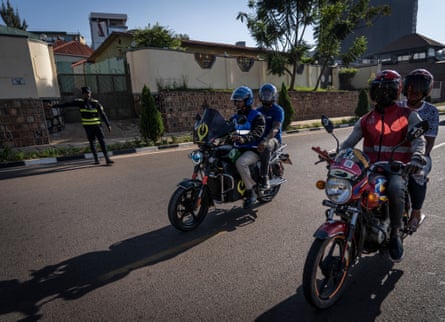
“After my breakfast, the hustle begins in earnest. First, I rush to the nearest swap stations in case my battery is down. I have a varied working schedule daily. Some of my passengers are permanent clients. Two months ago, I was contracted by three families in Kigali to safely transport their three nursery kids to and from school each day.
“Three years ago, I owned a petrol motorbike and I would wake up every Saturday to visit petrol stations to have my bike oil changed, air filter cleaned and other maintenance, at a cost of around US$1.15 [85p]. I love riding an electric motorbike because it’s automatic and isn’t noisy. I always advise my colleagues with fuel bikes to switch to electric ones.
“I feel privileged to work and live in a country that has the commitment of protecting the environment and feel honoured to share my ideas and experience with colleagues.
after newsletter promotion
“Lunchtime is rush hour, especially in the capital. There is one major problem that many electric motorbike riders are guilty of: many have just acquired bikes and are lacking skills, yet are always in a rush.
“Sometimes I skip lunch, but when time allows I’ll be in any restaurant. It’s the time to talk about the unpredictability of our business, the cost of living rising daily, let alone high inflation making the majority of us suffer.
“My daily work has become busier because I have more passengers, since an EV motorbike is cheaper for them compared to a fuel bike.
“Each kilometre I make today costs a fraction of what a petrol-powered motorcycle rider spends on fuel, cutting daily energy expenses significantly, and carbon emissions.
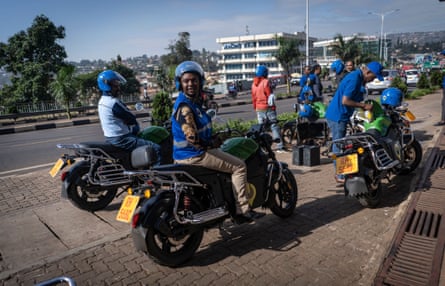
“My electric motorbike costs $2.03 for an annual road licence, while a fuel motorbike is charged $6.77. It means I can offer good prices to my clients, and also clients love to use our bikes since they are trackable.
“I visit battery swap stations three times a day and I am charged $1.69 per battery swap. I always remember that when I had a petrol bike, I could use 3 litres of fuel a day and make a profit of $6.09, but today I earn $11.50 a day with an electric bike.
“On Sunday, it is time for rest with my family. For me, what matters is that we have cleaner motorbikes that also cost less to own, and operate better than the fuel one I once depended on.
“I spend less today. That is all that matters to me and my family.”
As told to Ignatius Ssuuna
A journalist in Shanghai, China
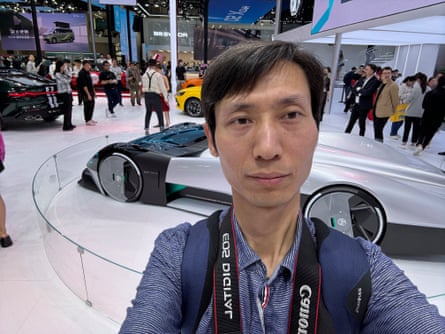
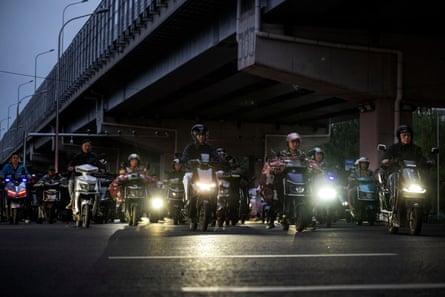
From rows of scooters plugged into charging pods outside supermarkets to armies of buses shuttling back and forth on high streets, electric vehicles have taken over China’s roads with astonishing speed.
Phate Zhang, the founder of the Shanghai-based news outlet CnEVPost, describes his typical day:
“I usually wake up at 6.30am to get ready for my day. After breakfast, school runs are looming large.
“My family own three electric scooters, Vespa-like two-wheelers perfect for running errands. I ride one to take my six-year-old daughter to her school, which is two blocks away. My father, who lives with us, rides another to ferry my nine-year-old son to his school, which is about 4km away. My wife rides the third to the nearest subway station to catch the train to work.
“When I get home, I start work. My job mostly involves writing news reports about Chinese EV companies for my own website, which I founded in 2020. That was also when I bought my EV to replace my old diesel car because I realised it would be much cheaper to power my car with electricity. Plus, I could get a number plate in Shanghai – which would cost about 90,000 yuan [£10,000] for a fossil-fuelled car – for free thanks to a government policy to promote EVs. I spend an average of 200 yuan [£22] charging my car each month. If I had gone for another diesel car, the bill would be about 400 yuan more.
“My father takes care of the school runs in the afternoon for both of my children to allow me to focus on work. Once that is done, he always makes sure that his scooter is charged up for the next day by plugging it into a charging pod in the communal bike garage under our apartment building. It normally costs 0.6 yuan [7 pence] to charge one scooter fully, which would be enough to cover 20km.
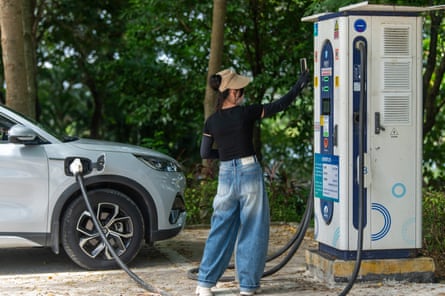
“At the weekend, my wife and I usually drive our daughter to her swimming lesson at noon, and then take her and her brother out for a relaxing afternoon in a shopping mall or park. It is so common for families in Shanghai to own an EV nowadays, and there are usually plenty of charging pillars in the parking lots in commercial districts. Just scan a QR code, and your charging starts.
“A couple of times a year, I drive my whole family back to our rural home town in central China. A one-way journey covers about 800km and takes 12 hours or so, including several stops at service areas for charging and rest. When I went home with my EV for the first time in 2020, there weren’t any charging pillars in my village, but now there are at least three within 3km of our house. In October, I also saw many electric trucks on the main road near my village – a promising sign that more types of vehicles are switching away from fossil fuel in China.”
KioskNews shows a cleaned-up reading view extracted from the publisher’s page — the original always lives on their site, not ours.