‘Small price to pay’: The young homeowners welcoming falling house prices even as it hurts them

Falling property prices have come at the worst possible time for Alex Hogan and his partner. They are now weighing up whether they can afford to have another child.
Locked out of the established housing market, the Queensland couple resorted to buying a block of land to build a family home.
Fast-rising construction costs are now limiting their options and the anticipated value of their finished home is sliding, as rising interest rates and the government’s property tax reforms drag down property prices.
Yet Hogan wants the government to go even further in tackling the housing affordability crisis.
“If you don’t seize that momentum when there’s a push for it, then things can just go back to bubbling away under the surface and nothing ever gets done about them,” the 41-year-old says.

Although falling prices are frustrating many property owners, and price falls leave Labor vulnerable to political attacks, there are some homeowners willing to accept lower valuations in order to make housing more accessible for others.
Hogan is among several recent property buyers Guardian Australia spoke to who is prepared to absorb the fallout if it helps close the growing divide between forever renters and their landlords.
“It might end up sucking,” Hogan says. “But it’s better than having a two-tier society.”
Prices could fall 10%
House prices are falling across the country amid higher borrowing costs, a weak economy, and a once-in-a-generation change in the tax treatment of property investors.
The government’s critics have blamed the downturn on Labor’s May budget reforms, which included getting rid of negative gearing for new investors, excluding new builds.
“Australian families already struggling to pay their bills are now sitting at the kitchen table watching the value of their biggest asset, their family home, fall through the floor,” Tim Wilson, the Liberal Treasury spokesman, said earlier this month.
Prices around Australia have fallen 3.6% from their peak earlier this year, according to Cotality data, led by steep declines in Sydney. The most expensive markets are falling the most, in a sign interest rates are a dominant cause.
Falls of more than 10% have been forecast by some analysts as elevated inflation makes a fourth rate hike more likely in coming months.
Most long-term home owners have enjoyed years of growth, which has included a 26% price surge in just the three years to March. Newer buyers who missed the boom are most affected by the recent weakness.
Eibhlinn Cassidy bought a Melbourne apartment two years ago. They know loan repayments could spike when they refinance next year if the value of the apartment falls.
Yet the 30-year-old junior doctor is stoic about the downturn if it makes housing more affordable because they remember the constant anxiety of grappling with soaring rents, weak tenant rights and losing bonds.
“I’d stress about it if it happened but, either way, I’ve got to be paying either rent or a mortgage and I’d rather be somewhere I can put paint on the walls,” Cassidy says.
“Even if I have to eat it, then big deal … I consider it a really small price to pay for a long overdue adjustment in the market that will let more people get in.”
Terry Rawnsley, a KPMG economist, says many recent buyers won’t have to refinance anytime soon and should be able to wait out the downturn. Prices are expected to rise again once the RBA starts cutting interest rates, likely in 2028.
after newsletter promotion
“If you’re in a situation where you bought in the last 12 or 18 months, or you come into refinancing, you might be felling a bit of stress,” Rawnsley says.
“But if you don’t have to sell at this point in time, that paper loss is just a theoretical one and you don’t have to worry about it.”
‘I do not want to be a landlord’
Australian homes were turned into unaffordable wealth-building assets after a surge in prices in the 90s and early 2000s, thanks largely to favourable tax settings for investors.
Experts expect the current downturn and the loss of those settings to push the Australian mentality back in the other direction – in part because those who played by the old rules could soon find themselves in financial pain.
Remy Coll, a 37-year-old business owner, has become an accidental property investor after the price falls made it impossible for him to sell his old house.
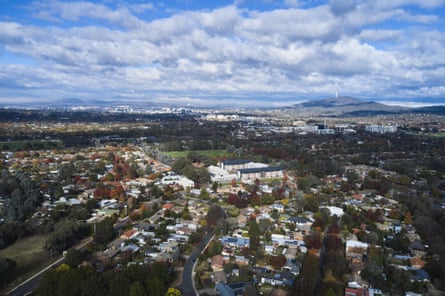
When he bought in Canberra’s inner north earlier this year, he used his old home on the city’s outer fringe as collateral with a view to sell it soon after settling. The government announced its tax reforms the following week and, months later, the median Canberra home is now $44,000 cheaper.
Coll says he is now stuck with rising repayments on two mortgages, taking rent from tenants he doesn’t want.
“I do not want to be a landlord,” he says. “I do not want to contribute to the problem of rentals. But equally, now the house that I live in is contingent upon me getting a certain price for that house.”
Selling in the current market would mean he loses money on his first purchase, while potentially grappling with a higher interest rate on his second purchase as the bank revalues.
He and his partner are working extra hours and spending less time with their young children to hold on to their home as prices fall. He still believes the Albanese government did the right thing.
“That period of [price] reduction will be painful for probably a lot of people like me, and maybe some investors,” Coll says.
“But in the future, as long as real estate grows by a small amount [and] peoples’ wages grow more ... people will be able to, in their early 30s, start to afford a house again.”
KioskNews shows a cleaned-up reading view extracted from the publisher’s page — the original always lives on their site, not ours.