Why the PLA’s Z-10 attack helicopter is taking a bigger role at sea
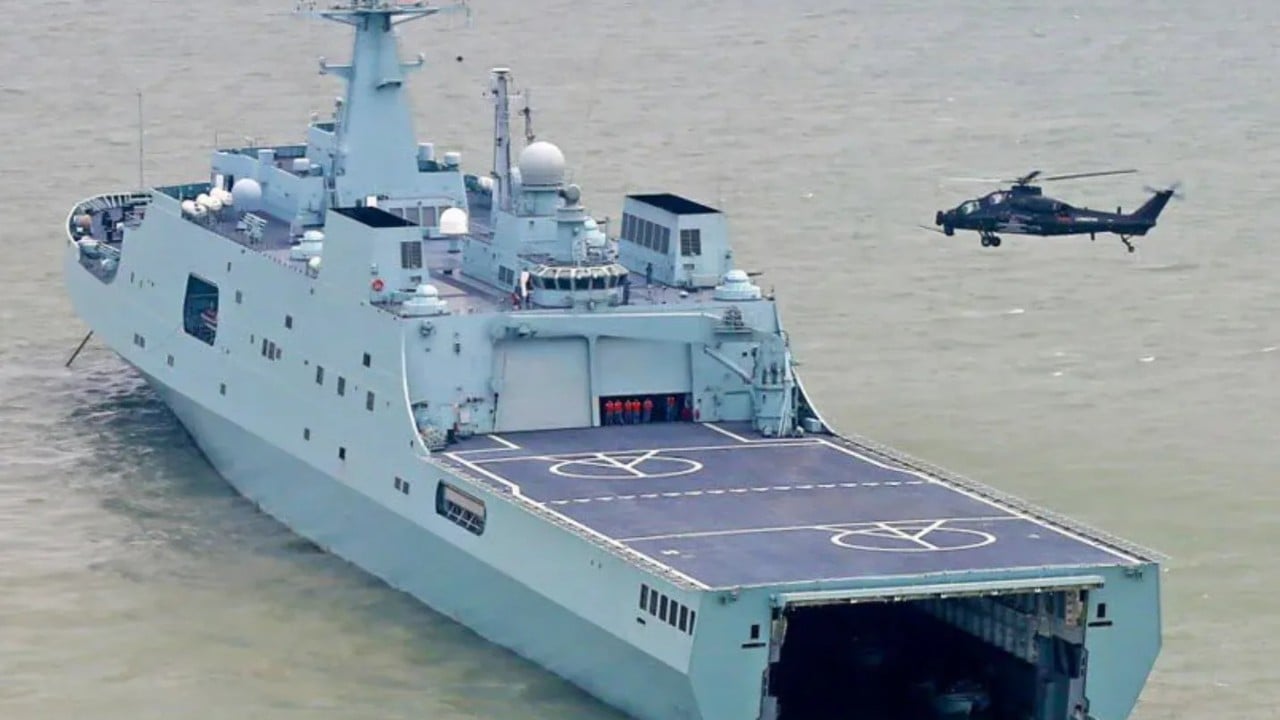
Built to hunt tanks and support ground troops, the People’s Liberation Army’s main attack helicopter is increasingly being prepared for operations at sea.
Crews of the Z-10 are training to fly from ships – a shift that could give Beijing extra firepower in an amphibious assault on Taiwan.
Manufactured by AVIC subsidiary the Changhe Aircraft Industries Corporation, the Z-10 entered service with the PLA Army in late 2010. It began documented shipboard trials in 2014, when Chinese navy imagery showed a Z-10 landing on the Baxianshan Type 072A tank landing ship.
The attack helicopter’s maritime role has gradually expanded since then. In 2020, army helicopters practised landing, refuelling and rearming on a civilian semi-submersible.
The PLA has also operated Z-10s close to the Taiwan Strait. Defence intelligence publisher Janes said satellite imagery from December 2020 showed 12 of the aircraft at the Yuanqian helicopter base on the Fujian coast opposite Taiwan, while it was still under construction.
Four years later, images appeared to show eight Z-10s aboard another semi-submersible. And in November of the following year, state broadcaster CCTV said the Type 075 amphibious assault ship could carry the army-operated helicopter.
Together, the coastal presence and shipboard trials could allow the PLA to operate Z-10s closer to Taiwan, where they could escort troop-carrying helicopters, attack coastal positions and support troops ashore.
That could be important because Janes estimates the Z-10’s combat radius at 114km to 294km (70 to 182 miles), depending on the configuration. At the lower end, that is less than the roughly 130km width of the Taiwan Strait at its narrowest point.
That range limitation also helps explain the PLA’s interest in semi-submersibles. An analysis published in June by the US Army War College’s China Landpower Studies Centre said the PLA Army would likely rely on such ships and other flat-deck vessels as forward refuelling and rearming points in any attack on Taiwan.
The PLA has also tested how the Z-10 could be used against targets at sea. Footage aired by CCTV in 2023 showed Z-10s from the Eastern Theatre Command’s 73rd Group Army firing rockets at simulated maritime targets off Fujian.
Such training points to a possible role against small boats or other targets at sea, not just positions ashore.
Official footage released this February showed Z-10s, Z-20s and Mi-17s from a PLA Army brigade taking off from a land base and training together out at sea, illustrating how attack and multirole helicopters could be used together in maritime operations.
That broader maritime role is notable because the Z-10 was developed mainly for battlefields on land.
China’s first dedicated attack helicopter emerged from a programme that drew on foreign expertise. Kamov general designer Sergei Mikheyev said in 2013 that the Russian bureau had secretly designed the helicopter’s baseline configuration for China in 1995 – a preliminary design known as Project 941 – before further development continued under Chinese direction.
The first prototype flew in April 2003.
Pratt & Whitney Canada also supplied 10 engines for development aircraft in 2001 and 2002, while production versions later switched to Chinese power plants.
The tandem-seat helicopter carries a chin-mounted 23mm cannon and can be armed with anti-tank missiles, rockets and short-range air-to-air missiles, giving the PLA Army a purpose-built platform for anti-armour strikes, close air support and armed escort.
The Z-10 has also continued to evolve in PLA service. Upgraded versions have appeared with extra armour, upward-facing exhausts intended to reduce their infrared signature, a new identification system and a new BeiDou antenna.
The PLA is also testing how the helicopter can work with drones. Chinese reports citing CCTV said crews practised engaging a drone with the helicopter’s cannon in 2026, while another exercise paired Z-10s and Z-20T assault helicopters with a KVD-002 drone.
A separate analysis published by the China Landpower Studies Centre said the exercise showed coordination between helicopter crews and drone operators, but did not show that Z-10 crews themselves controlled the drone.
The IISS Military Balance 2026, published by the International Institute for Strategic Studies, lists about 200 Z-10s in service with the PLA Army and another eight Z-10Ks with the air force’s Airborne Corps.
China also adapted the Z-10 for the export market. The resulting Z-10ME made its public debut in 2018 at Airshow China in Zhuhai. Six years later, a demonstrator at the Singapore Airshow was shown with additional features including a mast-mounted millimetre-wave radar and directed infrared countermeasures.
Pakistan inducted the Z-10ME into army aviation service in August 2025, becoming its first and so far only confirmed foreign operator. The number of Z-10MEs acquired by Islamabad has not been publicly disclosed.
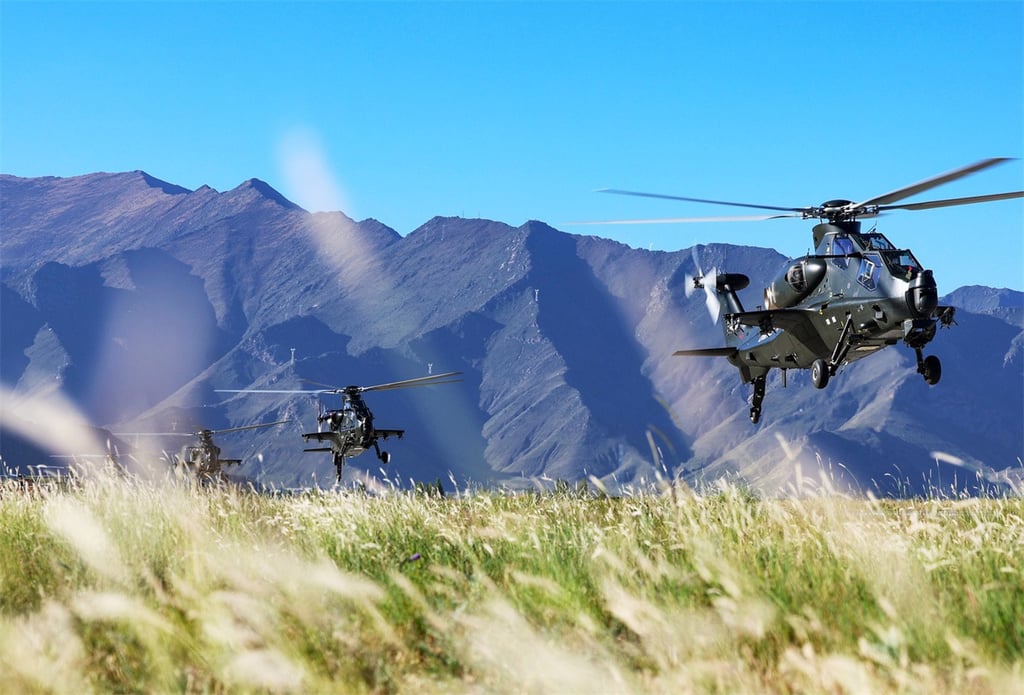
The Z-10 is considerably lighter than the US-made AH-64E Apache, which is also operated by the Taiwanese army. Janes puts its maximum take-off weight at an estimated 7 tonnes, about 3.4 tonnes less than the Apache’s maximum operating weight. While the figures are not strictly like-for-like, the gap reflects the Z-10’s smaller overall design, which gives it less scope to add fuel, armour, weapons and other equipment.
That helps explain why China is also looking at a larger attack helicopter. The country is now testing a new design commonly referred to as the Z-21, though the designation remains unofficial.
First seen in 2024, the tandem-seat aircraft is substantially larger than the Z-10. Separate test flights in 2026 have shown it carrying external fuel tanks and, on another occasion, a mast-mounted radar.
The June analysis said the fuel-tank tests pointed to an emphasis on longer-range missions and assessed that the new attack helicopter could enter PLA Army service by the end of 2027, though China has announced no service date. Its larger size could also provide more capacity for fuel, armour, sensors and weapons.
In an amphibious assault on Taiwan, the analysis said, the Z-21 could operate alongside Z-10s and Z-19s during beach landings or escort Z-20 transport helicopters in air-assault operations.
KioskNews shows a cleaned-up reading view extracted from the publisher’s page — the original always lives on their site, not ours.