Flight tickets, food and more: 5 charts that explain what’s driving inflation higher, wider

October saw, for the first time in two years, household prices in a month rise more than 6% compared to the same month a year ago. The 6% figure is significant for one reason and one reason only: it is the upper limit of the Reserve Bank of India’s legally mandated tolerance range.
By law, if average inflation — as measured by the Consumer Price Index (CPI) — is above 6% or below 2% for three consecutive quarters, then the central bank is deemed to have ‘failed’ in achieving its mandate.
Three quarters is a long time. But some are already sounding warning signs: according to Tanay Dalal, an economist at Axis Bank, inflation is “likely to print above 6% until June 2027”. But what is driving inflation so hard that economists think prices will keep rising rapidly? We break it down here.
‘Don’t travel by air’
Anyone who has tried to book flight tickets to go home for Diwali would have noticed just how much prices have risen. And while the war in West Asia has made jet fuel very expensive, flying became sharply more expensive in October.
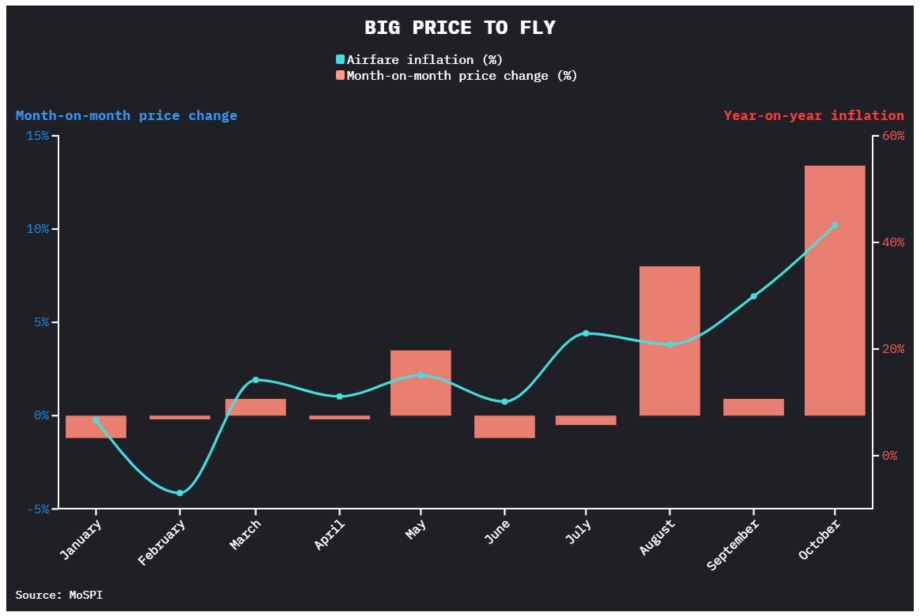 Airfare inflation.
In October, average airfares were a massive 43% higher compared to the same month last year. More importantly, of all the 358 goods and services in the CPI basket, airfares saw the largest increase in price (13.36%) from the previous month.
Flying has become so expensive that the matter even reached the Supreme Court this month, with an application seeking a cap on fares ahead of the festival season. The court, however, declined to grant an urgent hearing, with Justice Vikram Nath saying ‘don’t travel by air’.
All about chips
As this newspaper has been pointing out for the better part of a year, the spiralling price of memory chips used in the manufacture of consumer electronics — or ‘chipflation’ — is increasingly becoming a driver of household inflation.
Story continues below this ad
In October, pen drive inflation jumped to 22%, phones and laptops to 9%, and other major electronic appliances to 4-5%.
What will worry policymakers is that the global chip shortage, manufacturers say, is not going to end for several years.
Eat at home or out?
The first thing that households notice getting expensive is food items: in October, food inflation jumped to 8.94%. And if you want to dine out, throw in costlier cooking gas for restaurants.
Story continues below this ad
“The surge in food prices continues, reflecting the impact of a weak monsoon as well as the festival season,” said Gaura Sen Gupta, IDFC FIRST Bank’s Chief Economist.
Core inflation rising
Prices of food and fuel items can be volatile — they can rise and drop sharply from one month to the next if supply suddenly improves for one reason or another. This is why, to understand the underlying price pressures, economists and policymakers like to also see how inflation is evolving by excluding food and fuel. This is called ‘core’ inflation.
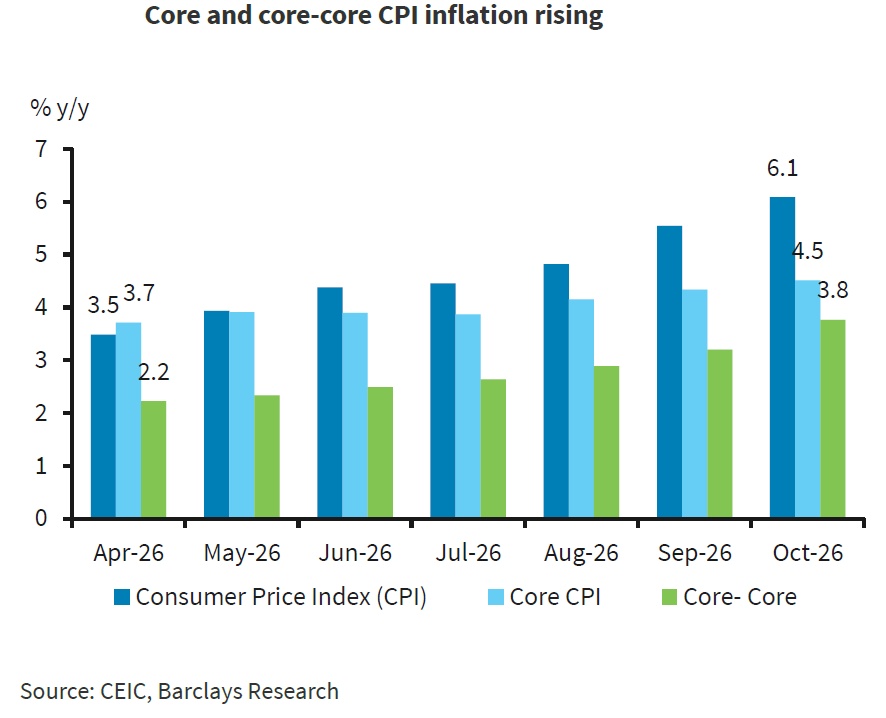 Barclays core inflation.
The problem, however, is that core inflation is also rising. The RBI predicted last month that core inflation will average 4.4% in 2026-27. With the October core inflation print already at 4.5%, the average for the first seven months of the fiscal year is 3.9%.
Higher… and wider
The RBI will not just be worried about inflation rising, but also spreading to more and more items in the CPI basket, like consumer goods and services: 95 of the 358 items of the consumption basket recorded 6%-plus inflation in October versus 40 in January. Other measures also point to price pressures spreading wider.
Story continues below this ad
“The latest CPI data show that inflationary pressures are spreading beyond energy-related sectors,” ANZ economist Dhiraj Nim said. “Acute pipeline price pressures are also likely feeding through to consumer prices more visibly, beyond energy-sensitive CPI. With WPI (wholesale) and PPI (producer price) inflation still in double digits and growth broadly resilient, further passthrough to consumer prices is highly likely.”
KioskNews shows a cleaned-up reading view extracted from the publisher’s page — the original always lives on their site, not ours.