‘Failure points you to the solution’: Students win HTX award for pushing past setbacks in research
SINGAPORE – Six months into building an artificial intelligence model to help doctors select suitable patients for immunotherapy, a cancer treatment, Aneesh Bondugula faced a setback that made him rethink the project.
His team’s model, trained on patient data from The Cancer Genome Atlas, performed well when tested against other data from the same repository. But its accuracy dropped when tested against a separate Asian dataset, said the 18-year-old.
“The first thing I felt was panic,” said Aneesh, a Year 6 student at NUS High School of Mathematics and Science. “It was a lot of work that we had done during those six months.”
As the team changed direction, members left. At several points, he considered dropping the project.
But he pushed on. His perseverance has earned him recognition as one of five recipients of the first Undaunted Student Award by the Home Team Science and Technology Agency (HTX). The award recognises students who persist through setbacks in science, technology, engineering and mathematics (STEM) projects.
The first such award involved three partner schools and drew 14 applications. Recipients receive a $4,000 cash prize each and opportunities to participate in HTX’s internship programme.
The Undaunted Award was created in 2023 to recognise unsuccessful initiatives by HTX staff, in the hope that these efforts would lead to successful projects that government agencies can use. The Undaunted Student Award is a newer extension of this initiative, aimed at recognising students who demonstrate similar perseverance.
HTX, a statutory board under the Ministry of Home Affairs, develops science and technology solutions for public safety and security.
The agency’s human resources director Lim Puay Sze said the agency was already engaging STEM students through career fairs and wanted to share its values with them, particularly the willingness to persevere through failure in research.
To do so, HTX rolled out the competition with NUS High School of Mathematics and Science, Nanyang Junior College and the School of Science and Technology, Singapore.
Lim said the judging placed emphasis on “failing forward” – the lessons students learnt from setbacks and how these informed their next steps.
The agency hopes that sharing such experiences will normalise conversations about failure and build resilience among students. It plans to extend the annual award to more schools.
Aneesh was inspired by his internship at A*STAR in 2024 to start an ambitious project to combine tumour images, genomic and clinical patient data to help predict whether patients will respond to immunotherapy, a treatment that helps the immune system fight cancer.
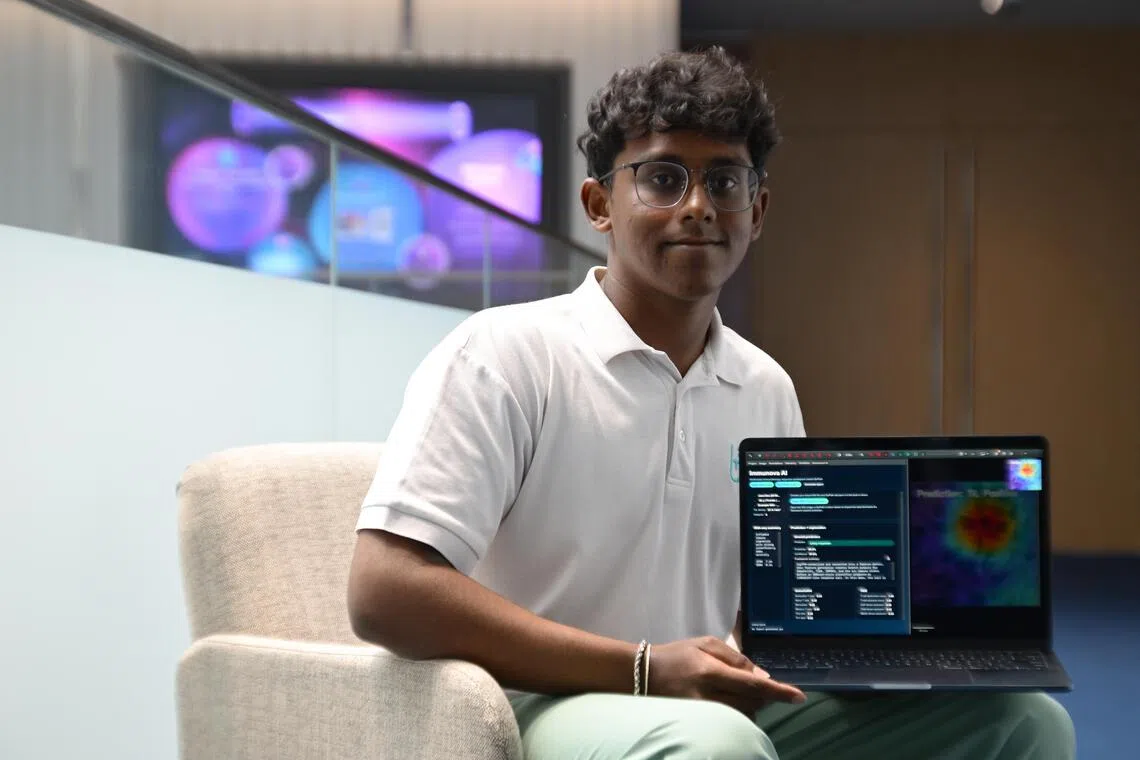
Aneesh was inspired by his internship at A*STAR in 2024 to start an ambitious project to combine tumour images, genomic and clinical patient data to help predict whether patients will respond to immunotherapy.
ST PHOTO: NG SOR LUAN
He said current diagnostic methods are not sufficiently accurate in predicting which patients would respond well to immunotherapy.
He was also moved by what patients told him when he was volunteering in a hospice.
“They’re not very confident about the decisions that they make when they choose their treatments. It’s a very large burden for them to bear.”
When Aneesh and his team encountered their roadblock, they initially suspected a problem with how they were training the model.
After consulting mentors, they realised that the older dataset lacked information the model needed, including certain gene data and patients’ past treatments.
They decided to shift towards newer Asian datasets. Fortunately, Aneesh had earlier built up an international network of mentors and other young people who could advise them and connect them with hospitals and researchers in their respective countries.
It took the team around three months to find Asian datasets and start training the model on them.
“I felt that the problem was worth solving, and a setback in our approach was not a sufficient reason to abandon it.”
“Even though our initial idea wasn’t working, at least we were able to find out what went wrong, and then try to find a new direction.”
Nearly two years into the project, Aneesh sees no fixed end point, preferring to focus on the next step. He is now confirming beta-testing partnerships with some hospitals and cancer centres in South-east Asia.
The aspiring medical student hopes to eventually develop a model reliable enough to be used in hospitals here to help guide treatment decisions.
Can chicken bones help remove dye pollutants?
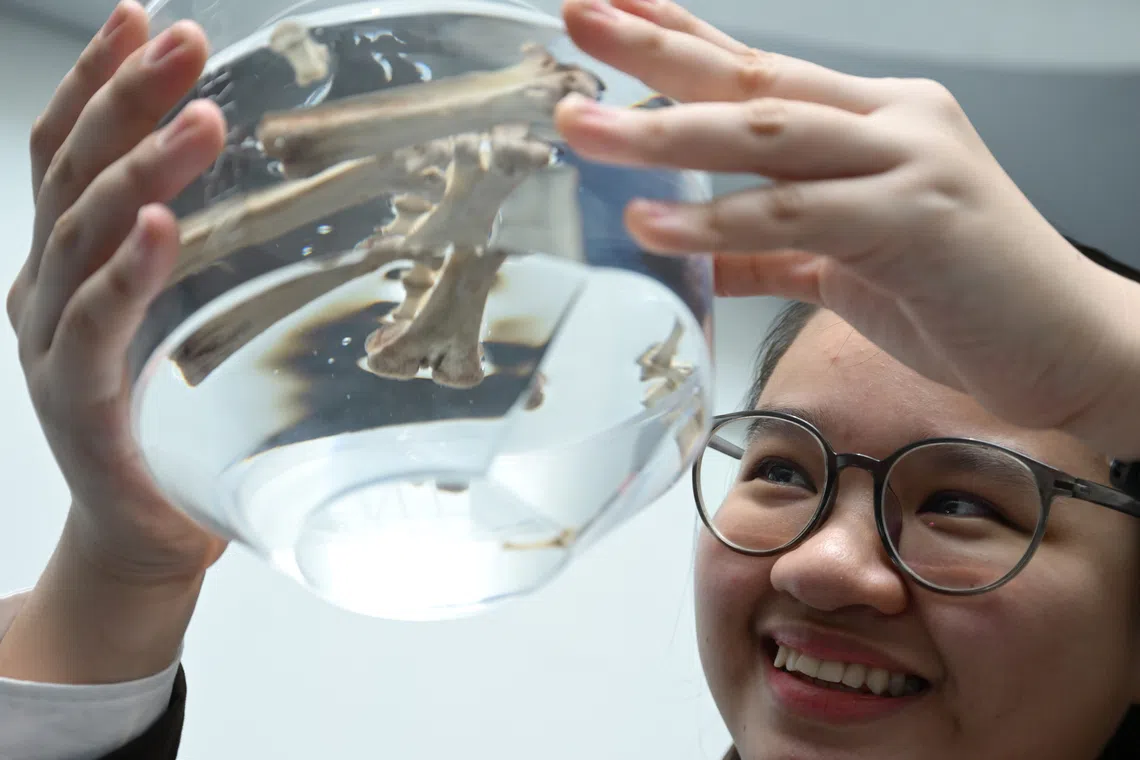
Shavonne Tok, a JC2 student at Nanyang Junior College, encountered a different set of problems while investigating whether discarded chicken bones could remove dyes from water.
ST PHOTO: NG SOR LUAN
Another recipient, Shavonne Tok, a JC2 student at Nanyang Junior College, encountered a different set of problems while investigating whether discarded chicken bones could trap and remove dyes from water.
She had wanted to tackle waste and water pollution. Textile dyes from factories can enter water bodies through improper disposal, she explained.
The year-long project, undertaken with a partner through the NUS Science Research Programme, involved scraping tissue off bones to prevent mould. But some bones still developed mould during storage.
Collecting and cleaning the bones was difficult, she said. To obtain more material for larger experiments, the pair bought frozen chicken feet to cook and harvest the bones.
Collecting the 2kg of bones used for the project also meant cooking and eating chicken feet, which Tok does not like.
The pair also had to adjust their approach along the way. While they expected heating to make the bones more porous and improve dye removal, the heated bones performed worse. Examining the bones under a microscope, they found that heating appeared to have caused their porous structure to collapse, Tok said.
Hence, they dropped the heat treatment, simplifying the preparation process, she said.
The pair also tested whether the bones could be used to remove silicon nanoparticles from water, but this yielded no results after two months. Tok said they then decided to focus just on dyes. Negative results could still inform other researchers, she added.
The experience has changed how Tok views failure.
“In school, when you look at bad grades or failing, it’s like a dead end. But when you think about research and failures, the data is pointing you towards the solution to the puzzle.”
KioskNews shows a cleaned-up reading view extracted from the publisher’s page — the original always lives on their site, not ours.