Why the world is closely watching the Trump-Xi-Putin meet in Shenzhen
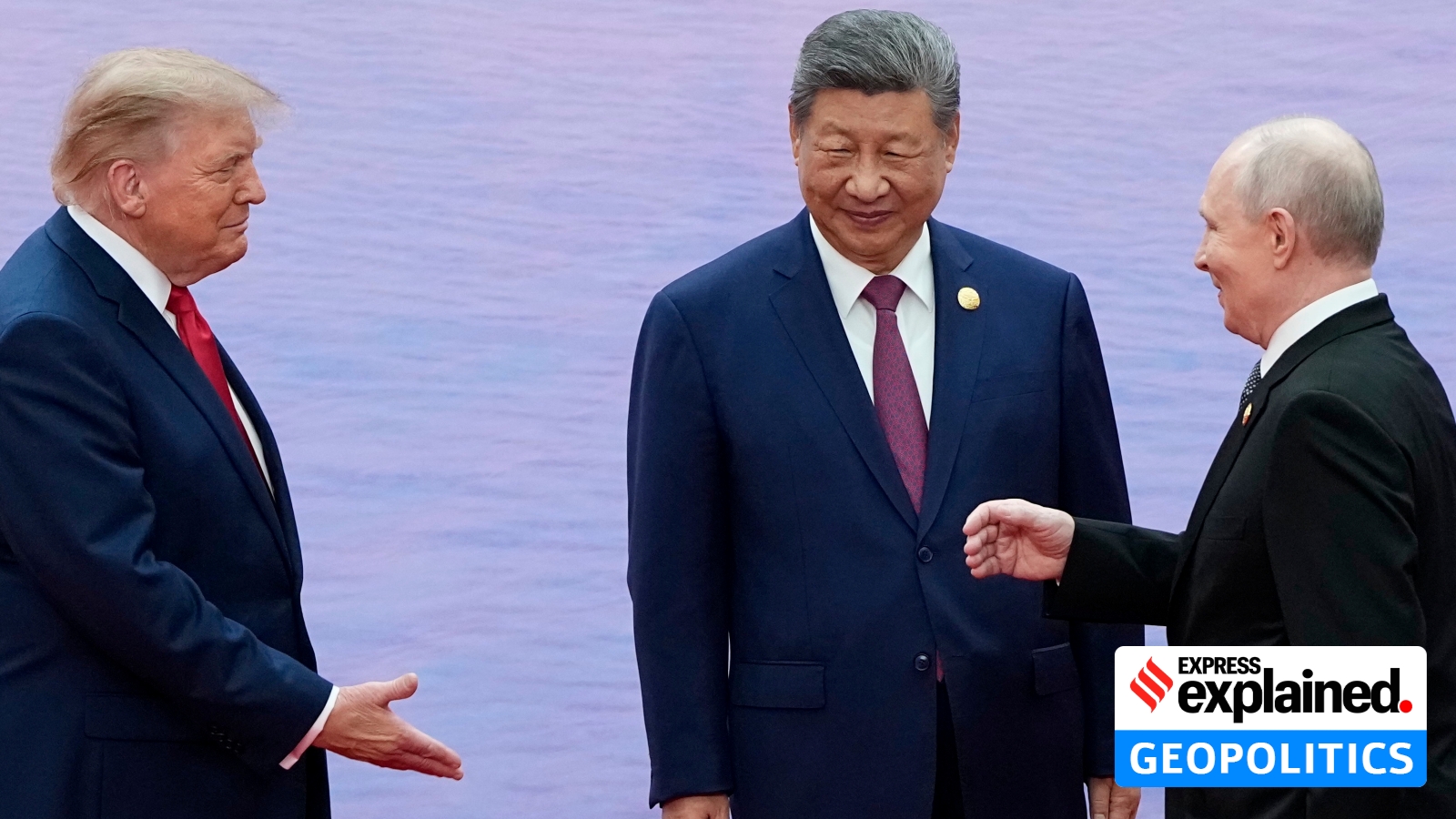
As US President Donald Trump, Chinese President Xi Jinping and Russian President Vladimir Putin prepare to sit across the table for their first-ever trilateral meeting in Shenzhen, the world, and India, will be watching the summit’s outcomes, and potential consequences, closely.
Many have compared the Asia-Pacific Economic Cooperation summit with the historic Yalta conference of February 1945, when US President Franklin D Roosevelt, British Prime Minister Winston Churchill and Soviet Union premier Joseph Stalin struck a deal that effectively divided post-war Europe into spheres of influence (see story alongside). At that time, World War II was coming to an end. In this case, the two wars in Russia-Ukraine and in West Asia against Iran appear rather intractable.
What happened at the Quad meeting?
Ahead of the trilateral meeting, Trump met the leaders of fellow Quad countries, India, Japan and Australia. All of them have long flagged China’s belligerence in the Indo-Pacific region, and conveyed the concern at their meeting.
This was reflected in the joint document issued after the meeting of all four Quad leaders. It said the members strongly opposed any destabilising or unilateral actions that seek to change the status quo, including by force or coercion, which escalate tensions and undermine regional peace and stability.
The grouping flagged economic coercion, arbitrary export restrictions, choking of critical supply chains, freedom of navigation and overflight, deployment of trusted artificial intelligence (AI), resilient maritime transit corridors. Each of these are key challenges posed by Beijing. If that were not enough, the Quad leaders agreed to hold a maritime military exercise next year, double down on AI development and organise a business forum, signalling that they are keen on sticking together — even as Trump sups with Xi and Putin.
So, the worries of countries including India, Japan and Australia have been conveyed to Trump, despite him being soft on China in his second term. The question is, will he be able to hold the line?
China, to be sure, has always rejected the Quad, calling it a bloc that promotes confrontation and likening it to “sea foam”.
The meeting of the strongmen
Story continues below this ad
With Xi and Putin at the table, the temptation for Trump will be to cut a grand bargain with the two strongmen who face little to no challenge domestically.
Trump, however, is a democratically elected leader who has just been delivered a massive setback in the midterm elections. He may not be able to deliver the goods in the same way that both Xi and Putin can in their respective political contexts.
Xi would want his way in the South China Sea and Taiwan. Putin would want his way in Ukraine, where the war has now crossed World War I in duration. The Europeans will be watching Putin’s actions more closely since it affects their security. Those in Southeast Asia, meanwhile, will be monitoring Xi.
Trump, as part of his strategic calculation, would want their help in stopping both the wars in Ukraine and West Asia. But for Xi, this is a golden opportunity. He wouldn’t want to stop a war that has stretched American military, economic and diplomatic bandwidth.
Spectacle or substance
Story continues below this ad
So, for many in the world watching the summit of the “big 3”, or “group of 3”, this would look like another spectacle — high-decibel, high on optics and without substantive outcomes. This playbook has happened before, from Trump’s high-voltage meetings with North Korean leader Kim Jong Un and bilateral meetings with both Xi and Putin.
When Trump met Xi last year in October, the US President was able to buy time for the world. He had postponed the problem of the Rare Earth magnets and brought home the point of managing resilient supply chains when it comes to critical sectors.
The world had come to notice the dependencies on China during the Covid-19 pandemic, and the leverage that Beijing had over the world’s supply chain systems. Washington had managed to buy more time for the world to develop their own supply chain, and diversify from China. So, from that perspective, this was an important win for the US and the world.
For China, Trump’s acknowledgement of it as part of a “group of 2” was a recognition of its status as a global power. Under Xi, Beijing has been pursuing the goal of becoming the world’s foremost power.
Story continues below this ad
That will be the bigger question in New Delhi. India stands to be affected if China is emboldened to take more aggressive actions without facing consequences. Trump’s power play with Xi is particularly consequential for India, given its border with China, which has become “more alive”, as External Affairs Minister S Jaishankar said last weekend. This has required India to maintain a much larger troop presence along the frontier on a sustained basis.
New Delhi will be hoping that this G-3 moment is short-lived and does not take India back to 2020, when it had to significantly increase its force deployment along the China border in just 10 days.
KioskNews shows a cleaned-up reading view extracted from the publisher’s page — the original always lives on their site, not ours.