‘We can’t let the far right take power again’: Lula voters in final push before Brazil runoff

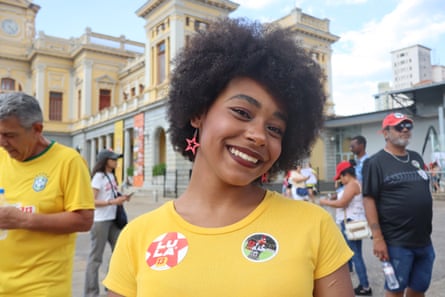
Naiara Boroni, Nikolas Domingues and Jodersson Diego live in the same city and do not know one another, but said they had done the same thing in recent days: persuaded at least one person who had not voted for the leftist president Luiz Inácio Lula da Silva in the first round to choose him in this Sunday’s runoff.
In Boroni’s case, it was her grandmother who had not turned out; in Domingues’s, a cousin who had chosen a candidate who finished fourth. But Diego achieved what to many sounds almost impossible in such a polarised country: he said he had persuaded a woman who voted for the far-right senator Flávio Bolsonaro to switch sides.
“She’s a student of mine and didn’t vote for Lula because of her evangelical church. I didn’t argue; I tried to explain that he wasn’t everything they said he was, and she said she had changed her mind,” said Diego, 33, a dance teacher from Belo Horizonte, the capital of the state of Minas Gerais.
Winning over voters who abstained or cast null votes, and flipping as many others as possible, is at the heart of Lula’s strategy as he tries to do what no presidential candidate has ever managed in Brazil: overturn a first-round defeat like the one he suffered to Bolsonaro on 5 October.
Lula received 3.8 million fewer votes than in 2022, when he ran against the senator’s father, then president Jair Bolsonaro – who would go on to lose the runoff and try to stage a coup, which failed after the heads of two of the three armed forces refused to join him.
Serving a 27-year sentence under house arrest, he chose his eldest son to stand in his place. Flávio Bolsonaro has said that, if elected, he will pardon his father and receive the presidential sash from him.
The senator won 5 million more votes than his father and saw his party sweep elections for congress, state governments and state legislatures, which made him the clear favourite for many analysts.
In the three weeks of campaigning since then, however, polls have shown the gap steadily narrowing, and the two are now about even, with Bolsonaro still slightly ahead, but only by fractions of a percentage point.
“The scenario is one of a very tight tie, but with Lula’s campaign performing markedly better in the runoff,” said political scientist Manoel Leonardo Santos, a professor at the Federal University of Minas Gerais.
The incumbent’s hopes rest on the narrowest-ever gap between first and second place, at less than 2% of the vote, while abstention reached a record 21%, which tends to hurt Lula more because it is more common among groups that favour him, such as lower-income and less-educated voters and older people.
Of the 10 cities with the highest abstention rates, eight are in Minas Gerais, the country’s second-largest electorate after São Paulo and a historical bellwether in presidential elections. No candidate has ever won nationally without carrying the state, where Lula now finished almost five percentage points behind Bolsonaro.
“If Lula’s voters turn out, he can win, but there is absolutely no guarantee that he will manage to make that happen,” said political scientist Helcimara de Souza Telles, also a professor at the Federal University of Minas Gerais.
Bolsonaro supporters are also trying to keep mobilisation high.
Last Tuesday, at an event with local politicians that included an appearance by the senator via video call on a big screen, as well as a 23ft inflatable figure of his father, Minas Gerais governor-elect Cleitinho Azevedo urged the dozens of people present “not to think that we have already won the election and keep asking for votes”.
Pharmacist Magda Aparecida Araújo, 44, lives in the working-class neighbourhood next to the exhibition centre and was sitting in the back row. “I’m not going to belittle Lula’s governments, because I went to university thanks to a scholarship, but I now vote for Bolsonaro because he defends the family and I support traditional values,” said Araújo.
Given its electoral importance, both Lula and Bolsonaro chose the state capital for some of their final rallies: the senator’s was scheduled for this morning, while the incumbent held his last Wednesday.
“I’m here because we can’t let the far right take power again and destroy all of our rights,” said student Ester Nascimento, 17, who was with friends her own age, a symbol of what many see as perhaps the main catalyst behind Lula’s hopes of a comeback: young people who organically took to the streets in large protests all across Brazil.
“I think everyone felt obliged to make their voice heard,” said Nascimento.
Following advice from young, digitally native politicians, Lula’s team overhauled his online communications, and the 81-year-old incumbent, who does not even own a mobile phone, began recording selfie videos. Millions of his supporters joined a WhatsApp channel called “Lula’s Army”, where congressman André Janones sent dozens of daily instructions on how to make pro-Lula content go viral, and for the first time, the president’s digital reach overtook Bolsonaro’s.
Lula also approved a “package of benefits” at the limits of what electoral law allows, including increasing and bringing forward payments from the main cash-transfer programme for poor families, while also securing a major political victory by getting congress to approve a shorter working week that could affect 30 million workers.
Even so, many analysts see much of the narrowing gap in the polls as driven more by Bolsonaro losing support, with his rejection rate having risen while Lula’s has fallen slightly.
Experts say some of Bolsonaro’s recent moves may have alienated the indecisive voters, including what was seen as an aggressive performance in the first presidential debate and a controversial speech in which he said he would use the new highly conservative congress to “change the constitution and re-democratise this country”.
That was the first warning sign that led administrative assistant Douglas Pereira Melo, 25, who voted for far-right influencer Renan Santos three weeks ago, to now choose Lula.
“It’s very dangerous for him to say that he’ll change the constitution. His father tried to stage a coup, and I’m afraid he’ll follow in his footsteps,” said Melo, adding that “the Bolsonaro scandals” had also weighed on his decision.
The senator is under investigation in two federal police inquiries, one into what happened to the £20m he was caught on tape asking a disgraced banker accused of corruption to provide for a biopic about his father, and another into alleged money laundering and a possible business partnership with a close friend, the betting-sector businessman and lawyer Willer Tomaz.
The senator is also embroiled in a dispute with the footballer Richarlison, who accuses Bolsonaro and Tomaz of conspiring to strip him of a mansion on an island, while Piauí magazine revealed last Thursday that, at the height of the Covid pandemic in 2020, the senator attended a barbecue on a boat with sex workers and lobbyists who were negotiating vaccine purchases with his father’s administration.
Political scientist Manoel Leonardo Santos said he has “no doubt” that Lula will enter the runoff with better chances than he did immediately after Bolsonaro’s first-round victory.
“Whether it will be enough for him to turn it around, we can’t say. But Lula has gained ground while Bolsonaro appears to have stopped growing,” he added.
KioskNews shows a cleaned-up reading view extracted from the publisher’s page — the original always lives on their site, not ours.