Lutyens’ bungalow for the Dalai Lama: How he left Tibet, with dilemmas for Nehru
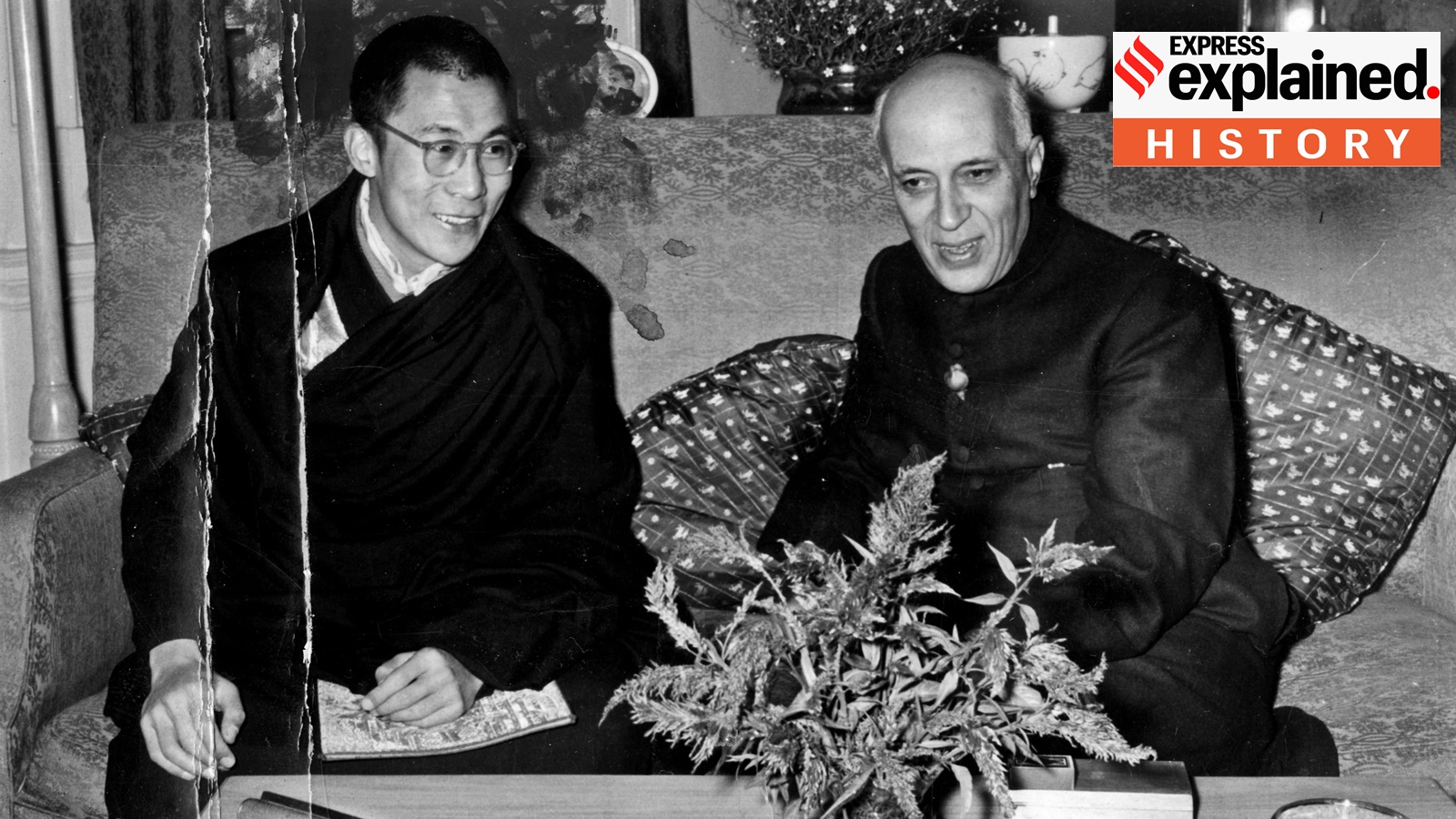
The Indian Express reported on Tuesday (November 24) that a bungalow in central Delhi has been provided for the Dalai Lama.
Almost 70 years ago, India accepted the Tibetan spiritual leader’s request for asylum amid criticism from China, which considers Tibet its own autonomous province. In the past, it has described his government-in-exile in Dharamshala as “outright separatist”.
Today, at 91, the Dalai Lama also faces the question of his succession. A report from the US-China Economic and Security Review Commission this week stated that “China is preparing to turn his succession into an international contest over legitimacy”, and “India, which hosts the Dalai Lama and the Tibetan government-in-exile and shares a longstanding disputed border with China, is the center of gravity in this dispute.”
Decades ago, under what circumstances did the Dalai Lama and his followers seek refuge in India? And how did Indian leaders respond?
Nehru’s view of China, Tibet
India and China became independent republics around the same time, in 1947 and 1949, respectively. A few key factors influenced the early days of the relationship, including the question of Tibet (then independent of Chinese control) that bordered both nations. It historically acted as a buffer State between them.
The Chinese leaders saw Tibet as a region to which they had historical claims, and one where imperialist powers were attempting to interfere by encouraging the notion of independence. For China, Tibet held strategic importance, and was part of the national project to assert the Communist Party’s absolute supremacy — including over the frontiers. Its historical claims, however, are disputed, with Tibetan leaders pointing to long periods of self-rule even during Imperial China.
As India’s Prime Minister, External Affairs Minister, and among the tallest leaders of his time, Jawaharlal Nehru’s views on China were pertinent in shaping ties. Historian Ramachandra Guha wrote in a journal article (“The Dalai Lama’s War”) for The National Interest in 2011 that “Nehru was long interested in (and influenced by) China… Nehru saw China at once as peer, comrade and soul mate.”
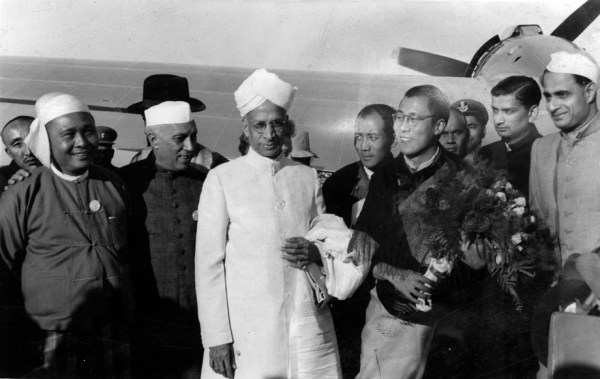 From left, former Prime Minister of Myanmar U Nu, Prime Minister Jawaharlal Nehru, Vice President Dr Radhakrishnan, the Dalai Lama and diplomat Appa Pant in Sikkim in 1956. (Express archives)
The Chinese view of India, however, was not perfectly mirrored. As a Communist nation, it was suspicious of India’s non-aligned stance in the Cold War era. As former Indian Ambassador to China, VV Paranjpe, wrote in the journal World Affairs in 1998, then Chinese Premier Zhou Enlai was also wary of what he saw as India’s “big brotherly” attitude.
In 1956, both Zhou and the Dalai Lama were in India, the former for an official visit, and the latter to mark the 2,500th anniversary of the Buddha’s parinirvana.
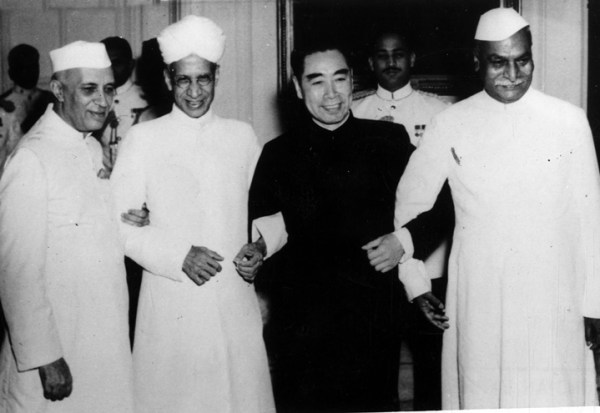 From left, Prime Minister Jawaharlal Nehru, Vice President Dr S Radhakrishnan, Zhou En-Lai and Dr Rajendra Prasad at Rashtrapati Bhawan in New Delhi in 1954. (Express archives)
This was five years after the Chinese government signed a 17-point agreement with Tibetan representatives, recognising it as an autonomous region while allowing for troops of the People’s Liberation Army (PLA) to enter. The Dalai Lama later said the 1951 agreement was signed under duress, coming a year after Chinese forces invaded Tibet.
By 1956, Paranjpe wrote that “A disturbing development distracted Zhou’s mind” — the apprehension that the Tibetan leader might try to defect to India. “Zhou talked to him several times but with not much success. Nehru intervened to help Zhou out and finally persuaded the Dalai Lama to return to China. This was undoubtedly a graceful act of friendship and kindness, but to Zhou, it was again a ‘big brotherly’ act; to a Chinese, it also implied a certain ‘loss of face,’” he wrote.
Uprising, escape to Arunachal Pradesh
Not all of Nehru’s contemporaries shared his blind spots on China. Guha cited Home Minister Vallabhbhai Patel, who wrote to Nehru as early as 1950 that “The Communists are as good or as bad imperialists as any other. Chinese ambitions in this respect not only cover the Himalayan slopes on our side but also include important parts of Assam… Chinese irredentism and Communist imperialism are different from the expansionism or imperialism of the Western Powers. The former has a cloak of ideology which makes it ten times more dangerous.”
It would only be about a decade later that Nehru seriously questioned Chinese actions. In the late ’50s, his request to visit Tibet on the Dalai Lama’s invitation was rejected.
The real test would come in 1959, when continued Chinese presence in Tibet and rumours of the Chinese planning to kidnap the spiritual leader would launch an uprising. Chinese forces killed tens of thousands to suppress the protests.
The Dalai Lama, his family members, bodyguards, and fellow Tibetans chose to escape in March 1959. The late political commentator Inder Malhotra earlier wrote for The Indian Express, “Late on the evening of March 17, the Dalai Lama… slipped out and managed to reach the relative safety of the rebel areas. Khampa (Tibetan) soldiers then escorted him on his hazardous journey to India. Later, it became known that in his escape, the Dalai Lama had some help from the CIA. On March 31, he crossed into India’s border near Khinzemane (in Tawang district of Arunachal Pradesh). The next day, his request for asylum was formally accepted.”
Dilemma after escape
As The Indian Express earlier reported, the decision to grant asylum came after several considerations and criticisms. Defence Minister V K Krishna Menon raised objections, as did Bharatiya Jan Sangh leader Deendayal Upadhyay, who said the move “obstructs, rather than helps, fulfillment of this objective [of actively supporting Tibet’s struggle for independence].”
Expectedly, China protested India’s decision. According to Malhotra’s account, Nehru sought to ask Chinese leader Mao Zedong whether China would want the Dalai Lama to live in Europe instead, posing the question through Ajoy Ghosh, the last general secretary of the Communist Party of India. “Mao told Ghosh: ‘It is better that he (the Dalai Lama) remains in Nehru’s India than go to any European country.’”
Nehru’s continued anxieties were reflected in an August 1960 letter to the Dalai Lama: “We have given asylum to more than 20,000 Tibetans in our country… Your Holiness knows well that this act of ours… has created considerable friction between India and the People’s Republic of China.”
While calling it a “duty” to receive them and help them rehabilitate, he said: “The only condition we have attached is that Indian territory must not be made a base for hostile propaganda or activities against the People’s Republic of China. It is true that our relations with the Government of China are strained because of various reasons. That is a matter between India and China. But it would be against international convention… to use the soil of India for any kind of hostile activities against another country.”
Guha wrote that the balancing act became delicate, but India had no choice but to admit the leader. “In a democracy that encouraged debate, and in a culture that venerated spiritual leaders, the Dalai Lama would attract visitors.” The “open manifestation” of support for the Tibetans was a “natural by-product of India’s democratic system”, compared to China’s authoritarian one, he wrote.
India’s position on Tibet, among other disagreements, contributed to conditions that led to the 1962 India-China War.
KioskNews shows a cleaned-up reading view extracted from the publisher’s page — the original always lives on their site, not ours.