Public media freedom has been eroded across central Europe. Now Czechs are rallying to protect theirs
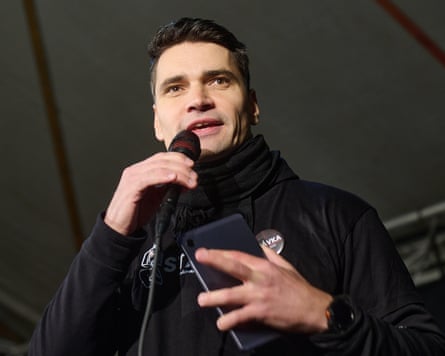
Daniel Stach was an erstwhile junior international slalom kayaker when he first walked into the headquarters of Czech Television in 2010. He had answered a Facebook ad inviting viewers to a behind-the-scenes tour of his favourite programme, a current affairs show called Hyde Park CT24. He did not expect to be offered a job shortly afterwards.
Stach, now 38, presents a science offshoot of that show doing long-form interviews. But he has also emerged as one of the most recognised public faces of the campaign to save the mandatory licence fees that fund the nation’s public broadcasters.
“Czech TV and Czech Radio are the most trusted media organisations in the Czech Republic,” Stach told the Guardian, still wiping the studio makeup off his face in a meeting room at Czech TV. “They are symbols. They are part of our history. They are part of our culture. And that’s why people are standing up for them.”
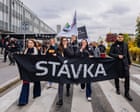
The first reading of a bill to scrap the licence fees was pushed through in the middle of the night in late October. Since then, thousands of Czechs have taken to the streets in protest at plans to fund the broadcasters from the state budget instead, a move staff fear would give ministers more leverage over their newsrooms.
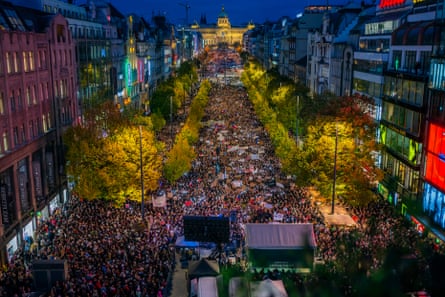
Organisers say the next rally – planned for this Sunday on Prague’s sprawling Letná Plain – could be the biggest in the country’s post-revolution history. Demonstrators look with nervousness to countries across central and eastern Europe – most notably neighbouring Slovakia but also Hungary, Poland and Serbia, where under previous rightwing populist governments media independence was severely weakened.
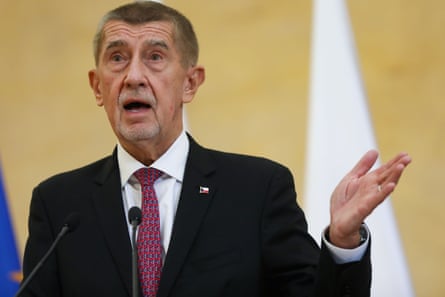
The prime minister, Andrej Babiš, has said his coalition of populist, hard-right nationalist and Eurosceptic parties will not be deterred by the protests, although he has suggested a number of alternative models including voluntary payments.
Staff at both broadcasters went on strike on 3 November, and demonstrations were held in 21 towns and cities across the country. During the strike Stach and fellow reporters, dressed in black, read on-air announcements from pieces of paper.
Some of the programming on 3 November was replaced with archive material. In place of its usual morning news programme, Czech TV’s rolling news channel showed old footage of the communist-era president Gustáv Husák touring the Prague metro.
It was a subtle nod to what campaigners say is in store for viewers if the changes go ahead, although one government minister said he thought the archive reports were an improvement on the station’s regular programming.
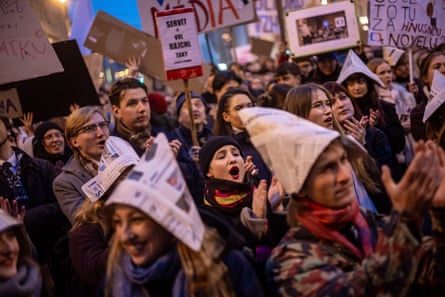
Stach conceded some of those attending the nationwide protests were channelling wider opposition to Babiš’s government, which came to power a year ago.
Babiš has accused the opposition and some journalists of firing up the public with unfounded claims the editorial independence of the two organisations is at risk.
He even compared a night-time protest outside parliament – the first reading of the bill to scrap the fees was scheduled for 4.36am – to the 6 January assault on the Capitol in Washington.
Police in Prague said one person was detained after throwing a cobblestone in the direction of the lower house. There were no reported arrests or injuries.
The culture ministry, which drew up the draft legislation, did not respond to a request for an interview. But last week Babiš published an op-ed on what he called the “seven lies” being peddled by the opposition over the licence fees, which together add up to 205 koruna (£7.03) per month.
“Anyone who talks about ‘nationalisation’ [of public media] is deliberately lying,” he wrote, describing the criticism as “hysterical outbursts”. “Under no circumstances will we interfere in editorial work.”
The prime minister, 72, argued that guaranteeing the broadcasters’ funding by law – and automatically adjusting it for inflation – would reduce politicians’ direct influence.
after newsletter promotion
Babiš, who acknowledged that the funding model could still change during the bill’s second reading, has ruled out raising taxes to pay for the change.
The Czech leader has repeatedly said that public media in 17 of the EU’s 27 countries is funded directly by the state. Government figures often point to “the Nordic model” as an example of where scrapping the licence fee can work.
There is in fact no single Nordic model. Finland and Sweden replaced their licence fees with compulsory levies earmarked for public broadcasting. Denmark funds its national broadcasters from general taxation. Non-EU member Norway does the same.
The Czech proposal would cut funding to both broadcasters by about 15%, reversing an increase introduced by the previous centre-right government in 2025.
The Babiš government says funding will return to 2024 levels, at a time when all public institutions are being asked to save money.
The broadcasters say this is disingenuous, as the licence fee had been frozen since 2008 with no allowance for inflation. “We’re talking about funding as if it was an issue of its own, but we also know there is a backlash against public service media that is being weaponised by some of the political forces in Czechia,” said Thibaut Bruttin, the director general of the global press freedom organisation Reporters Without Borders.
“So we can’t pretend that this assault on the funding is not also a way to undermine the quality, the capacity, and the trust in public service media,” Bruttin said during a visit to the Czech capital.
Bruttin, like other critics of the Czech proposals, says they risk repeating what happened in neighbouring Slovakia.
There, public broadcasting has been brought under tighter state control by the ultranationalist culture minister, Martina Šimkovičová, a former TV presenter who rose to prominence promoting conspiracy theories on YouTube.
Observers also question the timing of the bill. The first reading was fast-tracked through parliament weeks after bruising senate and local election defeats for Babiš’s ANO party and his far-right, Eurosceptic coalition partners.
KioskNews shows a cleaned-up reading view extracted from the publisher’s page — the original always lives on their site, not ours.