Is Buying Home In A Small Town Smarter Than In A Metro? Here's The Math

The biggest financial decision for an Indian family often comes down to one question: Should you stretch your budget to buy a home in a metro or choose a cheaper property in a smaller city?
The difference can run into lakhs of rupees. But a lower property price does not automatically make a home a better investment. Employment opportunities, loan affordability, infrastructure and resale demand can change the equation.
Advertisement - Scroll to continue
For homebuyers, the real question is not where property is cheaper, but where owning a home makes more financial sense over the next 20 years.
What The Numbers Reveal
According to Knight Frank India's H1 2026 Affordability Index, the EMI-to-income ratio stood at 69 per cent in Mumbai Metropolitan Region and 67 per cent in the National Capital Region (NCR). Ahmedabad, at 23 per cent, and Pune, at 28 per cent, were considerably more affordable.
Advertisement - Scroll to continue
While these are major urban markets rather than a direct metro-versus-small-town comparison, the figures reveal how sharply housing affordability can differ across cities.
The demand story is equally interesting. CRISIL Intelligence's July 2026 Housing Hotspots Report indicates that residential demand across selected Tier-II cities grew at a compound annual growth rate of 14 per cent between FY2021 and FY2026. Lucknow, Nagpur and Coimbatore recorded growth of around 20 per cent.
This suggests that smaller cities are increasingly becoming important housing markets. However, stronger demand does not necessarily translate into better investment returns or guaranteed resale opportunities.
The EMI Difference Can Change A Family's Future
Consider two homes priced at Rs 80 lakh and Rs 40 lakh. Assume a 20 per cent down payment, an 8.5 per cent annual interest rate and a 20-year loan tenure.
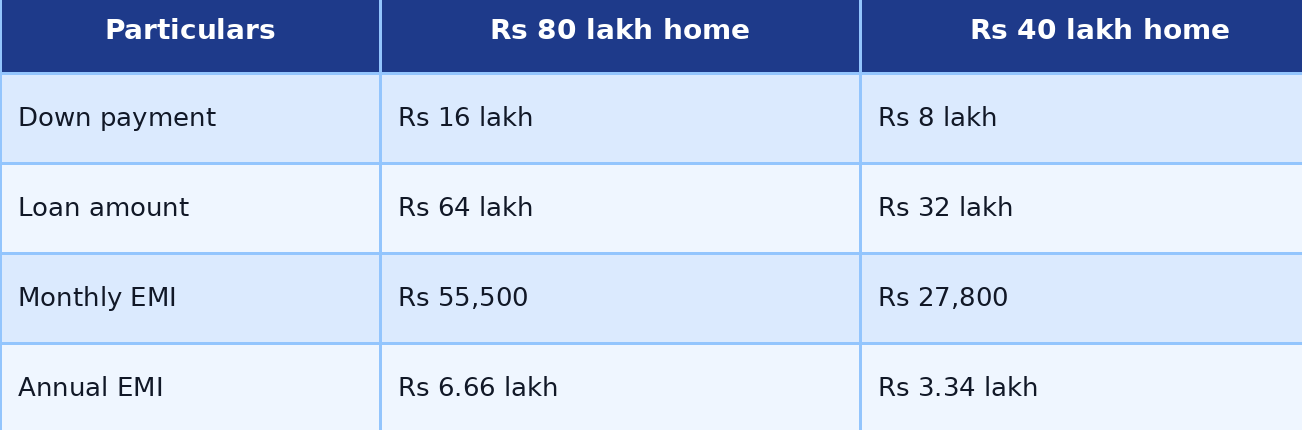
The cheaper home reduces the monthly EMI by nearly Rs 27,700. That is a saving of more than Rs 3.3 lakh a year.
For a middle-class household, this difference could mean more money for children's education, retirement savings, healthcare or simply a financial cushion against unexpected expenses.
But there is another side to the calculation. A home in a smaller city may cost less because local incomes are lower, employment opportunities are limited or demand is concentrated in a few sectors. Moving away from a metro could also mean losing access to a better-paying job.
What Homebuyers Should Consider
Ajeet Kumar Singh, Managing Director & Co-Founder, SAVE Solutions Pvt. Ltd. (SAVE Group), told NDTV that the decision should go beyond the purchase price. "The affordability of a property has to be assessed alongside the financial stability of the household. A manageable EMI can offer greater flexibility, but only when the buyer has a dependable source of income."
Singh's perspective is particularly relevant for families weighing the attraction of lower property prices against the uncertainty of future earnings. Ajeet Kumar Singh of SAVE Solutions Pvt. Ltd. (SAVE Group) also underscores the importance of financial security in a decision that can shape a family's finances for decades.
For buyers, this means looking at the entire cost of ownership, not just the home loan. Maintenance charges, property taxes, commuting expenses, healthcare access and the cost of moving can all influence the final decision.
Three Things To Check Before Buying In A Smaller City
1. Is your income secure?
A cheaper house is attractive when the buyer has a stable income. Families with businesses, remote jobs, pensions or established local employment may find smaller cities particularly appealing. For someone dependent on a metro job, however, relocating could mean sacrificing future salary growth.
2. Is the city becoming more accessible?
Roads, airports, industrial corridors and improved connectivity can change the attractiveness of a housing market. CRISIL Intelligence attributes the growth in Tier-II housing demand partly to infrastructure development and urbanisation. But buyers should distinguish between projects already operational and infrastructure that exists only on paper.
3. Can you sell the property when you need money?
A house is not as liquid as stocks or mutual funds. In smaller markets, finding a buyer may take longer, particularly for properties in peripheral locations or projects with limited demand. For investors, the ability to rent out a property also matters. A home that remains vacant for months can eat into the savings made through a lower purchase price.
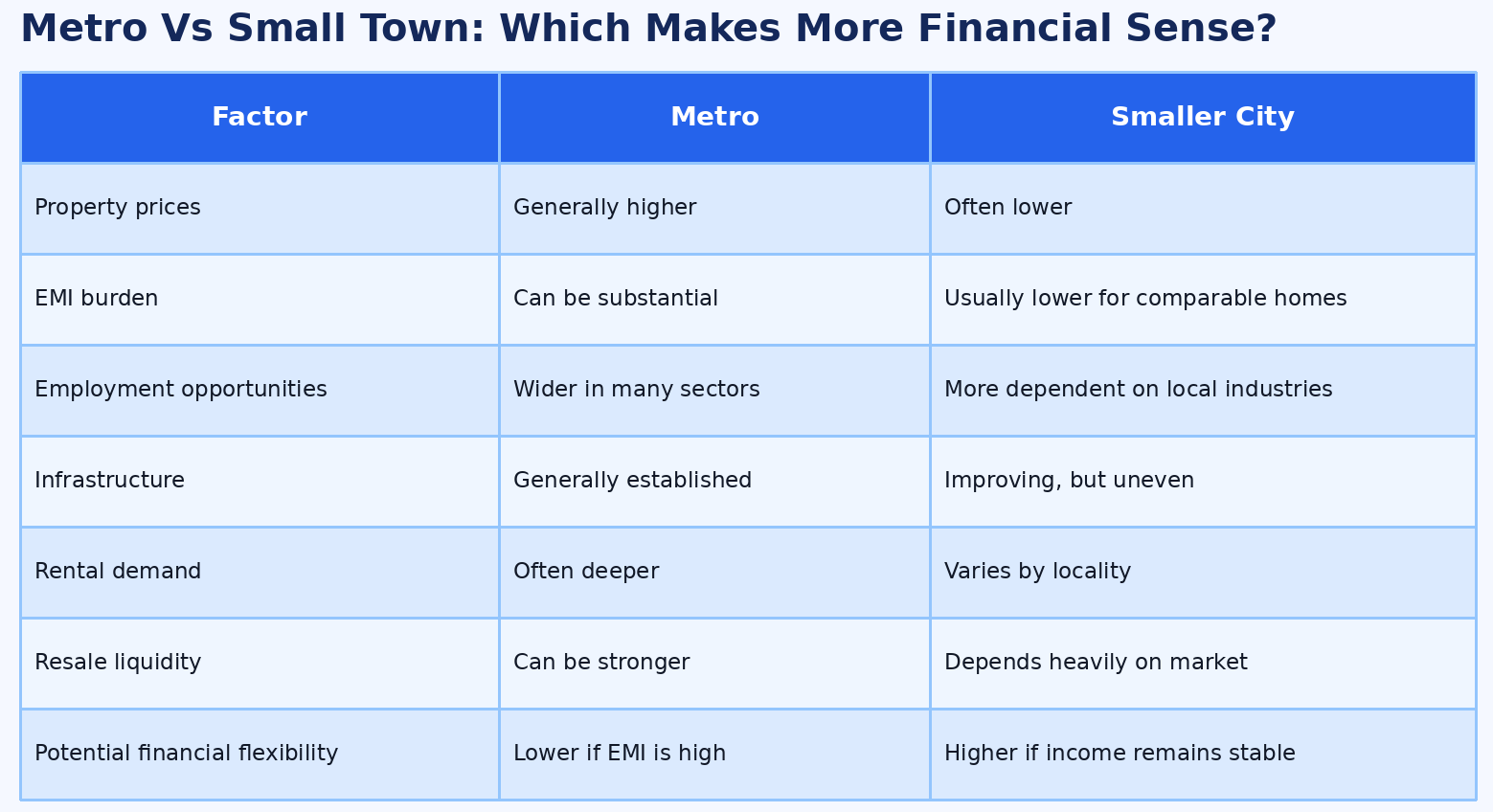
The Final Verdict: A Cheaper Home Can Be A Smarter Decision
For millions of Indian families, the choice between a metro and a smaller city is ultimately a choice between financial flexibility and access to opportunities.
The numbers suggest that housing affordability can improve substantially outside India's most expensive property markets. CRISIL's demand figures also show that Tier-II cities are no longer peripheral to the country's residential growth story. But buying in a smaller city simply because property is cheaper can be a costly mistake.
Ajeet Kumar Singh, Managing Director & Co-Founder, SAVE Solutions Pvt. Ltd. (SAVE Group), brings the financial security question into focus: homeownership should fit comfortably within a family's broader financial plans. The smartest home purchase is not necessarily in India's biggest city or its smallest town. It is the one that allows a family to own an asset without sacrificing savings, income security and future opportunities.
For some, that means a Rs 40 lakh home in a growing Tier-II city. For others, paying more for a metro home may be justified by better career prospects and stronger rental demand. The real measure of a good home is not how much it costs today, but how much financial freedom it leaves a family tomorrow.
KioskNews shows a cleaned-up reading view extracted from the publisher’s page — the original always lives on their site, not ours.