Govt respects judges with spine… Chandrachud was too deferential: Former SC judge Justice Kaul’s memoir reveals quiet rift with then CJI
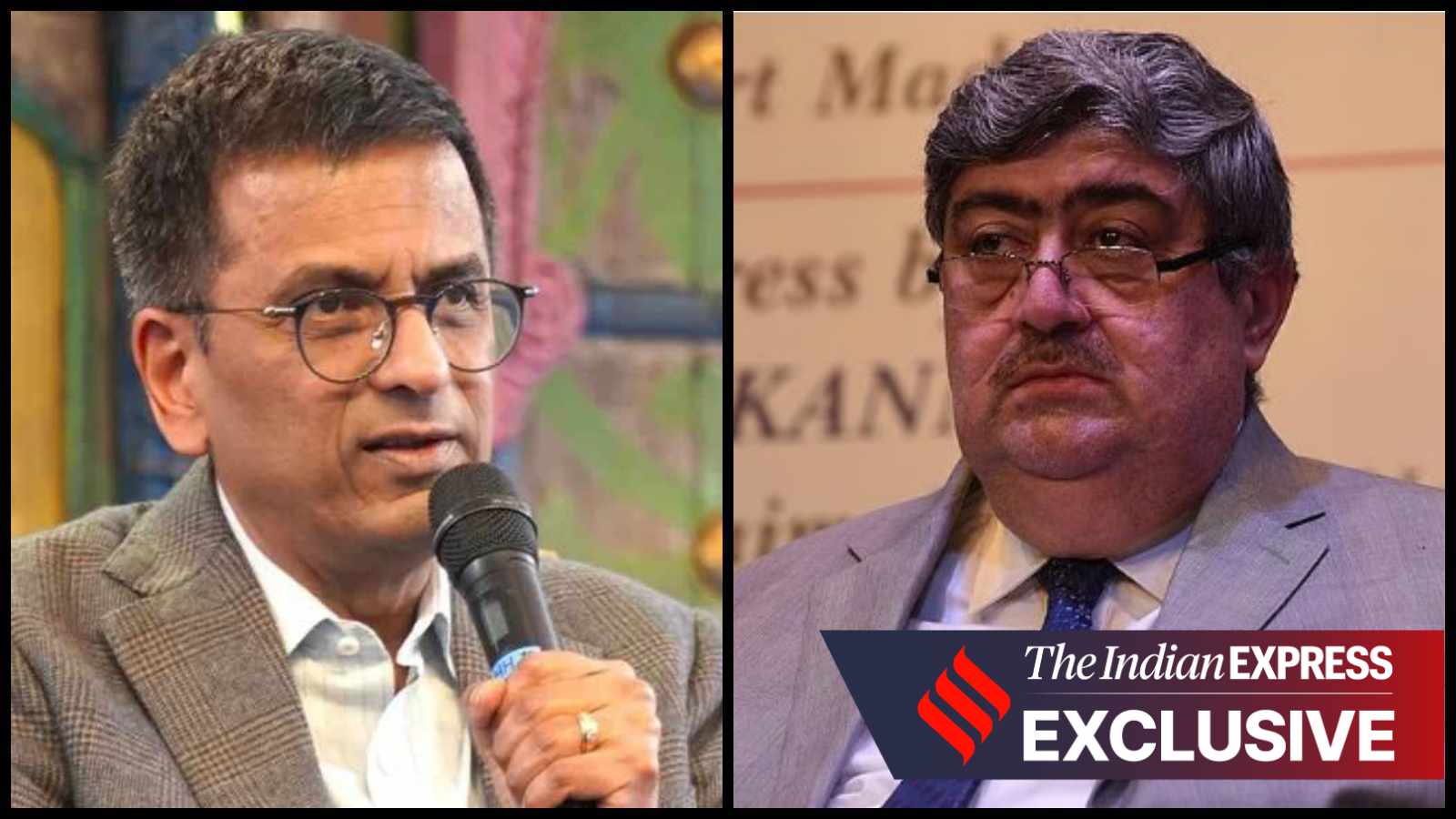
As Chief Justice of India, Justice D Y Chandrachud was “too deferential to the Government” when it came to appointments. At one time, he sought its “nod” before the Collegium had met and, once, even voiced the Government’s “bizarre” query regarding the caste of a minority-faith judge candidate.
This issue, of how to engage with a “political class” that will, inevitably, ask for more was a “strain” in his relationship with the then CJI, reveals Justice Sanjay Kishan Kaul in his memoir, ‘Without Fear of Favour’, to be published by Juggernaut later this month.
According to the pre-publication manuscript reviewed by The Indian Express, Justice Kaul, who retired in December 2023 after serving 14 months as “J1,” the most senior puisne judge after the CJI, repeatedly pushed back and once “walked out of the room”.
Justice Kaul’s criticism comes with an important qualification at a time when the role of the Supreme Court vis-a-vis a third-term Government is under increased scrutiny. “I found that the Government has far more respect for judges with a spine” and “the government respects judges who respect themselves,” writes Kaul as he lists many cases where the Government, when pushed, accepted the court’s recommendations.
At the same time, he makes it clear that the court has red lines. “The court is a check and balance, and it well may take a view the establishment dislikes, but it cannot be the rearguard action of the opposition,” he writes, recalling the Rafale fighter jet case, in which his bench dismissed the challenge to the deal. “Those who oppose the Government of the day expect the court to come to their aid. That is not the court’s function.”
Indeed, Kaul goes further on the most bitter judiciary-executive dispute of the past decade, the striking down of the National Judicial Appointments Commission (NJAC) in 2015 which gave the government a veto in judicial appointments: “I am of the opinion that the NJAC system should have been given a chance to work, rather than being rubbished immediately by the judiciary.”
His complaint is not that the Government had a say, it is about how that say was sought. “There is a difference between consultation and what I came to regard as pre-approval — seeking the Government’s nod before the collegium had even formally deliberated. That sends the wrong signal. Any political class will always assert itself if you give them a wedge in the door. This is not in any sense a partisan matter but simply a question of the inevitable dynamics of power,” he writes.
Story continues below this ad
Against that backdrop, Justice Kaul sets out his reservations about Justice Chandrachud. Once he became a member of the Collegium in June 2022, he says he suggested the two “face the Government together — a good-cop bad cop arrangement, if one likes since I was not the chief justice and could afford to be the firmer of the two.”
The Government, he writes, “was not averse to it; it had taken my measure and knew I was neither a walkover nor a man to be ignored.” But “Dhananjay, with a few exceptions, preferred to handle that relationship all on his own”.
The first major Collegium exercise, to fill six vacancies, shows the friction. The members had agreed on five names in advance. “On the day, while going to the meeting, Dhan (CJI Chandrachud) proposed a sixth name,” Kaul writes. The other judges resisted. “I suspected the name had been proposed at the government’s instance.” The CJI then took him aside and “wondered aloud whether he should telephone out to check the government’s view.”
Kaul writes: “My suspicions were confirmed, and I told him to see sense: He could not, in the middle of a collegium, do such a thing.” The five names went through. The sixth did not. “I had always been frank in my assessments. Elevation to the highest court in the land is not a matter of right or an office that can be obtained by a ‘word in the right ear’,” he writes.
Story continues below this ad
He also writes about how a minority-faith judge’s candidacy began with an official query and reveals “tension” between the Chief Justice and himself “peaked” over such issues.
According to him, the Government asked whether more representation of minority faiths was needed, pointing to judges from other religious minorities already serving. “I was troubled by this logic,” Kaul writes. Then came the caste question of the minority candidate’s family, which he found “rather bizarre”: “How on earth could we possibly have known that? His family had been in that faith for generations.”
“In any case it hardly seemed relevant. The follow-up was chilling: Dhan shared something with me as the government view which that I must now redact, but it did provoke me. ‘If this is how we are going to appoint judges’, I said ‘you may as well consult and appoint yourself. Chief Justices used to appoint judges before the collegium was created. You may do it that way. I cannot be party to such a decision’,” Kaul writes.
“I shut the file and walked out of the room. The meeting was quickly adjourned. No meeting was held for a while, by which time the government relented and the candidate was put through,” he writes.
Story continues below this ad
“This is the reality of the appointment process. It is fantasy to imagine that the collegium is isolated from political pressures. Governments assert themselves. If you give them an opening, they will grab it. The challenge is to maintain institutional integrity while navigating these pressures. Indeed, I found that the Government has far more respect for judges with a spine in such matters and the need for balance,” Kaul writes.
Reached for comment on these remarks, Justice Chandrachud told The Indian Express: “It is very difficult for me to comment on what Sanjay Kaul has written because I have not read the book. So unless I read what he has written, and in what context he has written it, I cannot give a detailed reaction.”
“Having said that, I would like to say that I have had excellent Collegium meetings as CJI, and even with Sanjay Kaul it has been a very respectful relationship as members of the collegium,” he said. “There have been good conversations, reasoned dialogue and we have had affable meetings in the Collegium together.”
“You are mentioning a walkout and disagreements. I cannot recall an occasion when Sanjay Kaul walked out of a Collegium meeting,” Chandrachud said.
Story continues below this ad
“Also, I made it a practice of passing a resolution after every Collegium meeting and do not recall any recorded dissent in resolutions. If you are saying Justice Kaul has written in implication that the CJI was in consultation with the government, I again will have to precisely read what he has written. But the government does have a say and is in dialogue with the CJI, doesn’t it? After all, it is the President who signs the warrant of appointment of judges,” he said.
In the book, Kaul also refers to another episode, which ran on the judicial side. A three-judge bench he headed had listed the question of whether aspects of the court’s Prevention of Money Laundering Act (PMLA) judgment “merited reconsideration”. He writes that “the government viewed this simple listing as an unfavourable development.” Later, “without a word to me, it surfaced before another bench altogether.”
His objection, he says, was one of principle: “Cases ought not to move from one bench to another because of apprehensions about how a bench might decide.” The bench was reconstituted, but the hearing could not be finished before he retired.
On senior advocate designations, Kaul says he “later learnt” that some people had advised CJI Chandrachud to keep extending the deadline until he retired because he “would be tough on the process”. He adds: “Whether or not it was true, the designations were held in January 2024, just after my retirement.”
Story continues below this ad
Kaul’s account is one side of a private institutional relationship. He is equally hard on the system he served. He calls the Collegium “deeply imperfect”, pointing to “the opacity, the concentration of power and the susceptibility to government pressure through informal channels.”
“It is fantasy to imagine that the collegium is isolated from political pressures,” he writes, and he traces much of that pressure to the fact that “the political branch never quite got over the rejection of the NJAC in 2015” – referring to the proposed National Judicial Accountability Council.
By his account, the Government was not unreasonable when someone engaged with it firmly. The memoir records several times it came round:
- The Centre was “dead set” on a particular judge heading one of the larger High Courts. Chandrachud told Kaul, “Let them get in touch with you directly.” Kaul writes: “I spoke to the concerned member of the Government…The Government agreed.”
- When clearance for two Delhi High Court judges was held back, he “took up the matter directly with the Law Minister. To the Government’s credit, both names were notified.”
- Referring to a minority-faith candidate, Kaul writes that after he walked out, no Collegium meeting was held “for a while, by which time the government relented and the candidate was put through”.
- For the first five Supreme Court names, he felt these were “kept pending unnecessarily”, but “the Government did respect the order of seniority in the end”.
Kaul’s memoir arrives amid a growing debate over the Supreme Court’s role in keeping a fair balance, especially in the appointment of judges to higher courts. That debate runs from the Collegium-Centre standoff of 2022-23, when then Law Minister Kiren Rijiju and then Vice-President Jagdeep Dhankhar publicly questioned the Collegium and the NJAC verdict, to the criticism Chandrachud faced for hosting the Prime Minister at a Ganesh Puja at his residence in 2024.
Story continues below this ad
Kaul’s own line is that the court must hold its ground on both sides: “We are not and must never become a populist court.”
Born in 1958 into a Kashmiri family, Kaul studied at St Stephen’s College and the Campus Law Centre, Delhi University. He was a senior advocate before joining the Delhi High Court in 2001, and later served as Chief Justice of the Punjab and Haryana and Madras High Courts. He was elevated to the Supreme Court in February 2017.
He retired in December 2023 after 22 years on the bench. In the High Courts, he wrote rulings defending artistic freedom in the M F Husain and Perumal Murugan cases. In the Supreme Court, he wrote a concurring opinion in the 2017 Puttaswamy privacy judgment that recognised a “right to be forgotten”. He was on the bench that dismissed the Rafale petitions. In the same-sex marriage case (2023), he sided with the CJI on civil unions. In the Article 370 verdict (2023), he wrote a separate opinion calling for a truth and reconciliation commission for Jammu and Kashmir.
In his final months, he writes, he had “the growing impression that it was time to get out” and that the system in the Supreme Court he had worked to improve remained “deeply imperfect.”
Story continues below this ad
He also sums up what he described were the “personal regrets ”of the years spent on the Supreme Court bench: “the short of it was that a case was pulled from my hands; that the matter of judicial appointments was withdrawn at the last minute; that designations were postponed and the appointment of High Court chief justices was held over until the day after I had gone.”
KioskNews shows a cleaned-up reading view extracted from the publisher’s page — the original always lives on their site, not ours.