Budgets show effort to beat 2027 warning
EYE ON CHINA: The PLA aims to develop joint-blockade and anti-access/area-denial capabilities by 2035, according to an MND report on China’s military power
By Aaron Tu and William Hetherington / Staff reporter, with staff writer


The Executive Yuan’s proposed defense spending over the past five years has increased 55 percent to this year’s initial proposal of NT$561.4 billion (US$17.1 billion) from NT$361.8 billion in 2021, Ministry of National Defense (MND) budget documents showed, as the nation seeks to bolster its defense ahead of the so-called Davidson window.
The Cabinet has also introduced several special budgets, reinstated one-year compulsory military service, reformed reserve training and expanded combat-oriented exercises to improve military readiness, the documents showed.
The Davidson window, named after retired admiral Philip Davidson, a former commander of the US Indo-Pacific Command, is a timeline between 2021 and next year when analysts believe China could develop the military capabilities to attack Taiwan.
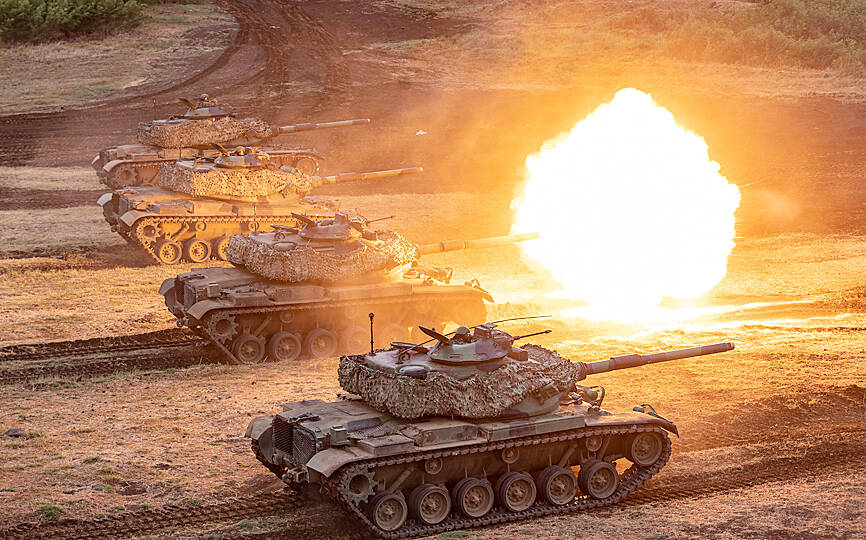
Taiwan’s M60A3 Patton main battle tanks fire during the annual Han Kuang military exercises in Penghu County on July 24, 2024.
Photo: Military News Agency via AP
Taiwan’s originally planned defense budget for this year totaled NT$806 billion when special budgets and nonoperating special funds were included, the documents showed.
Under NATO’s methodology for calculating defense expenditures, which also include Coast Guard Administration spending and retirement benefits for former military personnel, total defense spending was originally projected to reach NT$949.5 billion, or about 3.32 percent of GDP under the Executive Yuan’s original forecast.
The armed forces are continuing to implement the NT$247.2 billion Special Budget for Procurement of New Fighter Aircraft, approved in 2019 and funded from 2020 to this year. The program covers the purchase of 66 new F-16V Block 70 jets from the US, five of which have arrived in Taiwan so far.
The first major special defense budget proposed after Davidson’s March 2021 warning was the Sea-Air Combat Power Improvement Plan Purchase Special Budget, passed by the legislature in 2022.
The NT$236.96 billion program, which runs through the end of this year, covers eight major procurement areas: Hsiung Feng-series (雄風, “Brave Wind”) anti-ship missiles, the Lu Chien II (陸劍二, “Land Sword II”) and Tien Kung III (天弓三, “Sky Bow III”) air defense missile systems, Chien Hsiang (劍翔, “Rising Sword”) attack drones, Wan Chien (萬劍) air-launched cruise missiles, Hsiung Sheng (雄昇, “Brave Ascent”) surface-to-surface cruise missiles, Tuo Chiang-class patrol ships and the installation of wartime weapons systems on coast guard vessels.
The program aims to expand domestic production while bolstering anti-ship, air defense and long-range strike capabilities.
The government last year passed the special budget for strengthening the resilience of the economy, society and national security in response to international developments. The MND allocated about NT$108.1 billion for projects under the program for this year and next year, the budget documents showed.
The funding would primarily increase military stockpiles, improve ammunition storage facilities, enhance military and civilian communications equipment, and provide backup command-and-control and communications capabilities.
In May, the Legislative Yuan passed the Special Act on the Procurement Project to Safeguard National Security and Strengthen Asymmetric Capabilities (保衛國家安全及強化不對稱戰力計畫採購特別條例), authorizing up to NT$780 billion in spending, divided into two tranches of NT$300 billion and NT$480 billion.
The procurement program includes M109A7 self-propelled howitzers, High Mobility Artillery Rocket Systems, Javelin and TOW 2B anti-tank missiles, and anti-armor drone missile systems, the budget documents showed.
The first-year special budget of about NT$8.81 billion has passed its third reading, while subsequent funding allocations would require annual legislative approval.
The Executive Yuan also originally proposed a separate special act authorizing up to NT$210 billion for domestically developed uncrewed vehicles. An updated proposal is awaiting legislative review.
The armed forces have also improved their conscription and reserve systems. One-year compulsory military service was reinstated in 2024, with training focused on combat skills, battlefield first aid and weapons handling, while reserve training has been extended to 14 days from five to seven days, with full implementation beginning this year.
Training has also undergone major changes. Beginning with the 41st Han Kuang military exercises last year, Taiwan extended its live-fire and force-on-force drills to 10 consecutive days and nine nights, the documents showed.
The exercises focus on realistic, round-the-clock combat scenarios, reserve mobilization and urban defense.
The army also launched its 10-day, nine-night Combat Training Center 2.0 program this year, using opposing-force drills and real-time assessments to test troops’ battlefield readiness and ability to respond to unexpected situations.
The MND’s annual reports on China’s military power since 2022 highlight China’s growing military coercion, “gray zone” operations and preparations for a possible blockade.
Although the Chinese People’s Liberation Army (PLA) still faces limitations in its ability to launch a full-scale invasion, the ministry’s report from last year said the PLA aims to develop joint-blockade and anti-access/area-denial capabilities against Taiwan by 2035 and establish an overall military-power projection advantage west of the Second Island Chain.
KioskNews shows a cleaned-up reading view extracted from the publisher’s page — the original always lives on their site, not ours.