Opinion: Opinion | China May Be Turning Pak Into A Military Nightmare For India
The China-Pakistan military partnership is no longer confined to arms sales or diplomatic support. It is evolving into a multi-domain strategic arrangement spanning air power, missiles, naval warfare, electronic warfare, intelligence, cyber, and space-based surveillance.
For India, the challenge is not simply how to defend two geographical fronts, but how to confront an increasingly integrated military system. India's security debate has often approached the China-Pakistan threat through the lens of a possible two-front war. The focus has largely been on military preparedness along the Line of Actual Control (LAC) with China and the Line of Control (LoC) with Pakistan. This geographical understanding is important, but increasingly inadequate now. What is taking shape is a strategic alignment in which China's technological, industrial, and intelligence capabilities complement Pakistan's geographical position, military infrastructure, and operational objectives.
Advertisement - Scroll to continue
This is more vicious as Pakistan's ability to purchase weapons has dramatically increased despite its crumbling financial state. The relationship is not merely about Beijing supplying weapons to Islamabad. It is about building military capabilities, improving interoperability, and creating the conditions for coordinated pressure on India across multiple domains.
Supplier To Partner
The scale of China's military assistance to Pakistan is central to understanding this evolving threat. Beijing has steadily become Islamabad's principal defence supplier, providing combat aircraft, submarines, frigates, tanks, artillery, missiles, radars, unmanned aerial vehicles, and air-defence systems. More significantly, the relationship increasingly involves technology transfer, joint production, maintenance support, and the development of indigenous Pakistani defence-industrial capabilities.
Advertisement - Scroll to continue
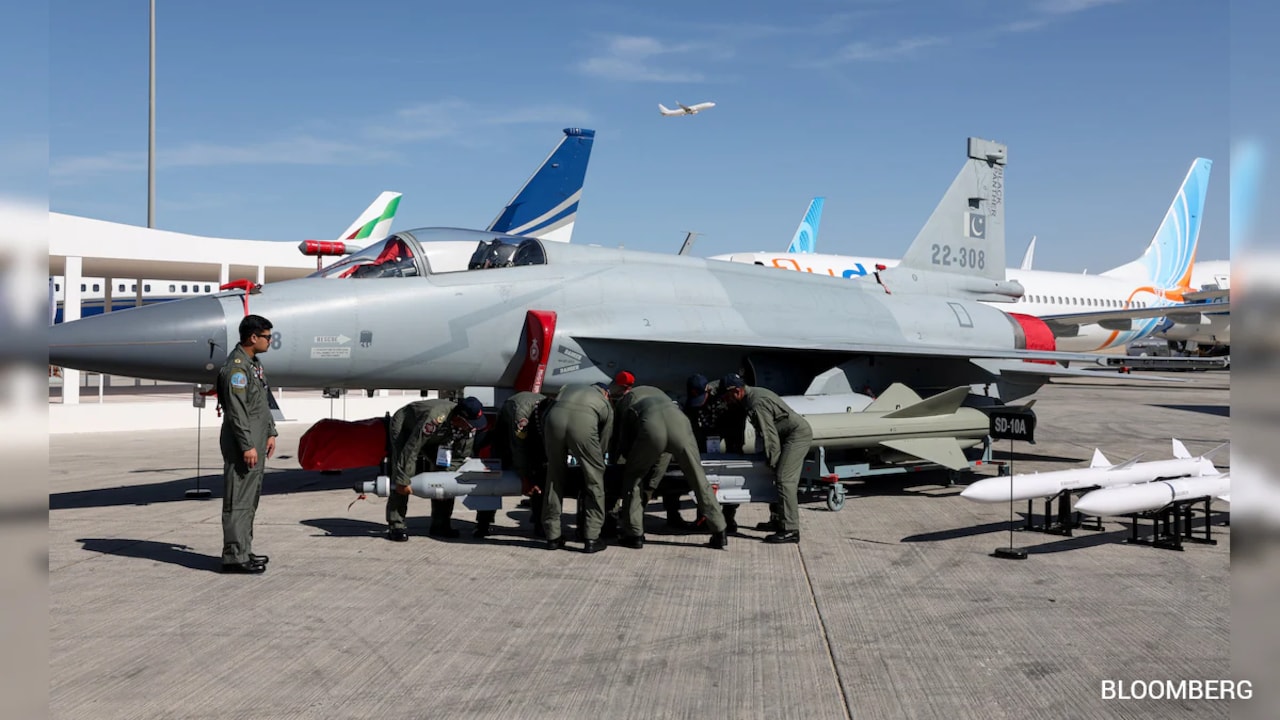
China's approach allows Pakistan to modernise several branches of its armed forces using a relatively common technological ecosystem, reducing dependence on multiple suppliers and improving the potential for interoperability. The JF-17 Thunder is perhaps the clearest example. Jointly developed by China and Pakistan, the fighter represents a defence-industrial partnership rather than a conventional arms transaction. Its newer Block III variant, together with China's J-10CE fighters and long-range PL-15E air-to-air missiles, gives the Pakistan Air Force additional options in beyond-visual-range engagements. The reported interest of Oman's Royal Air Force in the JF-17 also shows Islamabad's ambition to turn the aircraft into an export platform.
The next step could be even more consequential. Pakistan has publicly announced a Chinese offer involving 40 Shenyang J-35 fifth-generation stealth fighters, KJ-500 airborne early-warning and control aircraft, and HQ-19 missile-defence systems. However, an offer should not be confused with a completed acquisition or operational induction. The proposed package nevertheless indicates the direction in which Beijing is prepared to take Pakistan's military modernisation.
The Army Aviation Corps is also receiving attention. Pakistan inducted Chinese Z-10ME attack helicopters in August 2025. A report published by the South China Morning Post on November 2, citing an image circulated on Chinese social media, put the reported contract at 30 helicopters. These helicopters are intended to strengthen precision-strike and battlefield support capabilities.
At sea, the eight Hangor-class submarines represent one of the most important elements of the partnership. The agreement, in 2015, estimated at $4-5 billion, provides for four submarines to be built in China and four at Karachi Shipyard under a technology-transfer arrangement. Equipped with air-independent propulsion (AIP), the boats will improve Pakistan's underwater endurance, seeking to complicate the Indian Navy's anti-submarine warfare calculations. The first submarine, PNS Hangor, was commissioned on April 30 in China. The wider naval relationship also includes Chinese-origin Type 054A/P frigates and other missile-equipped platforms.
A Networked Battlefield
Yet the most important aspect of the China-Pakistan relationship may not be the weapons themselves. It is the network connecting sensors, surveillance platforms, command systems, communications, and weapons.
Pakistan already operates Chinese-origin ZDK-03 airborne early-warning aircraft, alongside Swedish Saab Erieye platforms. It has also acquired Chinese J-10CE fighters, HQ-9P long-range air-defence systems, and LY-80 medium-range surface-to-air missile systems. These capabilities contribute to a layered air-defence architecture, although the extent of integration and its operational effectiveness is questionable without evidence.
The proposed acquisition of KJ-500 aircraft would represent a further upgrade of airborne surveillance. The platform is particularly relevant for its ability to coordinate fighter operations, monitor airspace, and extend surveillance beyond the limitations of ground-based radars.
The reported appearance of Chinese SLC-14 radar installations in Pakistan in October 2026 has also attracted attention. While the identification is based on satellite imagery and visual comparisons, analysts have linked the deployment to a future HQ-19 ballistic missile-defence architecture. It would be premature to describe this as an operational missile shield, but the possibility deserves scrutiny.
Electronic warfare adds another dimension. The ability to detect and analyse radar emissions and access to the electromagnetic spectrum is sort of an engagement before a missile is fired. China's rapid growth in electronic warfare, combined with Pakistan's growing inventory of Chinese-origin aircraft, radars, and missile systems, creates the potential for greater coordination in this domain.
The same applies to unmanned systems. China's defence industry is supplying bulk UAVs, loitering munitions, and sensors to Pakistan, integrating them into operational planning. Some of them are definitely to be assessed, as China's desperation to look into this aspect of its military equipment is largely untested.
The 2025 India-Pakistan confrontation brought this issue into sharper focus.
In July 2025, India's Deputy Army Chief, Lt Gen Rahul Singh, alleged that China had provided Pakistan with live inputs, satellite coverage, and the reorganisation of radar and air-defence systems.
Joint Exercises
The relationship has also expanded beyond equipment and technology into military training, joint exercises, and strategic coordination.
The October 2026 Karakoram joint army training exercise is particularly relevant. Conducted in China's Xinjiang region, it focused on operations in high-altitude areas and included UAVs, target acquisition, live-force exercises, and joint command activities. China's Ministry of National Defence described it as the first joint army training of its kind between the two countries, intended to check interoperability.
The geography of the exercise is not incidental. Joint training in high-altitude conditions provides opportunities for surveillance and battlefield coordination. The February 2025 China-Pakistan joint statement had already emphasised military technology, joint training, exercises, and space cooperation. Their May 2026 joint statement went further, calling for a China-Pakistan Security Partnership and advanced military-to-military cooperation.
However, interoperability should not be confused with an established integrated China-Pakistan military command. There is no publicly established evidence of a permanent joint operational command structure or an automatic Chinese military commitment to fight alongside Pakistan in a conflict with India.
Nevertheless, common equipment, training, communications standards, intelligence exchanges, and defence supply chains can lower the barriers to coordination during a crisis. That is a serious strategic consideration.
A 'Grey-zone' Dimension
Perhaps the most difficult aspect of this alignment for India is the expansion of competition into the grey zone - the space between peace and open conflict. Pakistan's use of proxy terror networks, cross-border terrorism, and information operations has long been a major component of India's security concerns. China, meanwhile, has demonstrated its ability to employ economic pressure, cyber capabilities, tech, and military signalling to advance its strategic interests without necessarily crossing the threshold of conventional war.
The convergence of these approaches creates a more complicated security environment. Intelligence and counterintelligence must therefore become central elements of India's military planning.
What India Needs To Do
India's response should be based on five interconnected priorities.
First, establish a genuine multi-domain operational architecture. The Army, Navy and Air Force must be able to share intelligence and operational information in real time. Space-based surveillance, airborne early warning, ground radars, electronic intelligence and unmanned systems should contribute to a common operational picture.
Second, China's advantage in the relationship with Pakistan is not simply its ability to export weapons. It can supply equipment, technology, components, upgrades and maintenance support within an interconnected industrial ecosystem. India needs a comparable degree of integration and particular attention must go to engines, advanced sensors, electronic warfare, secure communications, drones and hypersonic missile technologies.
Third, develop an integrated intelligence and counterintelligence mechanism. The objective should be early identification of coordinated activity rather than reacting after a threat materialises.
Fourth, strengthen India's maritime strategy. China's growing footprint in the Indian Ocean, coupled with Pakistan's submarine modernisation and Chinese-origin naval platforms requires sustained maritime investment. Here, some key projects need urgent go-ahead, including P-75 (I) submarine. There is also a need to examine the financial dimension. So, the investment must be guided by operational requirements, technological advantages and the ability to impose costs on an adversary.
Here, India must recognise that the challenge is not necessarily a simultaneous conventional war on two fronts. It is the possibility of coordinated pressure across multiple domains, with each country using its comparative advantages to complicate India's military and strategic choices.
(Dr Manish Kumar Jha is a national security expert, defence editor, and the founder of the military think tank, Strategic Insights)
KioskNews shows a cleaned-up reading view extracted from the publisher’s page — the original always lives on their site, not ours.