US warns China is expanding its space toolkit with spaceplane and energy weapons
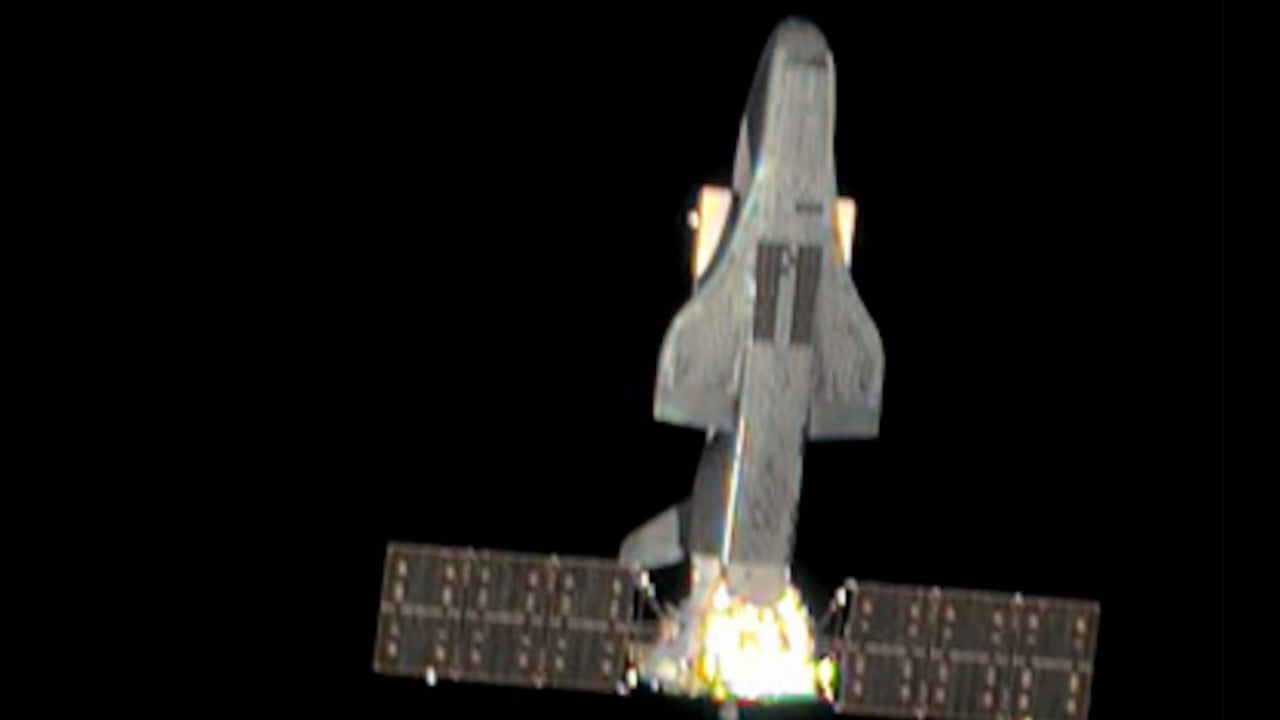
A rare satellite image of China’s secretive spaceplane has appeared in a new US intelligence report that warned Beijing was expanding its ability to track American forces and could deploy space-based directed-energy weapons by the late 2020s.
The US Defence Intelligence Agency (DIA) report published on Sunday included an image of the reusable spacecraft, credited to the Maxar satellite imagery firm in 2024, showing its shuttle-like design and apparent solar arrays.
A spaceplane is a spacecraft designed to operate in orbit and return to Earth through the atmosphere, much like the US Space Shuttle, although China’s secretive vehicle is believed to be uncrewed and more closely resembles the smaller American X-37B.
The DIA said Chinese spaceplane missions had involved manoeuvring close to a companion satellite and releasing an object in orbit, adding the vehicles were more manoeuvrable than traditional satellites.
The report also marks the first time that the agency has given a potential timeline for China’s development of space-based directed-energy weapons in its “Challenges to Security in Space” series of reports.
The DIA did not specify whether the weapons would use lasers or high-power microwaves, both of which direct electromagnetic energy at targets and can potentially interfere with or damage satellites.
To date, no Chinese spacecraft has been publicly identified as carrying an operational directed-energy weapon.
The report said that, by the late 2020s, China might also field more powerful ground-based directed-energy systems capable of affecting satellites beyond low Earth orbit.
02:00
Japan successfully launches spacecraft on 5-year mission to collect samples from Martian moon
The DIA said the People’s Liberation Army (PLA) “probably” viewed attacking satellites as a way of deterring or preventing foreign intervention in a regional conflict. It also cited Chinese defence academics who suggested that reconnaissance, communications, navigation and early-warning satellites could be targeted to “blind and deafen the enemy”.
“The US will be far more dependent on space than the PLA” in a potential conflict, Brendan Mulvaney, director of the China Aerospace Studies Institute, told the South China Morning Post in August. Disrupting those satellites could therefore disproportionately affect US forces, potentially weakening their ability to intervene in a regional conflict, such as one over Taiwan.
But how soon China could deploy such weapons remains uncertain. The DIA report does not disclose what evidence underpins its forecast, and analysts differ over when the systems could become operational.
Namrata Goswami, a space security professor at Johns Hopkins University’s School of Advanced International Studies, argued that Beijing could achieve an operational capability even sooner, citing China’s reusable spacecraft, orbital manoeuvres and long-standing directed-energy research as evidence of its progress.
Victoria Samson, chief director of space security and stability at the Secure World Foundation, took a more cautious view.
“I would be very surprised if China fielded space-based laser weapons by the late 2020s,” she said.
An April report from the foundation cited major obstacles, including the weapons’ weight, power requirements and difficulties tracking targets.
If those hurdles were cleared, such weapons could interfere with or damage satellites without generating debris, Samson said, reducing the danger to China’s own spacecraft. Lasers “could interfere with optical sensors”, impeding US and allied satellites monitoring a potential Taiwan conflict, she said.
01:02
Pallas-1 sees China’s Galactic Energy join reusable launch push, closing in on SpaceX
While the foundation’s report cited US Space Force officials as saying China already had space-based directed-energy weapons, Samson said the foundation’s own view was that Beijing was “thought to have at least one space-based jammer”.
But disrupting an opponent’s satellites may be only one element of the PLA’s ambitions in space. The DIA said its objectives included “space dominance”, which it defined as “the ability to control the space-enabled information sphere and deny its adversaries their own space-based information gathering and communications capabilities”.
China’s number of intelligence, surveillance and reconnaissance satellites has more than tripled since 2018 to over 510 as of July, the DIA said. The network was designed to improve worldwide surveillance and “enable long-range strikes”, and could support the tracking and targeting of US and allied forces.
The DIA said China’s low Earth orbit satellites could capture an image of a location within 30 minutes or less, while geosynchronous satellites, which remain positioned over the same region of the planet, could provide “persistent coverage with no latency”.
That expanding network could improve the PLA’s ability to monitor military bases, logistics hubs and ships, according to Garrett Hinck, a researcher at Columbia University. China’s geosynchronous sensors, including Ludi Tance-4 and Yaogan-41, could alert higher-resolution satellites in lower orbits to investigate potential targets, he said.
But seeing a target is not the same as hitting it. Hinck said the DIA’s 30-minute figure would likely hold only “under ideal conditions – daytime, no cloud cover, no jamming”, while deception tactics could further hinder tracking. A carrier “would move between the time that a firing solution could be created and a missile is launched”, he said. “True ‘persistence’ would mean no gaps in coverage.”
Hinck said there was some evidence that China was developing networks linking sensors with weapons in what one Chinese analysis called a “space-air-sea dynamic kill web”, although he would not say China had demonstrated such a capability operationally.
China’s PLA test fires missile into Pacific
Goswami also cautioned that China could not yet detect aircraft carriers in real time, saying there was “still a lag”, reducing the military effectiveness of its satellite network.
Meanwhile, China’s foreign ministry reiterated Beijing’s opposition to the weaponisation of space in an October 23 policy document. Washington, for its part, made “space superiority” a priority in a December 2025 executive order issued by US President Donald Trump. US Air Force Secretary Troy Meink acknowledged in September that his country already possessed on-orbit space-control weapons but did not identify them.
“There is always going to be a contest between ‘hiders’ and ‘finders’ and reliability is a spectrum,” Hinck said. “China’s capabilities are certainly improving, and the United States will seek to develop ways to negate those.”
KioskNews shows a cleaned-up reading view extracted from the publisher’s page — the original always lives on their site, not ours.