Total UK government debt hits £3tn for first time while inflation jumps to highest in nearly a year – business live

Adura CEO: Jackdaw 'equivalent to Norwegian gas in terms of environmental performance'
UK borrowing hits £24.5bn in September as John Healey prepares for budget
Green party leader calls Jackdaw approval 'climate vandalism'
UK chancellor: Energy wealth fund to 'spark new wave of clean power'
Introduction: UK inflation jumps to 3.5% on rising motor fuels cost; UK approves Jackdaw gas field
Carla Denyer, MP for Bristol and the former co-leader of the Green Party of England and Wales, said:
Jackdaw will not bring down bills or protect jobs. This is an irresponsible decision from a government that seems to care more about the profits of fossil fuel companies than the money in your pocket or the safety of our planet.
There is no future in fossil fuels. Pretending otherwise fails workers, billpayers, and the next generation who deserve to inherit a planet safe from climate catastrophe.
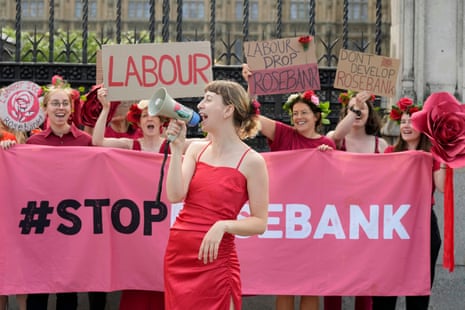
It is now more important than ever that politicians, campaigners, scientists, and lawyers continue to work together to stop any more climate vandalism at the hands of this government. We must implore them to say no to Rosebank and to halt any plans to allow new oil and gas extraction through tie-backs to existing production facilities.
What the government should be doing is making large-scale investments in cheap and reliable renewables to safeguard our energy security. They must also offer a package of support to future-proof jobs in the energy sector so that workers in oil and gas can transition to good-quality green jobs, alongside a nationwide home insulation programme and making polluters pay.
Industry groups in north-east Scotland have said the decision on the Jackdaw gas field is “hugely welcome”, but the pending decision on the Rosebank oil field is “every bit as vital”.
The Scottish government has called for the Treasury’s income from oil and gas to be placed in a “future generations fund”.
The approval came after months of speculation about the Jackdaw offshore development, which is in the North Sea 150 miles to the east of Aberdeen.
Groups representing the offshore industry had urged the UK government to approve the new development, stressing the economic and energy security benefits. However, environmental groups are dismayed by the move.
Russell Borthwick, chief executive of Aberdeen + Grampian Chamber of Commerce, said:
This is a hugely welcome decision, and exactly the sort of pragmatic call the North Sea has been crying out for. Jackdaw is 99.9% complete and, with approval now secured, gas from this field will be flowing into homes up and down the country within weeks.
This is a direct, tangible boost to the UK’s energy security at a time when it matters most. Every molecule of gas we produce in the North Sea, under some of the world’s highest environmental standards, is a molecule we don’t have to import on a tanker from overseas.
But Jackdaw cannot be the end of the story. Rosebank is every bit as vital to our energy security and every bit as ready to deliver for the UK supply chain anchored here in the north east of Scotland. Government must now move with the same urgency and pragmatism and get Rosebank over the line without further delay.
The Scottish government’s energy minister Stephen Gethins said the economic benefits of the Jackdaw field must be felt in Scotland.
He said:
Perhaps the most significant failure of the past half-century of Westminster energy policy has been the failure to establish a futures fund. The UK has been almost the only country to discover oil and gas but not deliver a long-term benefit from a finite resource. That must change today.
It is crucial that all further income from oil and gas resources taken by the UK Treasury is placed in a future generations fund. That would deliver a long-term benefit from a limited resource.”
I am sure that the prime minister will agree that it is absolutely critical that if any new production goes ahead, then the economic benefits should be felt in Scotland and should be used to bring energy bills down, rather than flowing to plug more short-term spending gaps by the Treasury.
The UK government must also replace the Energy Profits Levy with a fair system that protects jobs, energy security and investment in our energy sector.
Angela Hepworth, chief executive of Scottish Renewables, said global events have brought the need for domestic energy into “sharper focus”.
Today’s decision must now be matched by a renewed drive to deliver our long-standing clean energy ambitions.
The UK needs a pragmatic approach to its energy future that secures investment, jobs and energy supplies in a volatile world. As the global shift towards electrification continues, the case for homegrown clean energy is stronger than ever.
The approval of Jackdaw is an “important step” for the North Sea, according to Shell.
The UK energy giant jointly owns Jackdaw operator Adura, which is headquartered in Aberdeen, together with Norway’s Equinor.
Tony Nunan, Shell’s UK chief of staff, said:
This is an important step in ensuring the UK North Sea can continue to contribute to the country’s energy security and economy.
Long-term energy projects depend on a competitive and stable investment environment, alongside timely and predictable regulatory decisions.
We will continue to work constructively with Government and Adura to support secure energy, investment and growth in the UK.
UK oil and gas giant Shell and Norway’s Equinor have been lobbying hard for the green light for Jackdaw. Adura, a North Sea 50-50 joint venture between Shell and Equinor, commissioned a report this week that said rejecting the two projects would cost the UK economy nearly £10.8bn over the next decade.
The Jackdaw gas field in the North Sea is “equivalent to Norwegian gas in terms of environmental performance”, Adura chief executive Neil McCulloch claimed this morning.
Speaking on BBC Radio 4’s Today programme, McCulloch was asked about the UK producing “more pollution in British gas fields than they do in Norwegian gas fields” – with campaigners claiming four times as much.
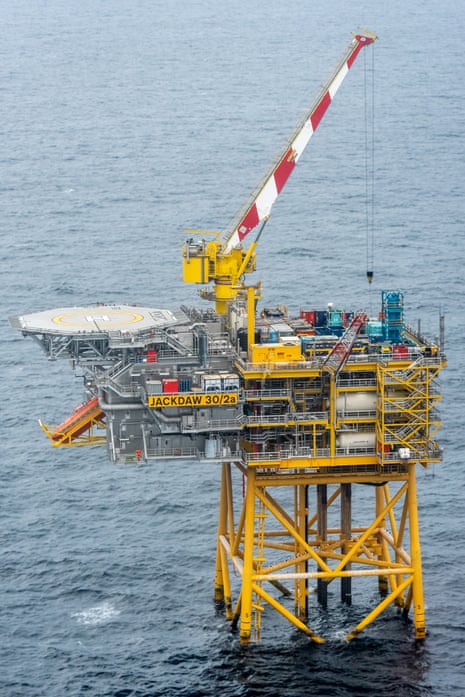
Asked about the example of emergency gas flaring, which Norway has banned, and whether he could “clean up your act”, McCulloch replied:
Jackdaw is a really good example of a very good gas field.
So, Jackdaw itself doesn’t have a flare, and its carbon intensity is eight kilogrammes per barrel of oil equivalent, which is exactly the same as Norwegian pipe gas.
So, this is exactly equivalent to Norwegian gas in terms of environmental performance, and so we should thank that it’s coming into the grid.”
What it does bring, though, is it brings jobs, it brings economic value to the UK, and it supports the supply chain as they transition into a future which will undoubtedly have more renewables within it.
Here’s a handy explainer from our energy correspondent Jillian Ambrose about what the decision means exactly.
About four years and six energy secretaries after it was given the green light, the Jackdaw gasfield has been given consent to begin production 150 miles east of Aberdeen.
So what does this long-awaited decision mean for the Labour party, household bills, the economy and the climate crisis?
Lale Akoner, market strategist at the etoro trading platform, said about the UK’s green light for the North Sea gasfield:
Jackdaw’s approval is a win for UK energy security, but it is not a quick fix for the cost-of-living crisis. The field is likely to provide around 6% of domestic gas production, yet only around 2% of total demand. Britain remains exposed to global energy prices, meaning households should not expect cheaper bills this winter.
For investors, the decision removes regulatory uncertainty for Shell and Equinor and is encouraging for North Sea investment. However, we think the bigger catalyst could be next week’s budget, particularly whether the government reforms the windfall tax to encourage further investment.
The Treasury ran a higher than expected budget deficit of £24.5bn last month as rising inflation pushed up the interest paid on government debt, increasing pressure on John Healey before his first budget next Wednesday.
Official figures out this morning show the government paid £10.9bn in debt interest: the highest September figure since records began, and only the eighth time the monthly number has been above £10bn.
Some government bonds are directly linked to the retail prices index measure of inflation, with payments rising in line with it. RPI has increased in recent months as the Iran war has pushed up energy costs. The Office for National Statistics said this had added £4bn to debt interest costs in September alone.
Total government debt is estimated to have hit £3tn for the first time – although as a share of the size of the economy it has fallen to 94%, from 95% a year ago.
The £24.5bn monthly deficit on the public finances was up from £17bn in August, and £1.9bn higher than the independent Office for Budget Responsibility had forecast.
In the financial year so far, public sector net borrowing is £97.8bn, the ONS said – £4.4bn lower than last year but still £6bn higher than the OBR expected.
The data underlines the impact of the Iran war on the public finances, before next Wednesday’s budget.
Healey has been keen to stress his determination to stay within the fiscal rules set out by his predecessor as chancellor, Rachel Reeves.
However, he is widely expected to accept a slimmer financial buffer, or “headroom”, against those rules than the £24bn Reeves had built up at the time of her spring forecast.
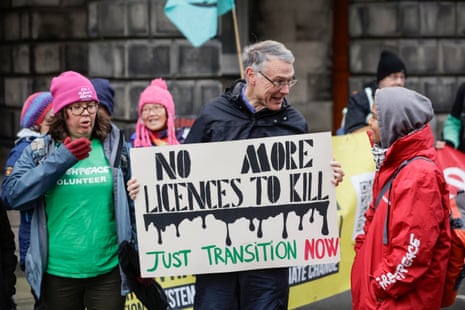
Green Party leader Zack Polanski described the Jackdaw gasfield approval as “climate vandalism” and a “victory for Shell over the people”.
Today’s decision by Labour is a betrayal of all of our futures, Labour has abandoned all credibility in the fight against climate change.
The energy secretary has herself said it will make no difference to energy bills; the health secretary has admitted the summer heatwave added to pressure on the NHS, and the industry’s own assessment is that it will create only 27 jobs.
The chancellor of the Exchequer, John Healey, focused on the new energy wealth fund – which looks similar to Norway’s fund but is too little, too late, according to critics – in his remarks.
I want Britain’s energy wealth to spark a new wave of clean power to work for the British people.
Since North Sea gas and oil were discovered decades ago, the benefit of our existing nation’s natural resources have not been turned into the long-term investment our country needs.
Through our new Energy Wealth Fund, we will invest in the clean energy industries of the future, creating jobs, driving growth and strengthening Britain’s energy security.
The pro-growth campaign group Britain Remade welcomed the decision.
Sam Richards, its chief executive, said:
Britain is going to need gas for decades to come, as even the climate change committee recognises. The choice is not between gas and no gas, but between gas produced in British waters and gas shipped in from abroad at higher cost and with higher emissions.
But while we should use what we have, the north sea is a declining basin, and we need to transition to homegrown clean power. Britain’s always-on electricity should come from new clean nuclear, both gigawatt-scale reactors and small modular reactors that can be sited in far more places than their bigger cousins.
Right now Britain is the most expensive place in the world to build new nuclear. Ministers should urgently implement the Fingleton Review in full in order to drive down cost. The government should also commit to a new small modular reactor at Dungeness without delay.
The environmental law charity ClientEarth is dismayed by the UK’s decision to approve the controversial Jackdaw North Sea gasfield. It said it has twice been successful in legal action against the UK government’s climate plan in recent years.
Kyle Lischak, the charity’s head of UK, said
Today’s decision from the government is very worrying. The courts had recognised allowing new large-scale oil and gas projects to proceed could risk locking in emissions that will worsen the climate crisis. The severe impacts of these projects do not disappear and only increase over time. And if approval is extended to the oil-heavy Rosebank basin, it detonates an even-greater carbon bomb that worsens extreme weather, drives future costs of climate damage, and threatens our farmland and food security.
Further oil and gas from the North Sea will not lower Brits’ ballooning energy bills and will be traded internationally rather than being ring-fenced for domestic use. Instead, the companies drilling our oil and gas field will soon leave the empty oilfields with record profits, whilst we pay the price of extreme weather for decades to come.
Good morning, and welcome to our rolling coverage of business, the financial markets and the world economy.
UK inflation has accelerated more than expected to 3.5% as the cost of motor fuels surged at the fastest rate in four years, with diesel topping £2 a litre this month.
The Office for National Statistics said annual inflation, measured by the consumer prices index (CPI), rose from 3.1% in August. Economists had forecast a rise in the consumer prices index to 3.4%.
The ONS said the biggest factor pushing up inflation was transport, in particular motor fuels; while restaurants and hotels made the largest, partially offsetting, downward contribution.
The motor fuel inflation rate was the highest since August 2022.
Core CPI (excluding volatile energy, food, alcohol, and tobacco costs) rose by 2.8% in the 12 months to September, up from 2.6% in August.
Oil and gas prices have soared since the end of February when the US and Israel launched their war on Iran. The practical closure of the strait of Hormuz to most fossil fuel traffic since then has sent the price of Brent crude well north of $100 a barrel.
Petrol prices have climbed above £1.70, while the cost of a litre of diesel has also risen, hitting a record high of more than £2 a litre this month.
Bank of England officials are widely forecast to raise interest rates when they meet next month, with concerns that inflation will jump above 4% next year – more than double the central bank’s 2% target rate.
The UK government has approved the controversial Jackdaw gasfield in the North Sea, a widely expected move that will nonetheless dismay environmental campaigners and a number of Labour MPs.
Miatta Fahnbulleh, the energy secretary, said the project will start supplying gas to homes and businesses from the end of this month.
At the same time, she said a new energy wealth fund will be set up by the government with a £2bn downpayment to reinvest oil and gas revenues into the climate transition, away from fossil fuels.
She said:
Following careful consideration of all relevant factors I have agreed that the regulator can grant consent for gas to be produced at Jackdaw, which will begin to supply the UK with gas from this winter thanks to the highly skilled and vital North Sea workers.
This decision will support the country’s energy security with homegrown gas this winter and help minimise the UK’s use of imported higher emission fuels as we continue our transition to renewables and nuclear.
The decision is compatible with our legally binding climate commitments, and we remain resolute in ending new licences for oil and gas and achieving net zero by 2050.
While Labour’s 2024 election manifesto committed to a ban on new drilling licences in the North Sea, the companies behind Jackdaw and the Rosebank oilfield project, which is being decided on separately, have sought environmental approval for existing licences.
The companies resubmitted their applications for environmental approval earlier this year. The decision on Jackdaw had been expected last month but was delayed, seemingly to take it beyond the Holborn and St Pancras byelection on 8 October, where Labour was defending a seat against a Green challenge and ultimately won.
Andy Burnham, the prime minister, said the decision will “protect hundreds of jobs and help keep millions of homes warm this winter”.
At a time when people are really struggling, it’s right that we look in a responsible way at maximising the existing energy reserves we have in Britain that could help.
We’re committed to moving towards renewable energy and reaching net zero by 2050. But even on our ambitious climate path, we’ll still require oil and gas as part of our energy needs for decades to come. That’s why we’re taking a pragmatic approach to the North Sea. We’re also establishing a new Energy Wealth Fund to invest in renewable energy, support the green transition and help reduce energy bills over the long-term.
Our approach will ensure we can boost our energy security, back British workers, ringfence future North Sea proceeds to speed up the green transition, hit our ambitious climate targets and - crucially - bring down bills.
The Agenda
-
2pm BST: Bank of England governor Andrew Bailey speech
-
5pm BST: European Central Bank president Christine Lagarde speech
KioskNews shows a cleaned-up reading view extracted from the publisher’s page — the original always lives on their site, not ours.