Donovan’s Deep Dives: Taiwan’s efforts to create a ‘Taiwan-Philippines Economic Corridor’
Beyond growing security ties, investment plans, Filipino talent and expanding unofficial diplomacy are drawing the two neighbors closer
By Courtney Donovan Smith 石東文 / Staff Columnist


Much attention is being paid to increasing security ties between Taiwan and the Philippines, and rightfully so. The stakes are potentially existential, as explored in “ Donovan’s Deep Dives: Taiwan, Japan and the Philippines need to face the common threat from Beijing” (Sept. 12, page 12).
Getting less attention is that across the board the relationship is growing stronger, and both sides appear to be planning to put more of their eggs in each other’s baskets.
Minister of Foreign Affairs Lin Chia-lung (林佳龍) in August last year confirmed plans to open a second Taipei Economic and Cultural Office (TECO) representative office in Cebu Province.
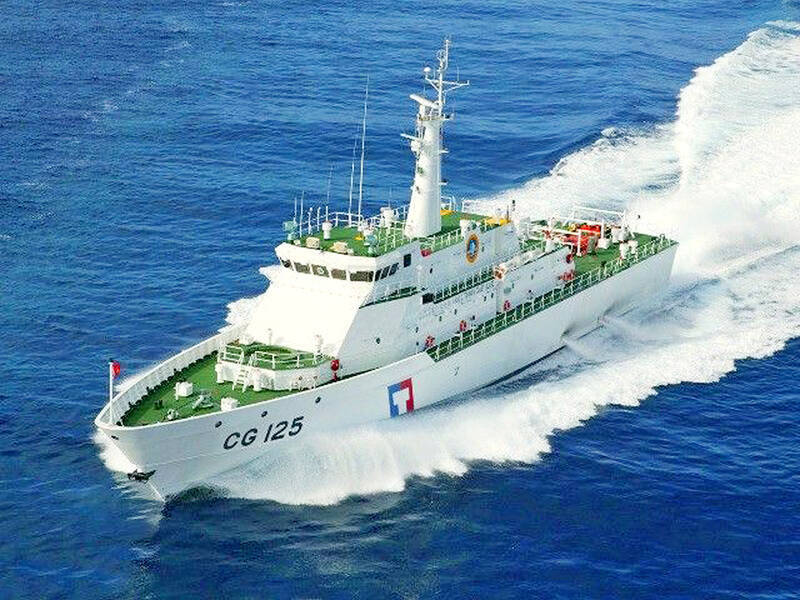
The Lienchiang Coast Guard Administration vessel sails in an undated photograph. Coast Guard Administration ships are scheduled to sail to the Philippines bearing the words “Taiwan Coast Guard” in a high-profile visit in October next year.
Photo courtesy of the Coast Guard Administration
Meanwhile, the Philippines representative office, Manila Economic and Cultural Office (MECO), earlier this month opened its largest overseas Filipino worker (OFW) service center in Taipei, with plans for establishing two more in central and southern Taiwan over the next two years. It is only the third such overseas service center the Philippines has opened. MECO has maintained a strong presence in Taiwan for years with representative offices in Taipei, Taichung and Kaohsiung.
These are just the latest significant moves, but they are part of a pattern of rapidly increasing ties and mutually reinforcing interest that could have long-lasting positive implications.
GOING SOUTH
In the democratic era, Taiwanese interest in the Philippines as a way to reduce reliance on China is not new. In the 1990s, President Lee Teng-hui (李登輝) launched the “go south” policy, encouraging investment in Southeast Asia, but with only modest success in the Philippines. In 2016, one of Lee’s top trade advisors, Tsai Ing-wen (蔡英文), was elected president and launched a similar New Southbound Policy, with similar results.
The election of Ferdinand “Bongbong” Marcos Jr as president in 2022 brought a positive change on the Philippines side towards relations with Taiwan, which has since been matched by a similar eagerness on the Taiwanese side under Foreign Minister Lin after he was appointed in 2024 by President William Lai (賴清德).
Marcos issued a memorandum in April last year easing decades-old restrictions on official exchanges with Taiwan. This quietly opened the door for higher-level, though still unofficial, contacts between the two sides.
This change quickly bore fruit; in August, Lin led a delegation of investors to the Philippines in a “private capacity” on his regular, non-diplomatic passport. Since the two sides severed diplomatic ties in 1975, this is only the second known trip by a Taiwanese foreign minister after then-minister Chang Hsiao-yen (章孝嚴) took a “vacation” to the Philippines in 1997.
This is part of a larger context. Reportedly, American investors were also in the delegation. Just the month prior to this trip, Lin had also visited Japan. Improved relations between Taiwan and the Philippines is part of a broader integration push in the region that includes the US and Japan into a more cohesive grouping of mutually supported interests.
Lin explicitly tied his efforts to those nations, saying on Facebook: “we are actively promoting the ‘Taiwan-Philippines Economic Corridor,’ linking it with the US-Japan-Philippines ‘Luzon Economic Corridor’ to build more resilient supply chains together.”
In the same post he added: “I have also taken note of the recent announcement by the US and the Philippines that they will work together to establish a 4,000-acre ‘Economic Security Zone’ to strengthen supply chain security and industrial development. In my view, the US possesses world-leading technological capabilities, Taiwan has a comprehensive manufacturing base and the Philippines has abundant land and a high-quality workforce.”
That development is part of the US-led Pax Silica initiative which, according to the State Department, “hails a new economic security consensus ensuring aligned partners build the AI ecosystem of tomorrow — from energy and critical minerals to high-end manufacturing and models.”
That statement lists 25 signatories, which of course does not include China, and rather forlornly Taiwan sits at the bottom listed as a “Non-Signatory Participant” with an asterisk noting that “Taiwan has endorsed the Pax Silica declaration principles via the Joint Statement on the Pax Silica Declaration and US-Taiwan Economic Security Cooperation.”
Such is Taiwan’s international standing that, despite being a key player in the “AI ecosystem of tomorrow,” it participates only through a separate endorsement rather than as a signatory.
DESTINATION: PHILIPPINES
Lin’s “Taiwan-Philippines Economic Corridor” remains ill-defined, but two things jump out. One is the addition of a Cebu office, and the other is his comment about “abundant land and a high-quality workforce.”
Cebu is far from Luzon geographically, but its central location makes it a major hub for domestic shipping and inter-island logistics. It is possible that Lin’s strategic calculation is to use his economic corridor plan to extend the US-Japan-Philippines efforts geographically in a way that is both complementary, but separate enough that it highlights Taiwan’s importance.
Taiwan lacks land and is increasingly desperate for a “high-quality workforce,” so, unsurprisingly, Lin sees the opportunities.
Quietly, but increasingly, Taiwan’s entire manufacturing ecosystem has grown reliant on Filipino talent. Contrary to expectations, this is happening at every level, from the lowest-tech to the highest.
The National Immigration Agency’s August report lists 214,806 Filipinos in Taiwan. The majority work in manufacturing, often starting at low-level positions. However, over time they become essential skilled technicians and managers, able to communicate in Mandarin, English and Tagalog.
Lin is likely counting on this for his “Taiwan-Philippines Economic Corridor.” Many Taiwanese investors already have a solid base of well-trained Filipino experts who know how to run their factory floors and manage the business.
Though exact numbers are not available, older estimates put the number of Filipinos working in white-collar high-tech positions in the low thousands, but this number is likely higher today. When I used to live near the Central Taiwan Science Park, it was not uncommon to run into Filipino engineers and technicians.
Crucially, more are being trained and prepared for just such roles. According to a July press release from the Ministry of Education, the number of Filipino students in Taiwan rose 78.7 percent between 2022 and last year, reaching 5,536. They are primarily studying engineering, information and communication technology (ICT), manufacturing, business management and medical and health sciences.
The AI ecosystem and supply chains stretch across the planet. A Filipino engineer or ICT expert trained in Taiwan, with Mandarin skills and excellent English is worth their weight in gold both locally, and even more so if they want to expand into the Philippines or English-speaking nations such as the US.
Much of China’s manufacturing dominance was originally built on Taiwanese expertise and capital, but once trained and capitalized, China favored local competitors over the Taiwanese investors. Taiwanese investment helped Malaysia develop into a significant mid-tier player in the semiconductor industry, and continues to fuel Vietnam’s growth in manufacturing.
Lin’s “Taiwan-Philippines Economic Corridor” has potential. Taiwan has the know-how, abundant capital, a desperate need for cheap land, energy and water and access to significant Filipino human capital to make it all work. With a presence in Manila in Luzon and future presence in the key logistics node of Cebu, Taiwan will be well positioned to facilitate investment expansion.
However, much depends on the Philippines making itself a desirable investment destination. Reviews vary widely in their assessment. In 2018 the US News & World Report named the Philippines as the “best country to invest in,” and CEO Magazineranked it seventh out of the top 10 best countries in 2020. Less positively, the Philippines ranked 95th out of 190 countries in the 2020 World Bank Report on Doing Business, though that was a jump of 29 spots from the year prior.
Ramped up interest by the US and Japan in investing in the Philippines could help smooth the way. Their financial and diplomatic muscle could pressure the Philippines to continue to make positive changes in its investment environment.
Donovan’s Deep Dives is a regular column by Courtney Donovan Smith (石東文) who writes in-depth analysis on everything about Taiwan’s political scene and geopolitics. Donovan is also the central Taiwan correspondent at ICRT FM100 Radio News, co-publisher of Compass Magazine, co-founder Taiwan Report (report.tw) and former chair of the Taichung American Chamber of Commerce. Follow him on X: @donovan_smith.
KioskNews shows a cleaned-up reading view extracted from the publisher’s page — the original always lives on their site, not ours.