RACISM CHARGE : Judge Hartle’s ‘peace offering’ of rusks mistaken for bribe, tribunal hears
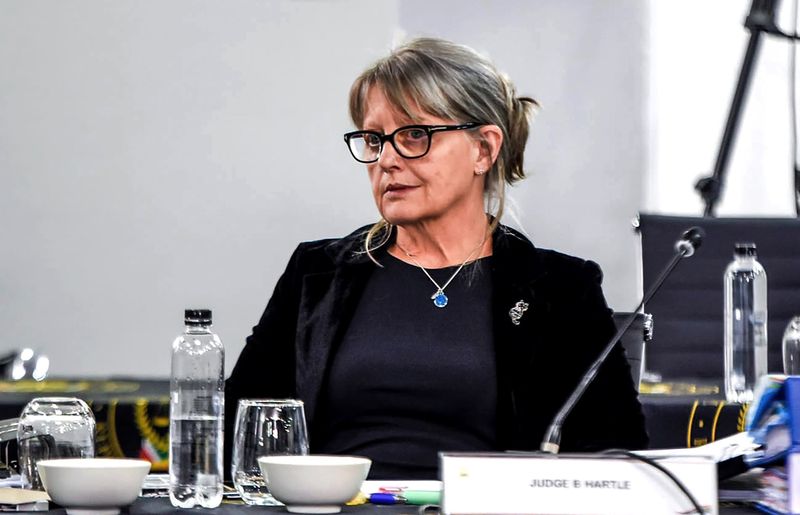
A day after Eastern Cape high court Judge Belinda Hartle allegedly racially insulted court clerk Thozamile Semekazi, she left what she described as a peace offering on his desk.
Semekazi, however, did not open the package because he believed it was an attempt to bribe him following the May 2025 incident.

On Wednesday, the Judicial Conduct Tribunal investigating allegations of gross misconduct against Hartle heard that the package was, in fact, a box of rusks, according to Hartle’s lawyer, advocate JC Heunis SC.
Hours before this, Heunis challenged Semekazi’s credibility, citing three audio recordings which he argued could prove that Semekazi had in fact lied under oath.
The recordings, dating back to March 2024, September 2024 and February 2025, allegedly capture telephone conversations between Semekazi and journalist Ray Hartle, Judge Hartle’s husband, who may be called as a witness.
Their existence came to light only this week, while Semekazi was being cross-examined by Heunis, prompting objections from evidence leader advocate T Kalakgosi, who questioned why the recordings had not been disclosed earlier.
The dispute has now left the tribunal to decide on whether the recordings should be admitted as evidence.

Hartle faces allegations of gross misconduct after Semekazi accused her of using racist and derogatory language towards him on 15 May 2025, following a disagreement over the delivery of court files.
Semekazi, who has worked as a court clerk for more than 20 years, alleges that Hartle repeatedly swore at him and used the f-word and k-word in the presence of her secretary, Shakira Frost.
Hartle, however, disputes the allegations, but through her legal team admitted to insulting Semekazi using the f-word.
Defence questions delay in reporting alleged racial slur
On Tuesday, the defence questioned why Semekazi waited nearly a month before mentioning the racial slur in a complaint to the police, despite having had earlier opportunities to report it.
The tribunal has also heard about statements from two other witnesses, including Semekazi's supervisor, to whom he reported the alleged incident shortly after it happened. However, neither statement made any mention of the alleged racial slur, although the use of the f-word was mentioned.

During cross-examination, Heunis questioned Semekazi about why the statements submitted to the tribunal did not mention the alleged racial slur, despite referring to the swearing that had taken place.
The defence suggested that these omissions raised questions about Semekazi’s version of events, particularly because he maintained that Hartle had used the k-word during the confrontation.
Heunis argued that the delay raised questions about Semekazi’s version of events, particularly because Hartle’s secretary, Shakira Frost, who was allegedly present during the incident, had given an account that directly contradicted his allegations.
The defence further referred to an apology Hartle made shortly after the incident, arguing that while the judge acknowledged having sworn, she denied that the swearing was directed at Semekazi, but rather at the office dealing with the files that had been submitted late.
Recordings emerge during cross-examination
On Wednesday, Heunis told the tribunal that the three recordings that had emerged could be important in determining whether Semekazi was a credible witness.
According to Heunis, the first recording was made on 8 March 2024, followed by two others on 26 September 2024 and 21 February 2025.
He alleged that Semekazi had contacted Ray Hartle before the publication of a newspaper article concerning allegations of corruption at the Mthatha high court, offering to provide information about alleged wrongdoing at the court.
The article, which was discussed during Semekazi’s testimony, concerned allegations that officials attached to the registrar’s office had accepted bribes ranging from R2,000 to R15,000 to perform duties that formed part of their jobs.
Heunis said Semekazi had denied making the initial call and having the subsequent conversations with Ray Hartle.
He argued that the recordings could establish whether Semekazi had told the truth when questioned about his contact with Ray Hartle.
“The credibility of this witness is a pivotal aspect of this matter… I submit that because of that issue and other considerations, it is vitally important to establish whether or not this is a truthful witness,” Heunis told the tribunal.
Heunis argued that the recordings would show that Semekazi had been dishonest when questioned about his contact with Ray Hartle.
“It goes to the truthfulness of a particular claim by him, ie, no such conversation ever took place.”
He said the accounts given by Judge Hartle and Frost differed fundamentally from Semekazi’s version of what happened in the secretary’s office on 15 May 2025.
He argued that the recordings should be played before the tribunal and that Semekazi should be given the opportunity to respond to them.
Application opposed
Evidence leader Kalakgosi opposed the application, arguing that introducing the recordings at such a late stage raised serious questions about fairness and the rules governing evidence.
He told the tribunal that the parties had held pre-hearing meetings in August and October to establish what evidence would be presented during the proceedings.
Although Judge Hartle’s legal team had indicated that Ray Hartle might be called as a witness, Kalakgosi said no statement from him had been included in the documents disclosed ahead of the hearing.
Instead, he received an email containing the three recordings only after proceedings had adjourned the previous day.
‘Ambush’
“What I have an issue with, first of all, is that I may very well regard this as an ambush…I’m well within my right to say it’s an ambush,” Kalakgosi said.
He also raised concerns about the authenticity of the recordings, pointing out that there was no affidavit from Ray Hartle confirming when and how they had been made.
“We do not know as to when did those recordings begin, for argument’s sake,” he said.
“Were they recorded immediately when this supposedly… or when the supposed conversations took place, right up until the end of those conversations?”
Kalakgosi argued that even if Semekazi were allowed to listen to the recordings and respond, questions about their authenticity would still need to be resolved.
“The fact of the matter remains, we would still have to cross the bridge of authenticity,” he said.
He also raised concerns about the relevance of the recording to the alleged k-word incident. “We are here to determine as to what transpired on the 15th of May 2025,” Kalakgosi said.
Responding to the objection, Heunis disputed the suggestion that the recordings amounted to an ambush, arguing that their relevance had only become apparent after Semekazi denied having the telephone conversations.
“Ambush is a harsh word,” Heunis told the tribunal.
Tribunal weighs fairness
The disagreement prompted intervention from tribunal chairperson, retired Supreme Court of Appeal Justice Boissie Henry Mbha, who repeatedly raised concerns about the timing of the disclosure.
Mbha questioned why recordings made as far back as March 2024 had only been brought to Hartle’s legal team’s attention this week.
“So Mr Hartle had these recordings from this date, and he only disclosed this to you, the recordings, yesterday. Is that what I’m hearing?” Mbha asked.
Heunis confirmed that the legal team had only recently learnt of their existence.
Mbha made it clear that the tribunal could not simply allow the recordings to be played without first considering the objections raised by the evidence leader.
He said the tribunal needed time to consider whether the recordings should be admitted.
“Our duty here is to ensure that there is fairness, to ensure that no one is ambushed or whatever, but we will afford you the opportunity to address us,” Mbha said.
“We’ll listen to the evidence leader, and thereafter we will decide what happens.”
The proceedings were subsequently adjourned to allow the tribunal members to decide on the admissibility of the recordings, depending on what the evidence leader tells the tribunal on Thursday.DM
KioskNews shows a cleaned-up reading view extracted from the publisher’s page — the original always lives on their site, not ours.