China tests powerful AI that could one day be used on submarines
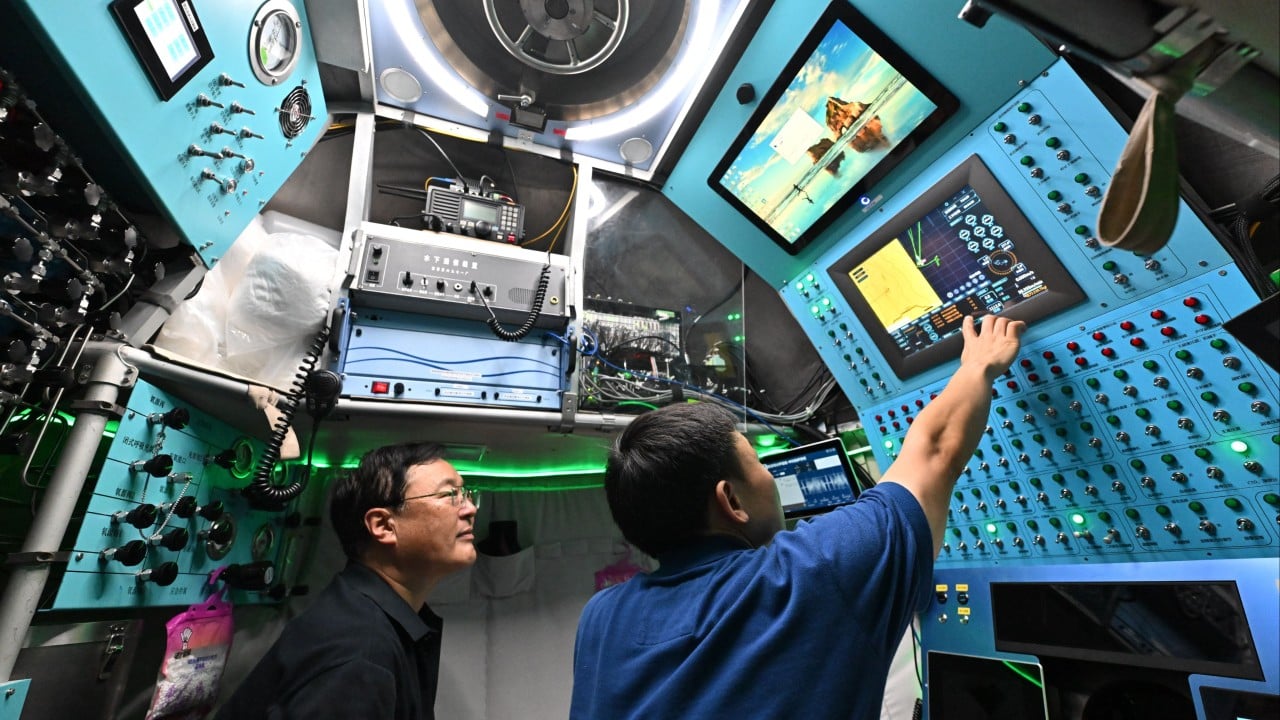
China has showcased artificial intelligence (AI) technology alongside 7,000-metre (23,000-feet) deep-sea trials of its upgraded Jiaolong submersible, highlighting the potential for similar systems to support decision-making and emergency responses aboard nuclear-powered submarines.
The Chinese crewed submersible reached a maximum depth of 7,056.9 metres during three dives in the Philippine Basin in the western Pacific Ocean, according to state news agency Xinhua on October 27.
The trials followed a major upgrade that introduced AI-powered seabed analysis and a separate fault-diagnosis system designed to assist pilots during underwater operations.
The developments highlight the growing potential of AI in underwater operations, an emerging area of strategic competition between China and the United States.
Both countries are exploring military applications of AI, although its role in nuclear-related decision-making remains controversial.
Submarines present particular challenges because they cannot rely on continuous satellite communications while submerged, forcing crews to process complex information and make critical decisions with limited external support.
AI could help analyse sonar signals, identify potential threats, detect equipment faults and recommend responses faster than human operators working alone.
Such capabilities could prove particularly valuable aboard nuclear-powered submarines conducting lengthy underwater missions, where equipment failures may require immediate action without external technical help.
One of the systems developed for Jiaolong offers a potential example of how AI could support such operations.
According to a separate Xinhua report published on October 25, Jiaolong is equipped with a fault-diagnosis and decision-support system that provides troubleshooting procedures, previous fault records and technical documents when equipment malfunctions during a dive.
02:57
China trials underwater data centres to solve energy woes
“This is a fault diagnosis and decision-support system,” Zhang Yi, a Jiaolong pilot, told Xinhua. “We developed it based on the project’s requirements and actual operational needs.”
The system covers equipment including propulsion and control systems, helping pilots identify problems and respond to emergencies before faults become more serious.
“Quickly identifying and eliminating potential hazards is extremely important,” Zhang said. “So is dealing with risks during dives and ensuring the safety of personnel.”
Similar decision-support technology could eventually be adapted for nuclear-powered submarines, helping crews diagnose equipment malfunctions and select appropriate responses during prolonged underwater missions.
AI-based predictive maintenance could also help detect abnormal operating conditions before components fail, potentially reducing unexpected breakdowns.
Beyond fault diagnosis, Chinese researchers have developed another AI system designed to help Jiaolong interpret its underwater surroundings.
Researchers at China’s National Deep Sea Base Management Centre have developed an intelligent exploration system using a multimodal large AI model capable of analysing images captured by Jiaolong’s cameras.
“We developed this intelligent deep-sea exploration system using a multimodal large AI model,” Li Jinpeng, a postdoctoral researcher at the centre, told Xinhua.
“It uses artificial intelligence algorithms to interpret footage captured by Jiaolong in real time,” he said.
Researchers have trained the system using more than 800,000 images of deep-sea organisms and seabed materials, enabling it to identify objects in underwater footage and automatically record their names, geographical coordinates, time and depth.
When the system makes mistakes, researchers can manually correct the information and feed it back into the model for further learning and improvement.
“Users can also interact with the system through dialogue,” Li said. “It will provide answers to their questions.”
The software can also reconstruct the submersible’s diving trajectory in three dimensions, analyse marine species abundance and generate reports on seabed ecosystems.
Although developed for scientific exploration, similar AI techniques could potentially be adapted for military applications by training specialised models to recognise patterns in acoustic data rather than images.
Sonar systems collect large volumes of signals from vessels, marine life and surrounding ocean conditions, making rapid classification particularly important in underwater warfare.
AI could potentially help submarine crews distinguish between different sources of underwater noise and identify suspicious acoustic patterns, reducing the burden on human operators.
However, the Chinese system currently focuses on visual analysis rather than military sonar-based target recognition. Although Xinhua highlighted Jiaolong’s AI capabilities during its deep-sea trials, it did not disclose the specific depths at which the technology was tested.
The deep-sea trials also showed the reliability of Jiaolong’s upgraded equipment, including domestically developed components.
“This fully verified the reliability and safety of Jiaolong following its upgrades and the replacement of key components with domestically developed alternatives,” Sun Yongfu, a researcher at the National Deep Sea Base Management Centre, told Xinhua.
“It has consolidated and strengthened China’s technological advantages in crewed deep-sea exploration equipment,” Sun said.
KioskNews shows a cleaned-up reading view extracted from the publisher’s page — the original always lives on their site, not ours.