Tang Prize laureates honored ahead of today’s lectures
The six recipients of the seventh Tang Prize were honored at a ceremony in Taipei yesterday, ahead of a full day of lectures today featuring their award-winning work.
Five of the six laureates attended the ceremony at the Taipei Performing Arts Center to receive their awards in person. Steven A. Rosenberg, one of three recipients in the biopharmaceutical science category, was unable to travel to Taiwan, according to the Tang Prize Foundation.
During the ceremony, Tang Prize Selection Committee convener Wong Chi-huey (翁啟惠), a former president of Academia Sinica, and the chairs of the four category selection panels introduced the laureates and outlined their major contributions.
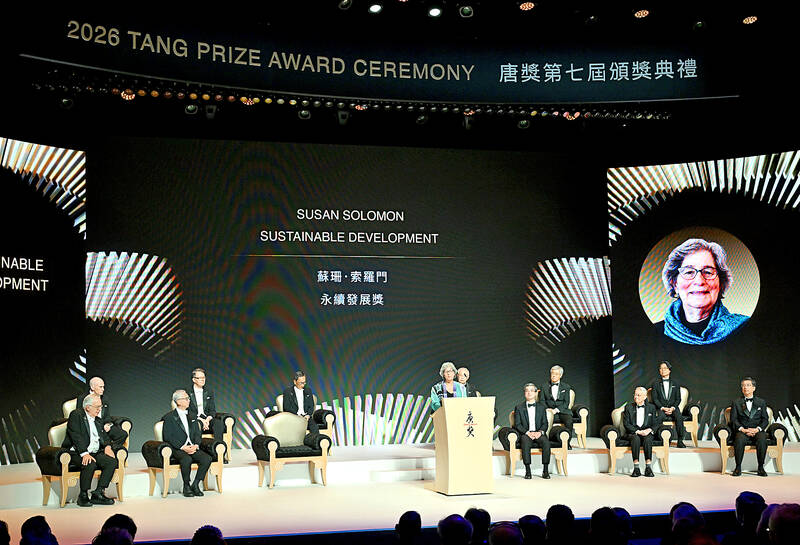
Susan Solomon, an atmospheric chemist and winner of the Tang Prize in Sustainable Development, speaks at the seventh Tang Prize Award Ceremony in Taipei yesterday.
Photo: Tien Yu-hua, Taipei Times
The six recipients were announced by the prize’s selection committees in mid-June.
They are scheduled to deliver lectures at the Taipei Bioinnovation Park throughout Saturday, discussing the research and ideas they have developed over their careers.
American atmospheric chemist Susan Solomon received the Tang Prize in Sustainable Development for research that helped establish chlorofluorocarbons, or CFCs, as the primary cause of the expanding hole in the ozone layer over Antarctica.
Her work explained the chemical reactions behind ozone depletion and provided a scientific basis for global efforts to phase out CFCs under the Montreal Protocol.
The Tang Prize in Biopharmaceutical Science was jointly awarded to Rosenberg, Michel Sadelain and Carl H. June for developing cancer treatments that harness patients’ own immune cells.
Their work on tumor-infiltrating lymphocyte and chimeric antigen receptor T-cell therapies helped pioneer “living drugs,” in which immune cells are collected, enhanced or genetically modified, and returned to patients to attack cancer.
Chinese historian Ge Zhaoguang (葛兆光) received the Tang Prize in Sinology for his research on Chinese intellectual, cultural and religious history.
His influential studies exploring the question “What is China?” have challenged conventional historical perspectives and introduced new approaches to the study of China.
Yale University constitutional scholar Bruce Ackerman received the Tang Prize in Rule of Law for his work on constitutional government, judicial review and democratic institutions.
His ideas include “dualist democracy,” which distinguishes routine government decision-making from rare periods of broad public mobilization that bring about fundamental constitutional change.
The Tang Prize is a biennial award established in 2012 by Taiwanese entrepreneur Samuel Yin (尹衍樑) to recognize significant contributions in four fields: sustainable development, biopharmaceutical science, sinology and rule of law.
KioskNews shows a cleaned-up reading view extracted from the publisher’s page — the original always lives on their site, not ours.