Modi draws US chip leaders’ backing
CHIPPING IN: Micron plans to assemble hundreds of millions of chips in India next year, while Applied Materials is to invest US$5bn in the country over the next decade
Indian Prime Minister Narendra Modi yesterday launched a charm offensive for global investors at India’s top chip-industry event, drawing pledges from US firms Applied Materials Inc and Lam Research Corp for billions of dollars in outlays.
Marking India’s audacious bid to win a seat at the global chipmaking table, Modi touted the country’s vast pool of engineering graduates and semiconductor-friendly policies as assets international companies should take advantage of.
“The world urgently needs new and reliable locations for manufacturing,” Modi told the conference in New Delhi. “India is readying itself constantly.”
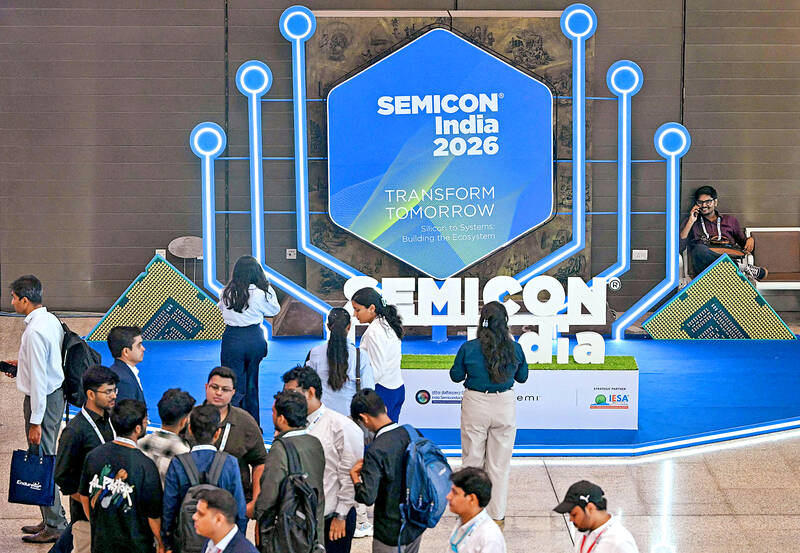
Visitors gather during the Semicon India 2026 Conference and Expo at Yashobhoomi Convention Centre in New Delhi yesterday.
Photo: AFP
Modi is using the three-day Semicon event to display India’s fledgling chip and electronics industry that barely existed a decade ago. He is courting global semiconductor producers, potential partners and customers for India’s homegrown contenders, as well as equipment makers and parts suppliers all seeking to ride the artificial intelligence investment wave.
The stakes are high for an economy that has outpaced much of the world for years. Modi is trying to prove the nation has what it takes to become a hub in higher value-added industries such as chips, all part of a bid to further modernize the economy and keep it humming by bolstering exports. Expanding manufacturing is crucial for Modi’s vision of moving more workers from farms into better-paying jobs.
“Semicon in New Delhi is Modi’s way of signaling that India has a long-term commitment to growing the chip industry,” said Pranay Kotasthane, deputy director of Bangalore-based think tank Takshashila Institution. “That’s his message to global investors.”
More than 600 exhibitors, more than 150 speakers and 300 global companies are converging on a state-of-the-art convention center in New Delhi. There are to be start-up showcases and a student hackathon.
The event comes just two months after India pledged a further 1.9 trillion rupees (US$19.86 billion) in subsidies to boost local chip and electronics production. The first round of subsidies in 2020 and 2021 helped Apple Inc expand iPhone manufacturing in the South Asian region. It now makes 25 percent of its marquee device there.
India sought to replicate that momentum in semiconductors with an initial US$10 billion fund that helped drive early initiatives. Some of those are starting to bear fruit.
Conglomerates Tata Group and Murugappa Group have begun packaging and assembling chips, while US memory maker Micron Technology Inc has also commenced production. Tata is also building a chip fabrication plant in western Gujarat that is due to become operational in early 2028.
Executives from Micron and Tata spoke ahead of Modi, pledging to forge ahead with their local plans.
Micron plans to test and assemble hundreds of millions of chips in India next year after starting output from its Gujarat plant this year, chief executive officer Sanjay Mehrotra said.
Chip-equipment maker Applied Materials is to invest US$5 billion in India over the next decade, said Prabu Raja, president of the US company’s semiconductor products group.
Competitor Lam Research plans to invest about US$1 billion in a local manufacturing facility, chief operating officer Sesha Varadarajan told the audience.
Germany’s Infineon Technologies AG, known for power and automotive chips, boosted its workforce 28 percent in the country over the past year, chief executive officer Jochen Hanebeck said.
Countries around the world are committing massive budgets to making chips at home as the race for AI supremacy heats up. AI is already becoming ubiquitous in everything from self-driving vehicles and healthcare to finance and fraud detection.
However, as computing resources remain scarce, chips and chipmakers are fast becoming kingmakers in deciding who is winning.
Although India’s push is in early stages, it is accelerating efforts to build a domestic industry spanning the entire supply chain. It is offering seed funding to start-ups working on semiconductor products, support for chip-making gear as well as for new fabs and assembly plants.
KioskNews shows a cleaned-up reading view extracted from the publisher’s page — the original always lives on their site, not ours.