Every family has its feuds: Inside the 15-second freeze-frame of APEC’s new world order
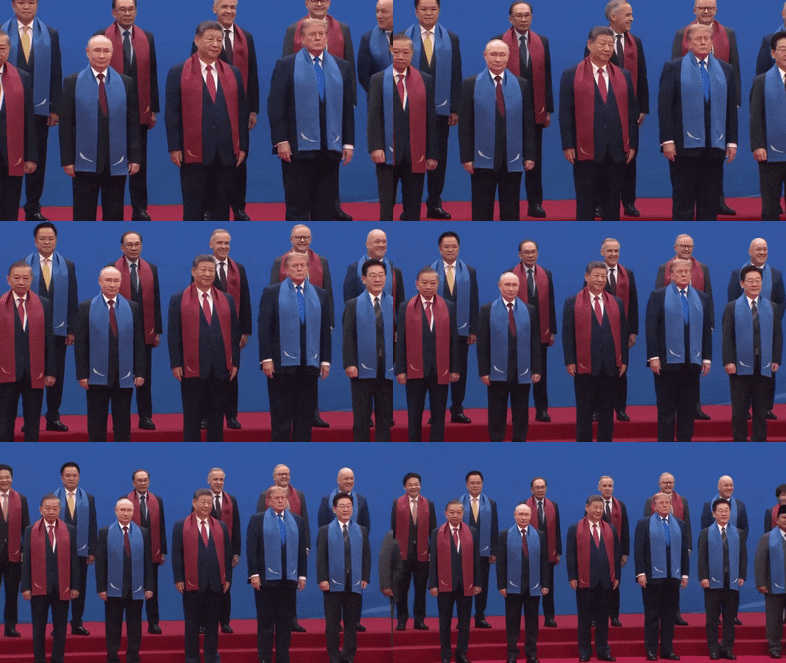
Every family has its feuds and frictions, and the so-called APEC family is no different.
The heads of 21 Asia-Pacific economies gathered for their annual “family photo” at the start of the leaders’ meeting in Shenzhen, China, on Thursday. There’d been speculation about who would stand near each other, and who might boycott, as Russian President Vladimir Putin made his first appearance at the forum since his invasion of Ukraine.
But for 15 seconds they put their differences aside for the sake of diplomacy: draped in red and blue silk scarves given to them by China, the leaders stood still and looked at the camera. The staged photo told a story of shifting power as three of the world’s strongmen took centre stage.
They’d had a dress rehearsal the night before, with a group photograph at the APEC gala dinner.
While a few leaders shifted position between Wednesday night’s pageant and Thursday morning’s staged shoot, the clearest message was sent by those who stayed in place.
Chinese President Xi Jinping, the host of this year’s summit, remained in the middle of the front row, flanked by United States President Donald Trump on one side and Putin on the other. Their place in the heart of the frame was fitting given Thursday afternoon’s historic trilateral meeting between the three leaders has overshadowed the wider summit.
Australian Prime Minister Anthony Albanese was not far behind. Ahead of Thursday’s photo, debate had erupted about whether Albanese, an avowed critic of Russia’s war in Ukraine, should appear in the same photo as Putin at all.
The Coalition, Greens and Ukrainians warned it risked legitimising a leader that Australia accuses of acting illegally. With Putin absent from APEC since 2017, it was a fresh dilemma for Canberra and like-minded countries, who also pointed to the need to respect the host country. Ultimately, Albanese put China’s wishes above the domestic blowback and joined the line-up.
Albanese was positioned in the back row, to the left, between Canadian Prime Minister Mark Carney and New Zealand Prime Minister Christopher Luxon. There was a sense of solidarity, at least, in the three Western leaders standing shoulder to shoulder while navigating the same discomfort with Putin’s presence. Japanese Prime Minister Sanae Takaichi stood to Luxon’s left.
Xi greeted each leader with a handshake as they filed in. Trump was second-last through the door, and shook hands down the line with leaders including Carney, Albanese, Luxon and Takaichi, according to reporters who were in the room. He then took his spot, framed by Carney and Albanese at each shoulder.
Putin was the final leader to arrive. He walked towards Trump, who leaned forward, shook his hand and patted him twice on the upper arm. Albanese, who was in the frame, looked straight ahead. As the Russian president shook hands with others in the front row, Albanese shared brief remarks with Carney and Luxon to his sides. A private joke must have been made, because the three men smiled.
Then Xi stepped into the centre, and the leaders held their poses for 15 seconds while cameras flashed.
At the close of the photo, Albanese turned to Luxon for a quick sideline huddle, while Carney stepped down a row to speak with Trump, and several other leaders rushed forward to greet Putin before heading for the exits.
Cut through the noise of federal politics with news, views and expert analysis. Subscribers can sign up to our weekly Inside Politics newsletter.
KioskNews shows a cleaned-up reading view extracted from the publisher’s page — the original always lives on their site, not ours.