Legislature uses AI to read legislation for the first time
APPLICATION: Legislator Chen Ching-hui said the idea came when she lost her voice and a coworker suggested using an AI-generated voice for work
The Legislative Yuan used artificial intelligence (AI) to read proposed legislation aloud for the first time yesterday.
Lawmakers on the Social Welfare and Environmental Hygiene Committee agreed to use AI to read 15 versions of a proposed “dementia basic act,” a standard procedure before the bill’s review began.
The AI read at 1.5 times its normal speed for 10 minutes before increasing to twice the normal speed after lawmakers said they had no difficulty keeping up, completing the reading in 70 minutes, Chinese Nationalist Party (KMT) Legislator Chen Ching-hui (陳菁徽) said.
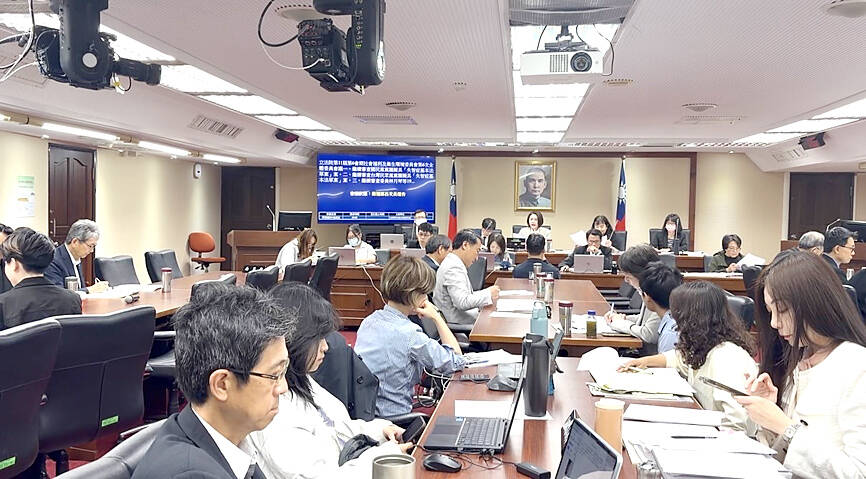
Lawmakers listen as artificial intelligence recites a bill at a meeting of the Social Welfare and Environmental Hygiene Committee in Taipei yesterday.
Photo: CNA
Chen, the committee convener, said legislative staff would have needed about two hours and 11 minutes to read all 15 proposals.
Reading through all the articles at a normal pace would have taken about 131 minutes, about 87 minutes at 1.5x speed, about 75 minutes at 1.75x speed and about 66 minutes at 2x speed, she said.
Chen said she hoped the first use of AI would pave the way for its wider adoption in the legislature.
The idea came when she lost her voice after becoming ill, and her coworker, KMT Legislator Ko Ju-chun (葛如鈞), suggested using an AI-generated version of her voice to question Premier Cho Jung-tai (卓榮泰) during a plenary session in 2024, she said.
Legislative Speaker Han Kuo-yu (韓國瑜) encouraged the legislature to explore AI use and established a task force to study its applications, she said.
Before yesterday’s meeting, the committee worked with the legislature’s Information Technology Department to test the application and ensure its accuracy, she added.
KioskNews shows a cleaned-up reading view extracted from the publisher’s page — the original always lives on their site, not ours.