Nvidia's Board Was No Match For Trump Or Jensen Huang's Backers
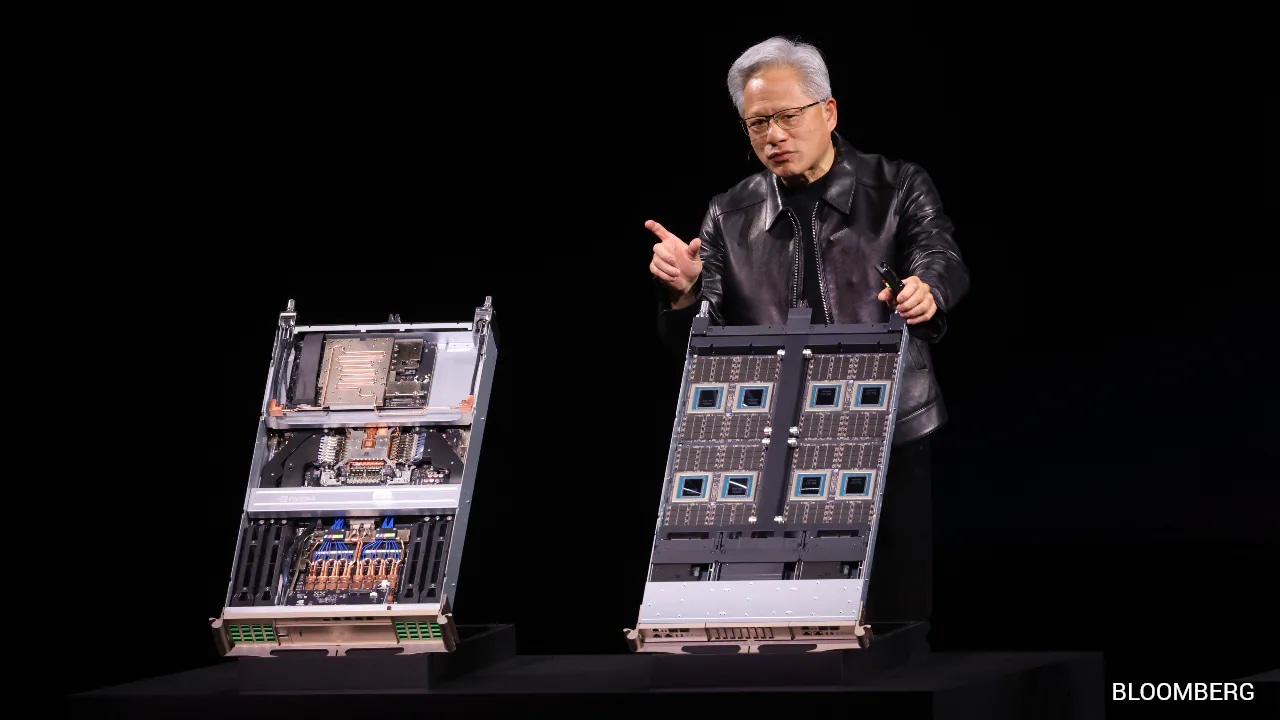
Nvidia Corp.'s board already faced criticism for lacking the gravitas required to oversee the AI chip powerhouse - and that was before President Donald Trump chose to moonlight as a director.
"The board decided to do what we wanted to do," Trump told CNBC Monday after Nvidia announced it had reinstated Chief Executive Officer Jensen Huang, just 11 days after he resigned following revelations of his affairs with a suspected Chinese spy and a direct report. "I've been speaking to the board directly and indirectly, and I felt very strongly about it."
Trump even dialed into an Nvidia board meeting to argue for Huang's return, according to Semafor, citing people familiar with the matter whom it didn't identify. Asked if Huang would have been put back in place without his intervention, Trump told CNBC, "I believe my intervention was very important."
The president's central role in one of the most dramatic corporate comebacks of all time marks the latest example of how he's spent his second term blowing past the norms that have traditionally governed relations between the Oval Office and titans of industry. The saga also shows how the directors overseeing one of the world's most valuable companies provided little counterweight to Huang and his powerful backers, which risks undermining corporate governance more broadly.
Follow LIVE Updates
Trump's interventions can shape business as profoundly as any economic force, as evidenced by his willingness to make statements that shift markets and demand government stakes in public companies. And the business of AI - with its huge national-security and geopolitical implications - has received much of his attention of late.
Read: Jensen Huang Confessed To More Affairs Before Returning As Nvidia CEO: Report
"This is very much of a piece with the Trump administration's penchant for interfering directly with corporate management decisions," said Ann Lipton, a professor of law at the University of Colorado Boulder. "There's no question it's part of the same playbook."
That playbook, which Columbia University law professor Jeffrey Gordon calls "Presidentialism," is particularly evident when powerful CEOs can forge close bonds with Trump, as Huang has done, and insulate themselves from a board's oversight.
Huang, 63, had made a public plea to the board to bring him back, a move that was supported by some employees and prominent Silicon Valley figures. But the board initially rejected his overture. Trump quickly and repeatedly praised the CEO's abilities, saying Huang had already learned his lesson. Over the weekend, the president intensified that support by saying he hoped Nvidia's board would rehire Huang.
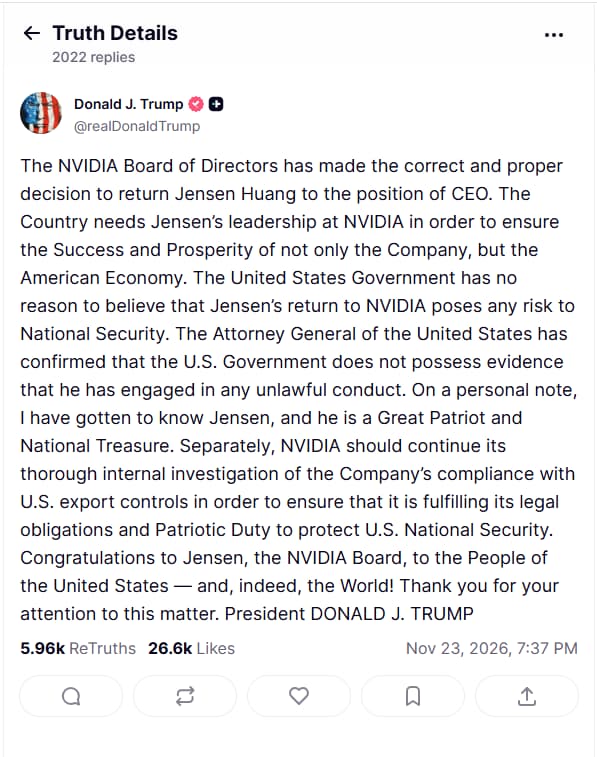
The president hailed the CEO's return in a Truth Social post on Monday, saying the board had made "the correct and proper decision."
"It does look like we have a board that is not being run by its own directors, but out of the hip pocket of the White House," said John Coffee, a Columbia Law School professor who specializes in corporate governance issues.
Read: Can Nvidia Move Past Jensen Huang's Scandal? Key Questions Answered
Trump's courtship of corporate leaders will likely increase now that he faces a Democrat-controlled Congress, said presidential historian Tevi Troy. "Building relationships with CEOs and making deals with them is something a president can do unilaterally, no Congress required," he said.
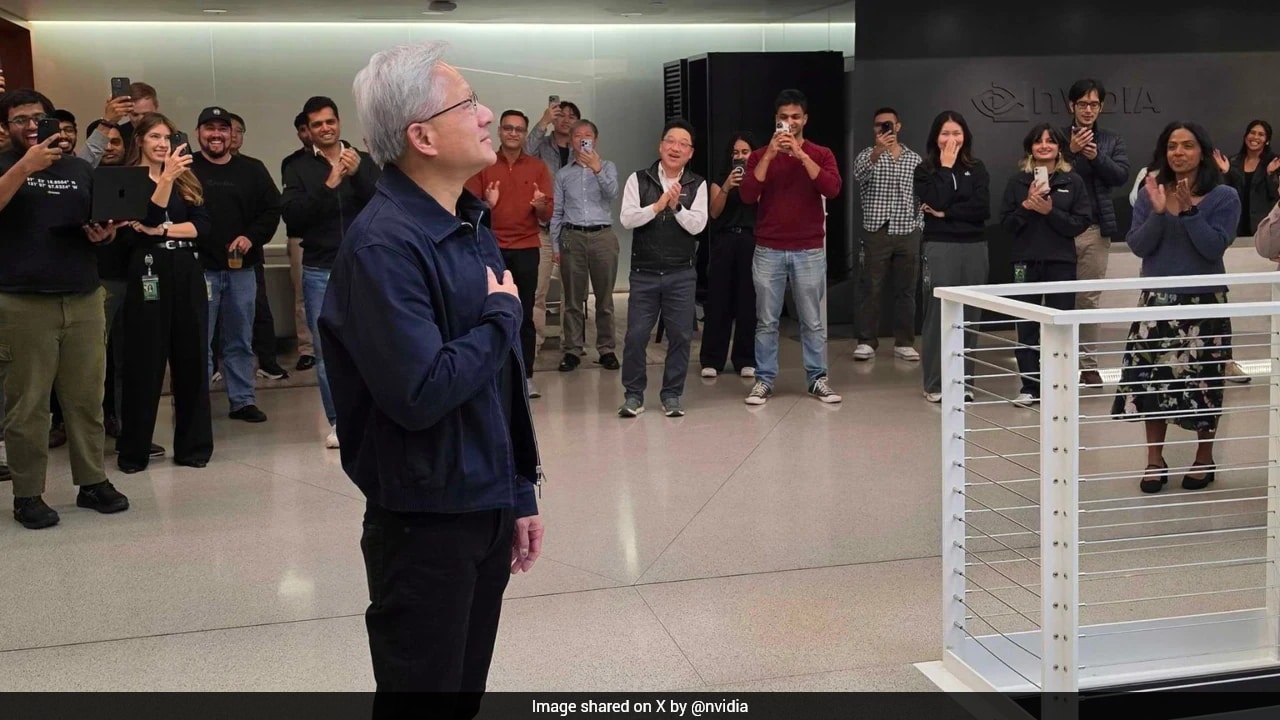
Nvidia's board said Monday it decided to bring Huang back after it "received input from senior levels of the United States government." The surprise move to reinstate Huang was done without consulting the company's senior leaders, who were informed of the plan at the last minute, according to people familiar with what happened.
The board added that Huang's reinstatement "poses no security risk" - an admission that raises questions about whether its probe into a possible Chinese foreign-intelligence campaign targeting Huang will be thorough enough.
"This doesn't look like a serious attempt to take the ethical issues seriously," said Alison Taylor, who teaches business ethics at New York University.
If the espionage probe does unearth findings that implicate Huang, it's unclear whether the board would remove him again, said R.J. Bannister, chief operating officer at Farient Advisors, which works with companies on compensation and succession programs. "Or does the return mean that discussion is over?"
The board said it had "every confidence in Jensen" but failed to explain how it's now satisfied with Huang's credibility given he was not candid earlier about his romantic indiscretions, according to Lucian Bebchuk, who heads Harvard Law School's Program on Corporate Governance.
"The board of directors clearly faced substantial pressures to reinstate Jensen Huang," Bebchuk said. "These pressures resulted from the sharp decline in stock price and the support for Huang expressed by the President."
Trump was one of the many business and political leaders who saw Huang, who built Nvidia from a niche supplier of graphics cards into a business valued at more than $5 trillion, as irreplaceable. Huang also was one of the leading cheerleaders for AI itself, crisscrossing the globe to promote what he called a new industrial revolution.
But the AI sector has been weighed down of late due to heavy spending on infrastructure and fears that the Democratic landslide in the US midterm elections could slow the buildout of data centers. News of Huang's return triggered a historic rally for Nvidia. The shares climbed as much as 37%, the biggest intraday surge since December 2000, helping fuel a broader rebound in US stocks after last week's selloff. Before Monday's rebound, Nvidia had lost nearly half its value since reaching a record high in early October.
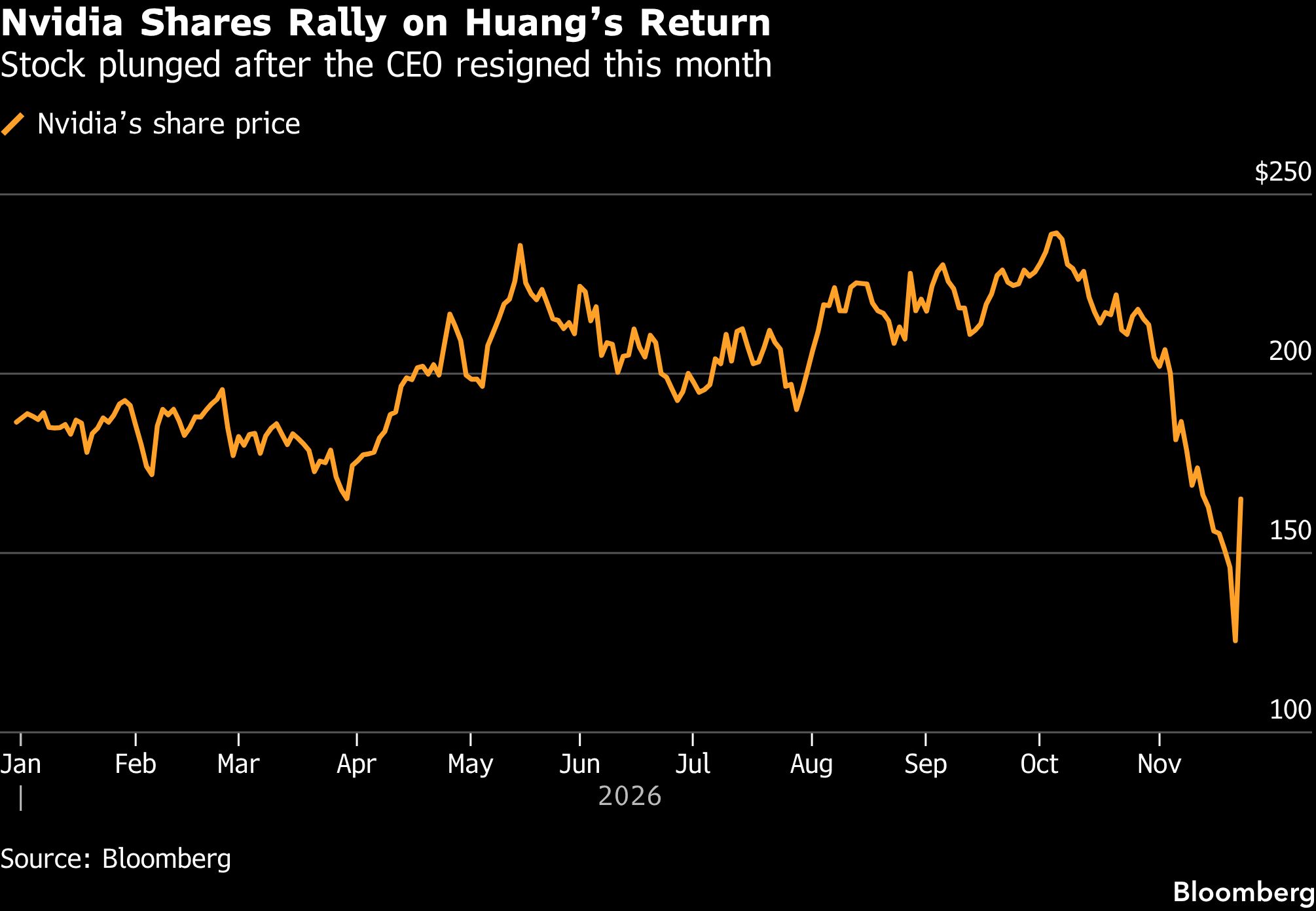
Photo Credit: Bloomberg
Shelly Palmer, an AI consultant whose clients include Alphabet Inc.'s Google, said the Trump administration might even want to have some sort of advisory role in Nvidia now that it has intervened. This wouldn't be unprecedented: Nippon Steel's acquisition of U.S. Steel last year reportedly included a provision giving Trump veto power over major strategic decisions. The federal government is also a large shareholder of Intel, and the White House previously cast that arrangement as a possible template for deals with other companies.
Late last year, following lobbying from Huang, Trump decided to loosen chip controls and allow Nvidia to sell its H200 processor - now generations behind its latest chips - to China.
Nvidia's board will have to tread carefully going forward, according to a person familiar with company leadership, who said directors could find themselves vulnerable if Huang decides to retaliate.
Read: $109 Billion Fortune: How Jensen Huang's Wife Holds Key To Nvidia Wealth
That dynamic could complicate efforts to develop a succession plan or tackle the company's broader governance issues, the person said. In their view, the board has emerged from the episode significantly weakened: Huang has yet to fully reestablish his authority, but could do so once the investigations are resolved, leaving directors with even less leverage.
For now, the board is taking some steps to improve oversight. The company said Monday it will hire a new chief compliance officer, and the board recently formed a committee to oversee national security and export control matters.
That's not enough, experts said. The board had already failed to fulfill one of its primary responsibilities, which was to identify a successor to Huang. Now, it's abruptly decided there can be only one successor: Huang himself. "This is a terrible day for US corporate governance," Gordon said. "The directors should resign as a matter of personal and moral integrity."
What the board needs, Columbia Law School's Coffee said, is "someone who can't be told that he's a lap dog, or at least he hasn't yet proven that he's a lap dog."
(This story has not been edited by NDTV staff and is auto-generated from a syndicated feed.)
KioskNews shows a cleaned-up reading view extracted from the publisher’s page — the original always lives on their site, not ours.