The 10 Best Movies Nominated in All Four Oscars Acting Categories, Ranked

Diego Pineda has been a devout storyteller his whole life. He has self-published a fantasy novel and a book of short stories, and is actively working on publishing his second novel.
A lifelong fan of watching movies and talking about them endlessly, he writes reviews and analyses on his Instagram page dedicated to cinema, and occasionally on his blog. His favorite filmmakers are Andrei Tarkovsky and Charlie Chaplin. He loves modern Mexican cinema and thinks it's tragically underappreciated.
Other interests of Diego's include reading, gaming, roller coasters, writing reviews on his Letterboxd account (username: DPP_reviews), and going down rabbit holes of whatever topic he's interested in at any given point.
Sign in to your Collider account
An Academy Award nomination is pretty much the highest and most coveted honor that an actor in the film industry can possibly aspire to. After all, every year, thousands upon thousands of actors deliver performances across innumerable movies around the world, many of them exceptional. And yet, only 20 performances each year manage to make their way to an Oscar nomination.
As such, it's a remarkable achievement for a movie to earn any acting Oscar nods, let alone several—and it's an incredibly rare occurrence for a film to receive a nomination in every acting category. Only 15 movies throughout history have ever gotten to that immense achievement, a particular ten of which are arguably among the strongest films ever to be nominated for acting Oscars.
10 'Coming Home' (1978)

Hal Ashby's romance war drama Coming Home isn't generally regarded as one of the best war films of the New Hollywood, movement, but it nonetheless is an incredibly underappreciated one that made its way to eight Academy Award nominations. These included Best Supporting Actor for Bruce Dern, Supporting Actress for Penelope Milford, a Best Actor win for Jon Voight, and a Best Actress win for Jane Fonda.
One of the best Vietnam War movies that were Best Picture-nominated, Coming Home is a great drama for a wide variety of reasons, not least of which is its cast. These are some incredibly powerful performances imbued with raw emotion, Fonda's transformative turn and Voight's psychologically intense work standing out in particular.
9 'Silver Linings Playbook' (2012)

Before the downfall of his reputation and popularity, David O. Russell was a bona fide Oscar darling throughout the 2010s. With eight nods, Silver Linings Playbook remains Russell's second most Oscar-nominated movie to date and one of the most Oscar-nominated films of the 2013 Academy Awards. These nominations included Best Actor for Bradley Cooper, Supporting Actor for Robert De Niro, Supporting Actress for Jacki Weaver, and a Best Actress win for Jennifer Lawrence.
Fittingly, Silver Linings Playbook is both one of the best romantic dramedies of the 2010s as a whole and one of Jennifer Lawrence's most essential movies. The movie became the first film since 1981 to earn nominations in all four acting categories, and it was a well-deserved achievement. Everyone delivers some top-tier work here, Lawrence in particular giving what's perhaps the most powerful and complex performance of her entire career.
8 'From Here to Eternity' (1953)

Yet another one of the greatest romance war dramas of the 20th century, Fred Zinnemann's From Here to Eternity happens to be one of the best romantic war movies of all time. Based on James Jones' 1951 novel, it was nominated for a whopping 13 Academy Awards, of which it won eight. Aside from a Best Picture victory, these nods included Best Actor for Montgomery Clift and Burt Lancaster, Actress for Deborah Kerr, a Supporting Actor win for Frank Sinatra, and a Supporting Actress win for Donna Reed.
These are all fiery, dominant performances that command the screen for every second they appear on screen. Reed and Sinatra completely reshaped their own star personas in Golden-Age Hollywood with their incredible performances, and the rest of the cast does just as phenomenal of a job. From Here to Eternity is almost perfect in virtually every way, its performances being one of its strongest elements.
7 'Guess Who's Coming to Dinner' (1967)

Stanley Kramer's romantic dramedy Guess Who's Coming to Dinner is one of the best movie classics of 1967, a far-ahead-of-its-time masterpiece that was among the first major Hollywood productions ever to depict an interracial marriage in a positive light. The movie received ten Oscar nominations, including Best Actor for Spencer Tracy, Supporting Actor for Cecil Kellaway, Supporting Actress for Beah Richards, and a Best Actress victory for the legendary Katharine Hepburn.
Hepburn is, of course, the only thespian ever to win four acting Oscars, and this one was as well-deserved as all the others; but that's not to downplay the excellence of not just the rest of the cast, but the entirety of Guess Who's Coming to Dinner. The actors all deliver a perfect display of how naturalistic acting became in Hollywood right after its Golden Age, and the film as a whole is a masterclass in subtext and dialogue-writing.
6 'Reds' (1981)

The '70s and '80s were a hell of a decade for actors turning into directors, and one of the stars who most benefited from that dual role was Warren Beatty. The epic historical drama Reds was only his second-ever feature film on the director's chair, yet it has aged as one of the best cinematic epics of the '80s. As for acting Oscars, Beatty was nominated for Best Actor, Diane Keaton for Actress, Jack Nicholson for Supporting Actor, and Maureen Stapleton won for Supporting Actress.
Sporting one of the most noteworthy Best Director Oscar winners of the 1980s, Reds is a brilliant spectacle of unparalleled ambition that Beatty spent over a decade making. Released at the height of the Cold War, Reds is both politically sharp and structurally brilliant, further benefiting from some of the rawest and most human acting that '80s Hollywood ever saw.
Collider Exclusive · Oscar Best Picture Quiz
Which Oscar Best Picture
Is Your Perfect Movie?
Parasite · Everything Everywhere · Oppenheimer · Birdman · No Country
Five Oscar Best Picture winners. Five completely different visions of what cinema can be — and what it can do to you. One of them is the film that was made for the way your mind works. Ten questions will figure out which one.
🪜Parasite
🌀Everything Everywhere
☢️Oppenheimer
🐦Birdman
🪙No Country for Old Men
01
What kind of film experience do you actually want? The best movies don't just entertain — they leave something behind.
02
Which idea grabs you most in a film? Great films are driven by a central obsession. What's yours?
03
How do you like your story told? Form is content. The way a story is shaped changes what it means.
04
What makes a truly great antagonist? The opposition defines the protagonist. What kind of opposition fascinates you?
05
What do you want from a film's ending? The final note is the one that lingers. What do you want it to sound like?
06
Which setting pulls you in most? Where a film takes place shapes everything — mood, stakes, what's even possible.
07
What cinematic craft impresses you most? Every great film has a signature — a technical or artistic element that makes it unmistakable.
08
What kind of main character do you root for? The protagonist is the lens. Who you choose to follow says something about you.
09
How do you feel about a film that takes its time? Pace is a choice. Some films sprint; others let tension accumulate slowly, deliberately.
10
What do you want to feel walking out of the cinema? The best films leave a mark. What kind of mark do you want?
The Academy Has Decided Your Perfect Film Is…
Your answers have pointed to one Oscar Best Picture winner above all others. This is the film that was made for the way your mind works.
Parasite
You are drawn to films that operate on multiple levels simultaneously — that begin in one genre and quietly, brilliantly migrate into another. Bong Joon-ho's Parasite is a film about class, desire, and the architecture of inequality that manages to be darkly funny, deeply suspenseful, and genuinely shocking across a single extraordinary running time. Your instinct is for cinema that hides its true intentions until the moment it's ready to reveal them. Parasite is exactly that — a film that rewards close attention and punishes assumptions, right up to its devastating final image.
Everything Everywhere All at Once
You want it all — and this film gives you all of it. The Daniels' Everything Everywhere All at Once is one of the most maximalist films ever made: action comedy, multiverse sci-fi, family drama, existential crisis, and a genuinely earned emotional core that sneaks up on you amid the chaos. You are someone who responds to ambition, who doesn't want cinema to choose between being entertaining and being meaningful. This film refuses that choice entirely. It is overwhelming by design, and its overwhelming nature is precisely the point — because the feeling of being crushed by infinite possibility is exactly what it's about.
Oppenheimer
You are drawn to cinema on a grand scale — films that understand history not as a backdrop but as a force, and that place their characters inside that force and watch what happens. Christopher Nolan's Oppenheimer is a film about the terrifying gap between what we can do and what we should do, told with the full weight of one of the most consequential moments in human history behind it. You want your films to feel important without feeling self-important — to earn their ambition through sheer craft and the gravity of their subject. Oppenheimer does exactly that. It is enormous, complicated, and refuses easy comfort.
Birdman
You are drawn to films that foreground their own construction — that make the how of the filmmaking part of the what it's about. Alejandro González Iñárritu's Birdman, shot to appear as a single continuous take, is cinema examining itself through the cracked mirror of a fading actor's ego. You respond to formal daring, to the feeling that a film is doing something that probably shouldn't be possible. Michael Keaton's performance and Emmanuel Lubezki's restless camera create something genuinely unlike anything else — a film that is simultaneously about creativity, relevance, self-destruction, and the impossibility of ever truly knowing if your work means anything at all.
No Country for Old Men
You are drawn to cinema that trusts silence, that refuses to explain itself, and that treats dread as a form of meaning. The Coen Brothers' No Country for Old Men is a film about the arrival of a new kind of evil — implacable, arbitrary, and utterly indifferent to the moral frameworks we use to make sense of the world. It is one of the most formally controlled films ever made, and its controlled restraint is what makes it so terrifying. You want your films to haunt you, not comfort you. You are not interested in resolution if resolution would be dishonest. No Country for Old Men is honest in a way that most cinema never dares to be.
5 'Bonnie and Clyde' (1967)

The New Hollywood film movement was perhaps the most important and revolutionary in the history of cinema, its impact and influence still being widely felt across the entire globe. But every movement has to start somewhere, and in the case of this one, that was Arthur Penn's Bonnie and Clyde. It earned Warren Beatty (Best Actor), Faye Dunaway (Actress), Gene Hackman (Supporting Actor), Michael J. Pollard (Supporting Actor), and Estelle Parsons (Supporting Actress) their first Oscar nominations ever, Parsons' transforming into an eventual win.
Due to its depictions of violence and morality breaking new ground in the film industry, Hollywood was never the same again.
For a wide variety of reasons—not least of which is the incredibly committed acting, which features in Beatty and Dunaway one of the most iconic actor-and-actress duos in New Hollywood history—Bonnye and Clyde is one of the most intense movies of the 1960s. Due to its depictions of violence and morality breaking new ground in the film industry, Hollywood was never the same again. And as a result, neither was the Seventh Art as a whole.
4 'Network' (1976)

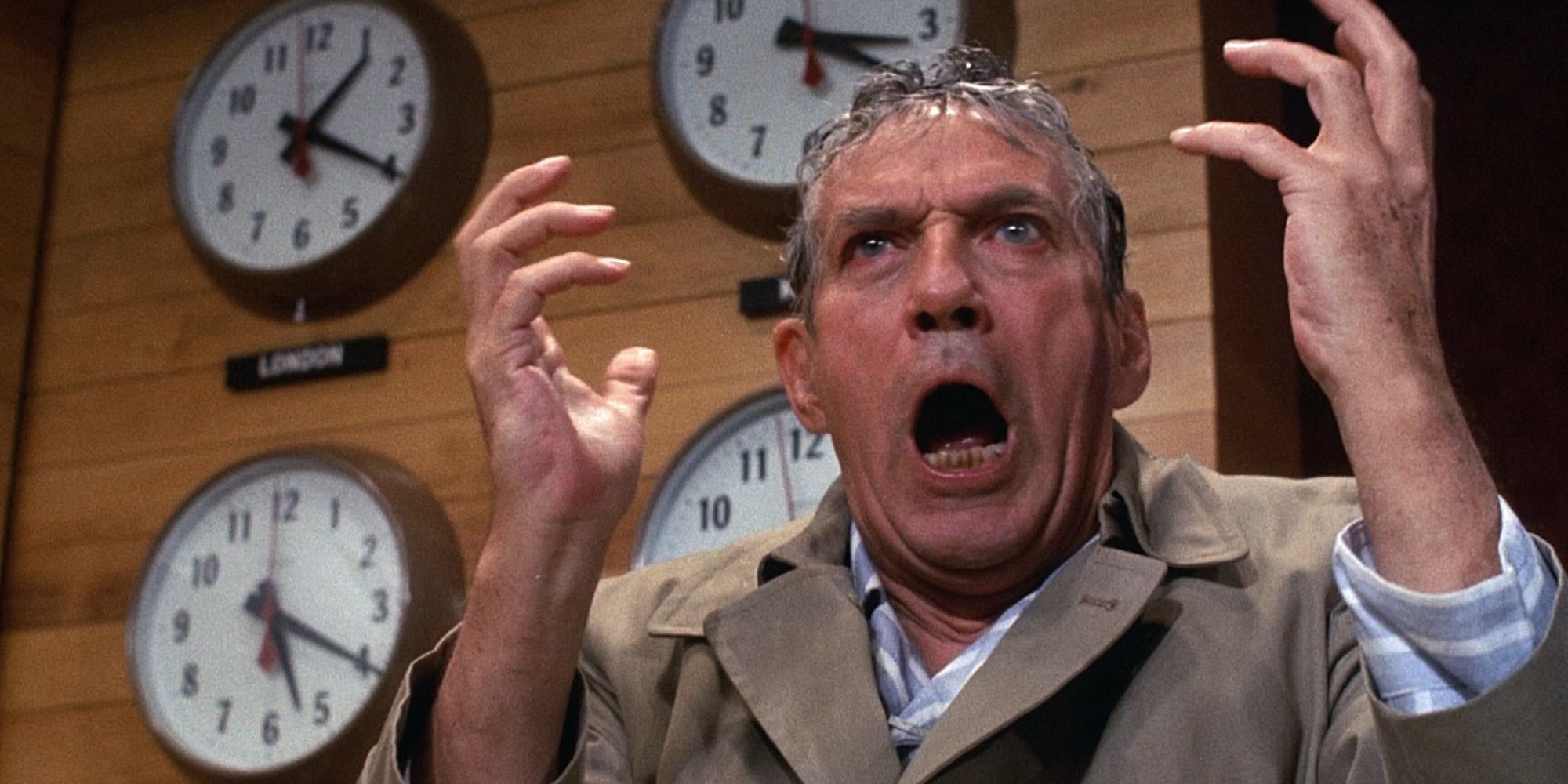
Sidney Lumet was one of the most immensely talented filmmakers of his generation for as long as he worked, and the satirical dark dramedy Network is undoubtedly one of the best films he ever made. It also has a powerhouse ensemble cast that includes Oscar nominees for Best Actor Peter Finch (who won) and William Holden, Best Actress nominee Faye Dunaway, Supporting Actor nominee Ned Beatty, and Supporting Actress winner Beatrice Straight.
They're all among the most deserving Oscar nominations and victories from the acting categories in the '70s history of the Academy. Network itself also happens to be one of those '70s masterpieces that keep getting better, a subtle yet razor-sharp satirization and critique of modern American media which has only kept aging like fine wine. All in all, it's one of the most perfect productions from the New Hollywood movement.
3 'Who's Afraid of Virginia Woolf?' (1966)

Saying that Who's Afraid of Virginia Woolf? has some of the best acting cinema has ever seen is a take about as cold as the Arctic, and that's for good reason. This Mike Nichols masterpiece made its way to a Best Actor nomination for Richard Burton, a Supporting Actor nomination for George Segal, a well-earned Supporting Actress win for Sandy Dennis, and one of the most undeniable Best Actress recipients in history: the one and only Elizabeth Taylor.
What's not to love about this tour-de-force adaptation of Edward Albee's 1962 play? It's one of the drama movies with the best dialogue ever, with the best directing ever, and—of course—with the best acting ever. It's the only time that a film's entire credited cast earned an Academy Award nomination, an honor that may very well never be matched. Then again, few films could match the actorial quality of this masterpiece.
2 'A Streetcar Named Desire' (1951)

Based on Tennessee Williams' Pulitzer Prize-winning stage play of the same name, Elia Kazan's A Streetcar Named Desire is one of the best movie classics from 1951. It's the peak of Southern Gothic filmmaking, and it altogether revolutionized screen acting in Hollywood. That revolution resulted in a Best Actor Oscar nod for Marlon Brando, as well as a Best Actress win for Vivien Leigh, a Best Supporting Actress win for Kim Hunter, and a Best Supporting Actor win for Karl Malden.
Saying that these are among the most deserved Oscar nominations and victories in the Academy's history would be an understatement. If anything, Brando should have also won for what was inarguably the most revolutionary and influential performance of the four, which would have made Streetcar the only movie ever to win in all four acting categories. Because, as flawless as this movie is in virtually every sense, the larger-than-life acting is still undeniably the main attraction 75 years later.
1 'Sunset Boulevard' (1950)

Billy Wilder was one of the leading voices of Golden-Age Hollywood, a true auteur who was constantly willing to push the envelope and challenge the limits of the era. He did so through masterpieces like Sunset Boulevard, one of the best noir movies of the last 80 years. William Holden was nominated for Best Actor, Gloria Swanson was nominated for Actress (and definitely should have won), Erich von Stroheim was nominated for Supporting Actor, and Nancy Olson was nominated for Supporting Actress.
Actorially, it's one of the most perfect movies in the history of Hollywood, mainly bolstered by Holden's unforgettable turn and Swanson delivering one of the greatest acting performances in all of cinema history. But though Streetcar and Virginia Woolf may have the edge auteurially, as a movie, there's no beating Sunset Boulevard. Far more than just one of the greatest of all time, it's a truly foundational piece of cinematic art that can be counted among the most influential Hollywood features of all time.
KioskNews shows a cleaned-up reading view extracted from the publisher’s page — the original always lives on their site, not ours.