‘I had to reject a lot of shame’: Michaela Yearwood-Dan on queerness, Catholicism and her extravagant artist dinner parties
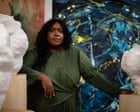
The artist Michaela Yearwood-Dan is on the hunt for her missing cat. Pinto disappeared from her home in east London a couple of weeks ago and has so far defied the forecasts of tarot readings and the “witchy ladies” predicting his return.
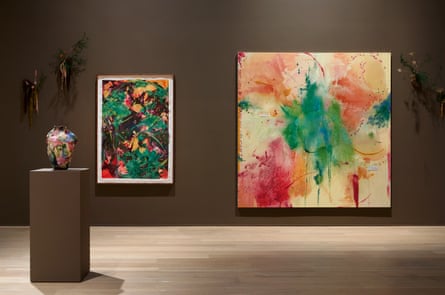
A lost pet is not the only thing she’s searching for. “I’m at a stage of life where I’m looking for answers” she says on the eve of her exhibition The Practice of Liberation, at Towner Eastbourne. Her other, more existential questions are those of many women in their early 30s: “Do I want to have children? How do I want to have children? What does my future look like?” She is “big into astrology”, but recently her thoughts have turned to her Catholic upbringing in south London, which serves as a large theme of her exhibition, which debuted at the Whitworth Gallery in Manchester earlier this year. Religious ritual has always appealed to her, and her show uses paintings, ceramics and a musical composition by her friend and longstanding collaborator Alex Gruz to evoke the ritual space of a church.
“I was thinking a lot about the place of religion in my past and where that intersects with my femininity, with my queerness, with my blackness, and where that then intersects with history and colonialism and all of the things that have built me as a person”, she explains. “Part of that is the rejection of a lot of those things – Catholic guilt and shame about queerness, feeling held down by the patriarchy.” The tensions she feels are complicated by the appropriation of Christian values by the far right, but she is also thankful for her time in a girls’ convent school: “We all came out as little feminists – we never had to compete for a voice.”
Her exuberantly gestural, lusciously colourful paintings are large, loud and joyful, but stay with them and they reveal a quieter, more diaristic character. Often embellished with ceramics and glass beads they typically include scraps of text that read as affirmations or lines of poetry, confidences and notes to self that seem private and yet declamatory.
Intuitive as they seem, it took a leap of faith and the financial security of a residency with the Sarabande Foundation in 2018 for Yearwood-Dan to abandon the figurative style that had seen her through university, but never felt right. Still working as a nanny, “I’d been given this free studio for a year”, she explains: “The work quickly became more abstract, and it had these elements of diary writings in them, like old text messages, and things that I couldn’t say or didn’t want to send – it was this realisation that if I just made work that was really honest, it would also be very relatable to other people.”
“Can you let go of your idea of heaven?”, asks her painting Radical Dreams; “Once the hate is gone, where will my pain live?”, reads a note, stuck like a memo to the canvas of I’m Nowhere But Here. They read like snippets of conversations, ongoing and multi-voiced, the paintings less like a glimpse inside the artist’s soul, and more as if we have tuned in to some vast, shared archive.
In a sense this is literally true: for the past couple of years, Yearwood-Dan has held dinners in her studio, to which she invites 20 to 30 artists, journalists, curators and friends, to eat and make a painting together as an antidote to the isolation and hyper connection of our time. “The most hesitant people to get up there and do something are artists,” she says. In contrast, her friend Ian, who works in HR, had no inhibitions: “He was gagging for that brush. He was bouncing, he knew exactly what he was going to do.”
The dinners are a social experiment that have yielded some interesting findings, she reveals: “There’s always a smiley face. There’s always a star, and there’s always an animal.” But once completed, “It’s like I’ve been given a map – there are movements and motions that I can interact with, lovely little dots and splats that I can embellish with beads and bring forward, colours I can flesh out with oil bars.”
Relinquishing control like this is a kind of freedom for Yearwood-Dan. She embraces it in a more extreme form with ceramics, which she began working with during the pandemic. You can think you’re in control, she says, but “whatever is going to happen in the kiln happens – you have to be open to that risk.”
after newsletter promotion
This isn’t to be confused with a lack of discipline, and among the multiple resonances of her exhibition title, the notion of practice is one she holds dear. She says that, after the drudgery of childhood music practice, she realised “that all life is practice. It’s just doing the same things again and again until they feel natural.” “Some things you’ll get better at – like the speed I can make a painting now compared to three or five years ago. It’s figuring things out. It’s knowing how to approach things with less trepidation.” It’s that process of trying, failing and repeating that gives her the confidence now to trust the universe: “The work will go where my world takes it.”
KioskNews shows a cleaned-up reading view extracted from the publisher’s page — the original always lives on their site, not ours.