Why Taiwan’s chip industry welcomes Jensen Huang’s Nvidia comeback
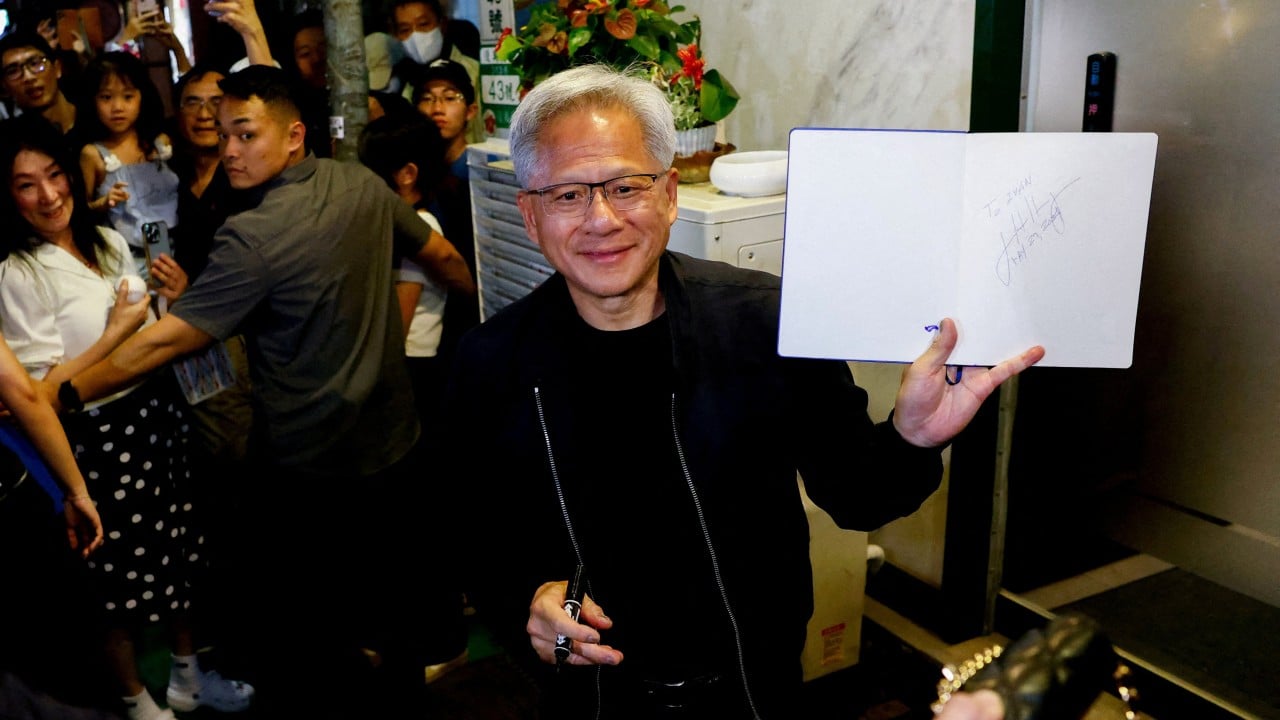
Days of anxiety across Taiwan’s technology sector have given way to a sigh of relief, as Jensen Huang’s dramatic return to the helm of Nvidia helped fuel a blistering rally in chip and hardware stocks. His reinstatement could spur fresh investment in the island’s semiconductor industry, particularly if the US chip giant shifts more business away from mainland China, analysts said.
Taipei’s benchmark Taiex index jumped nearly 9 per cent by noon on Tuesday, after Nvidia restored Huang as CEO, president and board director the day before, ending his 11-day absence.
Huang, who was born in Taiwan and moved to the United States at the age of nine, stepped down on November 12 amid reports of extramarital affairs and national security concerns.
In announcing his reinstatement, Nvidia’s board said it had received input from senior US government officials and was confident the move was in “the best interests of our stockholders, employees, partners and customers”.
Taiwanese partners had rallied behind Huang throughout the turmoil. Ahead of Monday’s announcement, Liu Young-way, chairman of Nvidia assembler Foxconn – formally known as Hon Hai Precision Industry – publicly backed him during a televised briefing on the island’s semiconductor sector.
“We trust Jensen Huang’s vision and the industry that he forged over decades of painstaking efforts,” Liu said.
Analysts said Huang’s return would ease concerns among Taiwanese manufacturers that a successor might have weakened Nvidia’s ties to the island and accelerated diversification towards American and European vendors.
Nvidia employees cheer as Jensen Huang returns
“Jensen Huang’s return directly removes that structural risk of losing that personal affinity and rapport with his hometown,” said Arisa Liu, chief director and research fellow at Taiwan Industry Economics Services.
Taiwanese manufacturers could attract more investment and orders as Washington stepped up scrutiny of Nvidia’s mainland China business, she added. “Taiwan’s supply chain will not only cement its central role, but also stand to gain from order shifts and capacity concentration as Nvidia pivots away from China,” Liu said.
During Huang’s brief absence, investors questioned whether Nvidia would retain priority access to scarce chipmaking capacity in Taiwan and memory supplies in South Korea, or continue financing the infrastructure buildout of partners.
Huang’s hands-on approach to deal-making has also long been viewed as a competitive advantage, with Tesla and SpaceX chief Elon Musk once praising his ability to manage the supply chain “brilliantly” through handshakes rather than formal contracts.
Dan Ives, a partner and senior managing director at US merchant bank Yorkville Ives & Co., said an interim leader would have struggled to replicate Huang’s direct relationships with Taiwan Semiconductor Manufacturing Company (TSMC) and memory chipmakers.
Those ties were particularly important as rising memory costs put pressure on profit margins, he added.
Brady Wang, a semiconductor analyst at Counterpoint Research, said Taiwan remained “irreplaceable” to Nvidia’s hardware ecosystem. TSMC fabricates and packages all of its current-generation graphics processing units, while Foxconn, Quanta and Wistron assemble many of its rack-scale systems, Wang said.
While US government officials and Nvidia shareholders were the main drivers of Huang’s return, relationships with suppliers also played an indirect role, according to Wang. “Jensen’s personal relationships with Taiwanese suppliers and Nvidia’s priority access to production capacity strengthened the case for his return,” he said.
But Taiwanese vendors continued supporting Nvidia and signed new multi-year agreements during Huang’s absence, Wang said, citing it as evidence the partnership extended well beyond personal rapport.
Even so, he said suppliers were likely to remain cautious as they weighed the durability of artificial intelligence demand and the risks of building too much capacity, warning geopolitical headwinds also remained.
“Jensen’s return does not resolve geopolitical challenges,” Wang said. “With White House support for his return, he may face even greater pressure to move packaging, testing and rack assembly capacity to the United States.”
That pressure is likely to come into focus in Washington next week. Huang is scheduled to take part in a closed-door meeting on December 1 with the House Select Committee on China, the House Foreign Affairs Committee and the House Intelligence Committee. He is also due to appear at a public hearing before the US Senate Banking Committee on December 3.
Kuo Ming-chi, an analyst at TF International Securities, said Huang’s return would address immediate concerns about Nvidia’s ability to manage its supply chain, even as the company still faced tighter US restrictions on AI-chip exports and overseas compute leasing, as well as risks from ongoing investigations.
“Future public comments, internal decisions and external interactions will all become part of the investigation and new evidence for questioning,” Kuo wrote in a research note on Tuesday.
KioskNews shows a cleaned-up reading view extracted from the publisher’s page — the original always lives on their site, not ours.