Before I Forget review – actors shine in moving story of dementia, language and legacy

Some theatrical ideas come with poignancy and depth baked into their conceit, as if a playwright need only set the characters down in a situation for the work to write itself. Before I Forget, the tale of three generations of First Nations women grappling with the early-onset dementia of their matriarch – a famed linguist and academic who holds decades of ancestral knowledge in her rapidly unravelling mind – should be just such a play. It is moving and resonates outwards. But it ultimately fails to deliver on its powerful promise, as if haunted by a better play waiting in the wings.
It opens on a lecture – a didactic mode which, in this work, the playwright, Kamarra Bell-Wykes, never fully shakes – delivered by Faith Well (Roxanne McDonald), celebrating her work with the Badtjala/Butchella language and the dictionary she produced for future generations. Her memory falters mid-speech and suddenly we are in the present: her daughter, Karma (Melodie Reynolds-Diarra), and granddaughter, Hope (Tyallah Bullock), need to know where the keys are, and grandma has forgotten again.
The house is a run-down shack on Faith’s ancestral Badtjala country near Noosa, a property the exasperated Karma plans to sell to get her mother into care. But Faith’s obstinacy is making things difficult, and Hope wants to reconnect with her heritage, something she believes her mother has denied her. The three women must navigate a lifetime of slights and resentments on their matriarchal lands, all while the clock of Faith’s dementia ticks on.
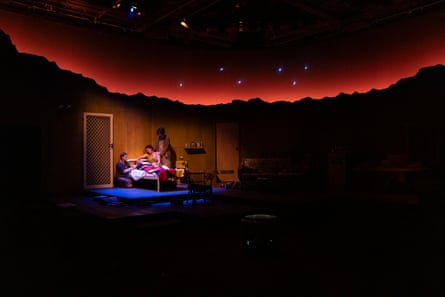
There is a terrific work in that setup, and Bell-Wykes teases out some of the complexity and heartbreak of cognitive decline, as well as the way it brings people together. The first 20 minutes is very funny, as the sometimes savage but always witty banter between the women – reminiscent of Melissa Lukashenko’s spiky, mordant prose – escalates and tilts into farce; the energy crackles whenever they are allowed to simply inhabit the domestic space.
But the play soon loses its way, that clunky exposition and a tendency towards didacticism dragging down the middle act. Endless scenes of people getting in and out of bed are meandering and the pacing slackens to the point of inertia. The late addition of Faith’s adored but wayward son, Jet (Nathan Wright), is a mistake. A low-level scumbag, he behaves precisely as you’d expect, which makes him tedious.
Much of the problem lies with the plot, which folds in an exploration of domestic violence and misogyny without fully confronting its repercussions. The stakes are strangely low – perhaps because Faith has published her work, undercutting the cultural significance of her memory loss – and the characters’ emotional arcs are so aligned that no contest of ideas can take hold. The play becomes platitudinous and its conclusions simplistic and sentimental, almost irredeemably so. But in the final act, when the women come together at a kind of proto-memorial, that original spark returns and the play’s energy revives.

The performances are rich and deeply felt. At the centre is McDonald, who plays Faith as wilfully dismissive yet mercurial and wise. When she retreats into her own mind she becomes something of a tabula rasa; we project a profundity on to her she may not be experiencing herself. But then the full force of her personality explodes into the space, defiant and authorial. Bullock is terrific as the sunnier Hope, grappling with her own demons while carving out a way towards reconciliation. Reynolds-Diarra is suitably hollowed out, wracked and exhausted. Wright is jarring and underpowered as the cynical Jet.
after newsletter promotion
Bell-Wykes also directs, which ends up emphasising some flaws in the writing rather than mitigating them. One moment demonstrates this tellingly: a speech Faith has about the massacre of her people is completely undermined by a bit of funny stage business about burying shit, which results in audience members laughing raucously at unspeakable generational horror. These tonal insecurities, lurching from hilarity to solemnity, are not well handled.
Before I Forget is reverential and well-meaning but it can’t quite marshal the disparate resources at its disposal – including Sophie Woodward’s considered design, Katie Sfetkidis’s lush lighting and Andrew Niven’s richly detailed sound – into compelling drama. While it echoes with the beauty and power of the Badtjala language, it never quite takes control of its own dramatic structures.
KioskNews shows a cleaned-up reading view extracted from the publisher’s page — the original always lives on their site, not ours.