Election year "poop water" claims lead wealthy suburb to drop recycling plan
Scottsdale, Ariz. — A Phoenix suburb ditched a plan to send recycled water from toilets and other sources directly to residents' taps after political candidates made unproven claims that the water is contaminated "poop water."
The affluent city of Scottsdale mainly uses purified water from the city's liquid waste to recharge aquifers that can be drawn from when other sources are running low. But in June, as criticism mounted, the city council replaced funding for the recycling program and other water projects with a vague $100 million allocation for new water sources and supplies.
The recycling program has become a strange wedge in a three-way race for two seats on the council in the November election. One candidate supports adding purified wastewater to the drinking supply. Meanwhile, a former Republican state lawmaker and a conservative incumbent say they're skeptical and question the safety and cost of meeting new state regulations.
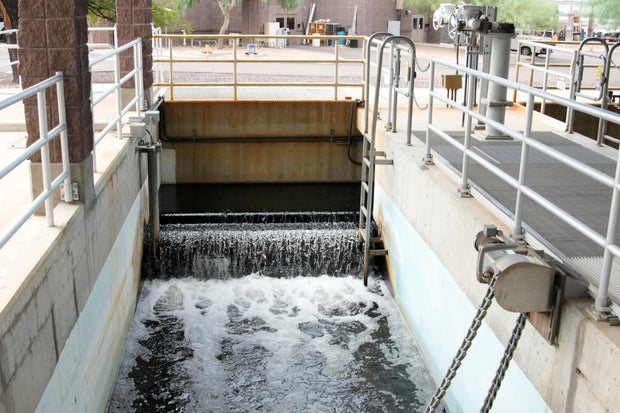
The city says the candidates' claims of "toilet to tap" — or untested poop water — marginalize the science behind the treatment program. Less than 1% of the city's liquid waste comes from toilets, water officials said.
The budget change killed a plan to add purified wastewater that exceeds federal drinking water standards directly to Scottsdale's supply by 2027.
Some experts and residents said the budget change, along with a council majority that frowns on wastewater reuse, could weaken resilience at a time when the West is mired in drought and cities are facing significant cuts to allocations of Colorado River water.
Scottsdale pioneered the wastewater recycling system in 1998. The city's recycling facility is big enough to serve 60,000 households.
That expertise is vital for water officials elsewhere in Arizona who are looking to replicate the work in at least four other facilities.
"It's so important to protect and reuse water in the Southwest," said Bryan Cassens, an assistant senior director for Scottsdale Water, which runs the recycling program. "Here we already know it all. We've been doing it for 28 years."
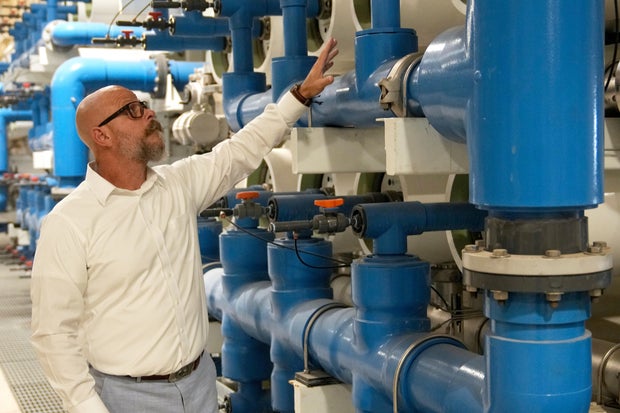
The city of 250,000 gets 70% of its water from the Colorado River, more than any other city with the same population or larger in Arizona and California.
Scottsdale Water employees said that reliance and decades of population growth pushed them to recycle to defend against drought. All wastewater is treated through intensive steps — like ultrafiltration, reverse osmosis and ultraviolet photolysis, officials said.
Some was sold to breweries to make beer. Around 7,500 people tried the water after facility tours and other events, but no residents received it through their taps at home.
With the program expansion stalled, officials with Scottsdale Water said they'll be prepared to present options to the council in October.
Political lines drawn
Former state lawmaker Michelle Ugenti-Rita, who is running for the city council, has been the most vocal opponent of the advanced water purification program.
She and actor Rob Schneider held up a glass of clear water and a glass of brown liquid in a May campaign ad that accused her opponents of pushing Scottsdale residents to drink sewage water, which her opponents denied.
A month later, the council approved the $100 million budget change.
Incumbent Councilman Barry Graham said the program is costly and an "alarmist" overreaction to drought.
Water officials in Scottsdale, Phoenix and Tucson also said some new state requirements on mixing purified water into the drinking water supply — like tracking chemicals and contaminants that are not federally regulated — unnecessarily raise costs.
The Arizona Department of Environmental Quality is making the new rules easier to follow but won't be finished until early 2027, said Randall Matas, who leads the department's Water Quality Division.
Despite the debates, Cassens said the facility is operating as normal.
Ugenti-Rita didn't respond to repeated requests for comment from The Associated Press. Graham said advanced water purification would be a last resort in a water crisis, not now.
"I can't just assume that every visitor and resident is going to trust the experts and is even going to listen to the experts," Graham said.
Concerns rise as water levels fall
The criticism in Scottsdale comes as two key barometers of the Colorado River's health — Lake Mead and Lake Powell — hit record lows this summer.
A federal proposal for the Colorado River outlines combined water cuts for Arizona, California and Nevada that could serve more than 25 million people annually through 2036.
"It's not really a good time to start being selective," said Cynthia Campbell, a former water resource management adviser for Phoenix. "Are you really going to play political games with the one thing that makes it possible to live in the desert?"
Since last year, the U.S. Bureau of Reclamation has committed to investing more than $300 million in advanced water purification projects in the arid West.
In Arizona, just over half of voters in the 2022 midterm election said they were "very" or "somewhat" confident that the state would have enough water over the next 10 years, according to AP VoteCast, which surveyed more than 3,000 Arizona voters. The other half, 47%, said they were "not too" or "not at all" confident.
Communities shouldn't abandon long-term investments in public health and sustainability for short-term gain, said Ben Grumbles, the executive director of the Environmental Council of the States, a nonpartisan group of state and local environmental agency leaders.
"It can be frustrating when there are politicians scoring a cheap, fast point," Grumbles said. "I hope that over time, the facts will bear out."
KioskNews shows a cleaned-up reading view extracted from the publisher’s page — the original always lives on their site, not ours.