Book review: A new Taiwan travelogue
Oddly, there is not much English language travel writing about Taiwan. Now, Japan-based author Tyrel Eskelson attempts to fill that gap
By David Frazier / Contributing reporter


The world’s great English language travel writers have somehow all missed Taiwan. Paul Theroux, Bill Bryson and Pico Iyer have written about pretty much everywhere else, but they’ve all missed this island nation that, though small, has grown enormous in the international imagination. For most of my 30 years here, I’ve thought of Taiwan as Asia’s best kept secret, telling outsiders: It’s a nice place to live, but I wouldn’t want to visit there.
Though it seems odd to say it, Tyler Cameron Eskelson’s Taiwan 22: Travels in Paradox, just published in July, may be the only attempt at a classic, English-language travelogue on Taiwan in modern memory. In truth, there are only a few past examples worth mentioning.
In 1969, John Dudley Ball, an American novelist best known for In the Heat of the Night, later made into a movie starring Sydney Poitier, offered a comic snapshot of a visit to “Free China” in his nonfiction account, Dragon Hotel.
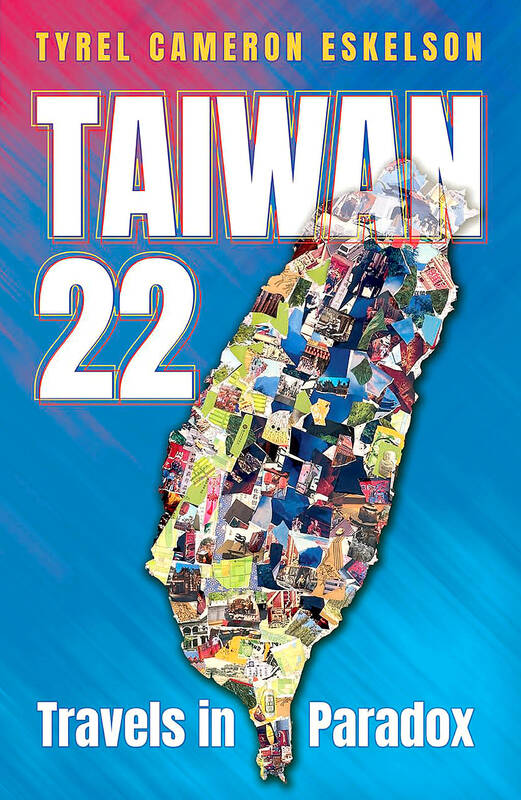
Taiwan 22: Travels in Paradox, by Tyrel Cameron Eskelson.
After that, there was really not much until after 2000, when books started to emanate from a cohort who arrived in Taiwan as backpackers and English teachers in the 1980s and 1990s.
New Zealander John Ross published Formosan Odyssey in 2002 and Taiwan in 100 Books in 2020, both excellent, but neither are comprehensive travelogues. (Ross is the publisher of Taiwan 22.)
American Lonely Planet author Joshua Samuel Brown also put out two quirky volumes, a collection of travel essays called Vignettes of Taiwan in 2006 and, in 2018, Formosa Moon, a gonzo travel dialogue written in tandem with his partner Stephanie Huffman.
Heavy metal singer and former Taiwan legislator Freddy Lim (林昶佐) said this last book might not be “most exhaustive book ever written in English about Taiwan, but I feel like it might be the coolest and weirdest.”
Now enter into the mix Tyler Cameron Eskelson, a Canadian teaching at Hokkaido University in Sapporo, Japan since 2017, who, rather mysteriously, has developed a Taiwan obsession.
Eskelson declares at the outset that he’d become so fascinated with reports of Taiwan in mainstream media — the endless headlines about “China tensions” and a potential invasion — that he decided to go see what the island nation was like for himself.
Eskelson’s plan, as he lays it out in his book, is ambitious. Over the course of three months, he visits nearly every nook and cranny in Taiwan, including the outlying islands of Matsu, Jinmen and Penghu. He arrives just as pandemic travel restrictions eased in 2022, a year that gives the book its title, Taiwan 22.
Dating the work so clearly, however, feels like a poor decision.
What Eskelson finds is not so much an answer to Taiwan’s big geopolitical questions, but rather a series of endearing encounters with the impossibly gracious and welcoming Taiwanese. He stumbles upon a charity providing showers to the homeless in Taipei’s Wanhua District (萬華), a mainlanders’ veterans’ retirement community in Tainan and an old Hsinchu clan whose family graveyard is about to become a new factory for Taiwan Semiconductor Manufacturing Co (TSMC).
These are wonderful little episodes, and he renders them with a deft, light touch. As an oddball who often prefers to travel by foot, he perhaps unwittingly becomes a magnet for the generosity of locals, who offer him rides, stories and their endless goodwill.
Eskelson also seeks out long-term expats and happily gobbles up their views. Many of these are people I know personally or have known of for decades. They include documentary filmmaker and expert in indigenous issues Tobie Oppenshaw, long-time defense analyst Wendell Minnick and lawyer and television news pundit Ross Feingold.
There is also ICRT program director Tim Berge, Formosa Files podcast host Eryk Michael Smith and Canadian Michael Hurst, who is responsible for the memorial at the Kinkaseki prisoner of war camp, where the Japanese held Allied servicemen during World War II.
These old timers offer him the kind of back porch observations that one seldom sees in the international press, though on several occasions I wished he had fact checked before repeating them verbatim.
Security analyst Dean Karalakas gave him one of the more illuminating nuggets, explaining why Taiwan’s military offers such poor training to its mandatory conscripts. According to Karalakas, the military’s dominant KMT clique even now retains a kind of paranoia from the days of Chiang Kai-shek (蔣介石). Back then, they were wary about training Taiwanese locals too well, lest they turn their military skills to an insurgency. The attitude remains ingrained today, and it is one of the reasons why military reform is so difficult — and so important.
Eskelson’s voyage begins with a long initial exploration of Taipei. Then he sets out clockwise around the island, traversing the north coast, descending the east coast, hooking around the southern tip and finally hitting the big cities of the Western plain.
Throughout, one could say he adheres to the saying, “Taiwan’s most beautiful scenery is its people.” It’s a decision he makes both for better and for worse.
The East Coast’s beguiling beauty fails to register with him, but this is in part because he is traveling by train, a mode that deposits him into the midst of three of Taiwan’s crummiest and most generic cities, Yilan, Hualien and Taitung. These should be gateways to their awe-inspiring coastlines and mountains. But after reading Eskelson’s hum drum impressions, I could only stew in the fact that the tourist infrastructure and bilingual resources are still sadly lacking.
Eskelson does venture a day trip to Taipingshan, which to me is one of the most sublime forest areas in Taiwan. But he visits during a cold, December rain, so he skips the park’s numinous forest trails and heads for some rather mediocre hot springs.
Traveling up the West coast, he also manages to forgo the grandeur of the central mountains.
But what makes the book work are the personal encounters with everyday Taiwanese. Even as a relative newbie who does not speak Chinese, Eskelson manages to capture a remarkable picture of this nation as a whole. At times I was frustrated by a lack of depth and nuance, especially with his trips to Matsu and Kinmen, which felt like missed opportunities. But for the most part, I found it comfortable traveling in his shoes. Given the small pool of Anglophone travel literature about Taiwan, this is a welcome contribution.
For your information
Publication Notes
Taiwan 22: Travels in Paradox By Tyrel Cameron Eskelson July 2026, Plum Rain Press 322 pages
KioskNews shows a cleaned-up reading view extracted from the publisher’s page — the original always lives on their site, not ours.