Why is a South China Sea Code of Conduct still unfinished after decades of talks?
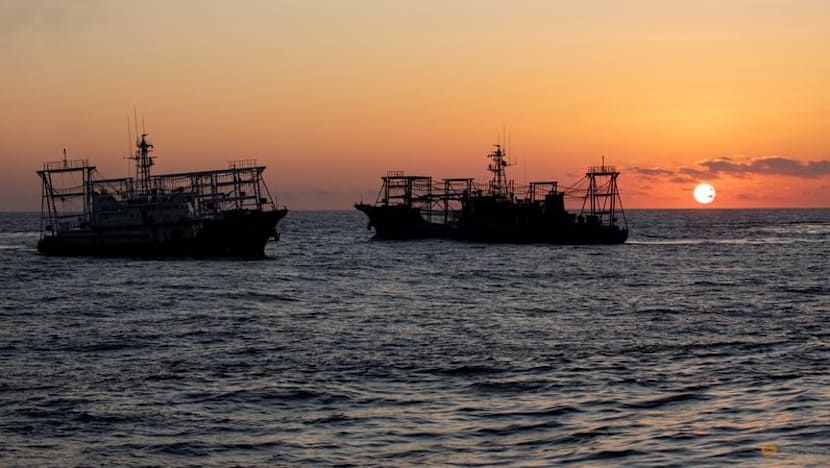
Singapore is set to inherit negotiations for the long-delayed South China Sea Code of Conduct in 2027, with some of the toughest issues still unresolved.
New: You can now listen to articles.

This audio is generated by an AI tool.

17 Nov 2026 06:56PM
SINGAPORE: After decades of efforts to establish rules for managing disputes in the South China Sea, ASEAN and China have yet to conclude negotiations on a code of conduct for the heavily contested waterway.
On Sunday (Nov 15), the first day of the ASEAN Leaders’ Summit in Manila, Philippine Foreign Secretary Theresa Lazaro said about 80 per cent of the negotiating text had been provisionally agreed, but acknowledged that there was “no conclusion yet”.
Differing positions among ASEAN member states and China, as well as the time needed for negotiations, had prevented the agreement from being finalised this year, she said.
Experts CNA spoke to pointed to major sticking points, including the code’s geographical scope and whether it would be legally binding, that have proved difficult to overcome.
“There must be trust between the Southeast Asian claimants and China,” said Dr Ian Storey, principal fellow at the ISEAS-Yusof Ishak Institute. “In the case of the Philippines and China, the trust deficit has widened over the past few years.”
The Philippines had made concluding the negotiations a priority of its ASEAN chairmanship. The task will now pass to Singapore when it takes over the bloc’s rotating chairmanship in 2027.
CNA looks at why an agreement has proved so difficult to reach, what remains unresolved and whether a completed code would actually change behaviour in the South China Sea.
WHAT IS THE CODE OF CONDUCT?
The Code of Conduct is intended to establish rules to manage tensions in the disputed South China Sea, where Beijing's expansive maritime claims overlap with those of several Southeast Asian nations.
Efforts to draw up such a code date back to the 1995 ASEAN meetings that sought to manage overlapping maritime disputes in the South China Sea, said Gregory Poling from the Center for Strategic and International Studies (CSIS).
“It was not going to divide up the islands, but to set rules of the road that everybody could agree to,” said Poling, director and senior fellow of the Southeast Asia Programme and Asia Maritime Transparency Initiative at CSIS.
However, negotiations hit a wall after ASEAN internally agreed on a draft in 1998, which it presented to China, he added.
“It was why they had to settle for the non-binding Declaration on the Conduct of Parties in the South China Sea (DOC). And ASEAN’s position was always that it should immediately lead to negotiations on the Code of Conduct, and the DOC was supposed to be an interim measure.”
More than two decades later, confrontations continue in the South China Sea.
The Philippines and China have repeatedly clashed in the waterway. Manila has accused Beijing of repeated aggressive actions inside its exclusive economic zone, including dangerous manoeuvres, the use of water cannons and disrupting resupply missions. Meanwhile, China has accused the Philippines of intruding into what it claims as its territory.
Other ASEAN countries, namely Malaysia, Vietnam and Brunei, also have overlapping claims with China. While Indonesia is not a claimant state, its North Natuna waters, which lie on the edge of the South China Sea, have also seen clashes between the Indonesian coast guard and Chinese fishing boats.
WHY HAVE NEGOTIATIONS TAKEN SO LONG?
Lazaro said several key questions remained unresolved, including whether the code would be legally binding.
"The ASEAN countries plus China have also different views on how things are," she told reporters at the ASEAN Summit on Sunday.
Experts told CNA that another fundamental obstacle is the code’s geographical scope: The parties have yet to agree on precisely where its rules would apply.
“The issue here has always been that even if you agree on a certain geographical scope, then as one of the parties, do you therefore essentially give de facto recognition to the other parties' claims?” said Dr Collin Koh from Nanyang Technological University’s S Rajaratnam School of International Studies (RSIS).
For example, China does not want the Paracel islands to be included in the code’s geographical scope, while Vietnam does. Also known as Hoang Sa in Vietnamese, the Paracel islands are controlled by Beijing but have been claimed by Vietnam.
Beijing’s expansive claim in the South China Sea creates further complications because it overlaps with the exclusive economic zones of several Southeast Asian states.
Koh said ASEAN countries would have to consider whether accepting a geographical scope based on China’s claimed boundary could be interpreted as implicitly recognising Beijing’s claim.
"If China wants the geographical scope to cover well within the so-called 10-dash line, and if from the ASEAN perspective, you accept that, then does it mean that you essentially recognise that China does have a legitimate 10-dash line claim to it," he said.
Poling added that China would want to include areas within its claim, including waters off Malaysia and farther south that overlap with Indonesia’s waters.
“So there’s the whole bucket of, ‘How do we have a code if we can’t even agree on where we’re talking about?’” he said. “You can’t manage disputes if we can’t decide on where they are.”
Another major question is whether the eventual agreement would be legally binding.
Poling said that China’s preference would be for a code that is not legally binding.
Negotiators must also agree on what behaviour the code would seek to restrict.
RSIS’s Koh said the parties would have to define what constitutes a provocative action or conduct that goes against “the spirit of self-restraint”. This topic, he said, would be “contentious”.
“You need to define what exactly are those actions that go against the spirit of self-restraint … and the whole question of whether your actions are deemed provocative,” he explained.
“Essentially, it goes back to the 2002 (DOC), which does not essentially address these points so concisely, it just leaves it open-ended,” said Koh, adding that the open-endedness leaves it “very much open to everyone’s interpretation”.
COULD A DEAL BE REACHED NEXT YEAR?
The Philippines had made concluding the negotiations by the end of 2026 a key priority of its ASEAN chairmanship.
Lazaro said Manila had made substantial progress, with the proportion of provisionally agreed text rising from about 50 per cent to 80 per cent.
She had also expressed confidence that Singapore, which takes over the bloc’s chairmanship in 2027, “will be able to finish discussions next year”.
Analysts, however, cautioned that the 80 per cent figure did not necessarily mean an agreement was close.
“The last 20 per cent are the parts that matter,” Poling said.
“This is true of any negotiation, the hard part is the last part. Saying you’re 80 per cent done means you have done the easy things,” he said, adding that many of the same issues holding up the code today had also prevented progress in the late 1990s.
Storey, meanwhile, said three main obstacles would have to be overcome for an agreement to be reached.
“All the parties must be willing to compromise, and ASEAN must forge a consensus among the member states on the outstanding issues,” he said.
Trust would also be needed between China and the Southeast Asian claimant states, he said.
“Even though Singapore is a skilled diplomatic operator, forging a consensus within ASEAN and between ASEAN and China is going to be a very tough challenge.
“But hopefully Singapore will be up to the task and this time next year we’ll have a comprehensive, substantive and legally-binding (Code of Conduct),” said Storey.
Koh said much of the text agreed so far was “likely the tidying up of repetitive language on practical security cooperation measures”.
The remaining 20 per cent could include more difficult confidence- and security-building measures, as well as clauses “that will truly make a difference in promoting real peace and stability in the South China Sea”, he said.
“I suspect (these) are also the sort of prerequisite conditions that you need to create before you can even embark on practical security measures … I don’t think it necessarily means that we are any closer to getting the code.”
WOULD A CODE ACTUALLY CHANGE BEHAVIOUR IN THE SOUTH CHINA SEA?
Lazaro said negotiators had reached provisional agreement on how the existing 2002 DOC would relate to the proposed Code of Conduct.
Under the agreement, the declaration would provide the foundation for the new code, which would establish more substantive provisions to guide the conduct of parties in the waterway.
The parties have also agreed that the code would serve as a platform for practical maritime cooperation and a mechanism to manage differences at sea, rather than settle competing territorial claims.
But analysts cautioned that the conclusion of a code of conduct would not necessarily lead to changes in behaviour in the disputed waters.
For the code to “add value” to the existing declaration, Storey said it would need to include a list of prohibited activities that “reduce tension-generating behaviours”.
These could include, for example, prohibiting the occupation of new features and reclaiming atolls or using law enforcement vessels and warships to harass other countries’ coast guard vessels, drilling rigs, survey ships and fishing boats, or deploying offensive weaponry to occupied features.
Poling said agreeing on the code’s geographical scope was crucial.
“If you don’t have the geographical code agreed upon, then it’s useless,” he said. “And if it’s not legally binding, then it’s no different from the 2002 Declaration of Conduct, which has not accomplished anything."
Koh similarly cautioned that if concluding the Code of Conduct became “just another tick in the box” for ASEAN and China, it could end up as another “piece of paper” like the 2002 declaration.
“The only difference is that this time around, the damage is likely, reputationally, going to be bigger on ASEAN compared to 2002.”
KioskNews shows a cleaned-up reading view extracted from the publisher’s page — the original always lives on their site, not ours.