Arms sales vital to ‘T-Dome’: source
TIMING: Missing a production window could push a weapons order into a later run, causing delays that would have significant consequences, the source said
By Aaron Tu, Lo Tien-pin and William Hetherington / Staff reporters, with staff writer


The long-delayed US$14 billion arms sale that Washington put on hold prior to US President Donald Trump’s meeting with Chinese President Xi Jinping (習近平) last week is closely tied to Taiwan’s plans for developing a layered air-defense network known as “T-Dome,” sources said.
The package is expected to include hundreds of Patriot Advanced Capability-3 Missile Segment Enhancement (PAC-3 MSE) units, nine National Advanced Surface-to-Air Missile Systems (NASAMS) and an Integrated Battle Command System (IBCS).
Taiwan has sought to expand its missile stockpiles to potentially counter Chinese ballistic missiles and advanced military aircraft. The PAC-3 is primarily designed to intercept high-threat targets, such as ballistic and cruise missiles during their terminal phase.
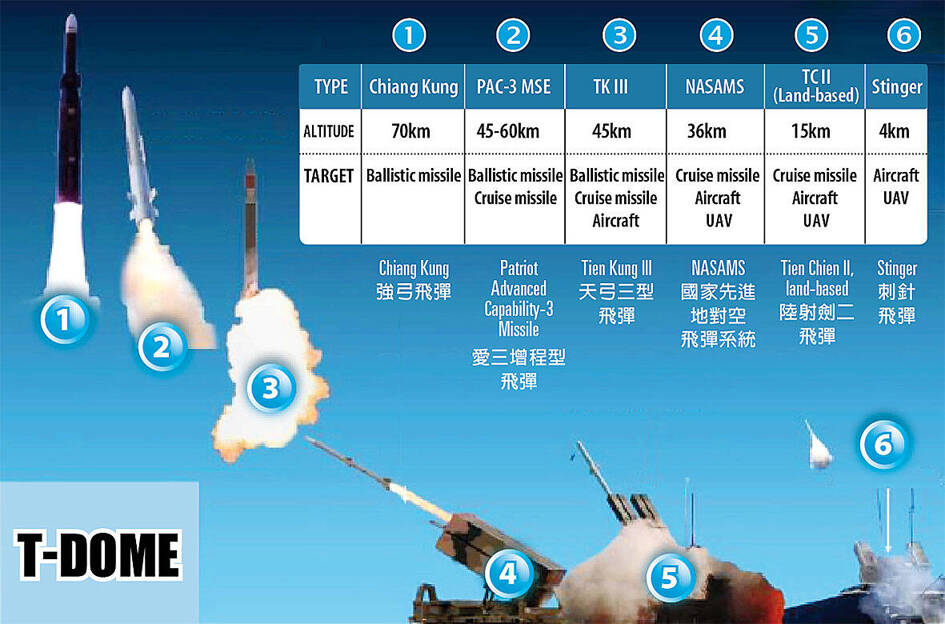
The NASAMS units would provide medium and low-altitude air defense against cruise missiles, drones and aircraft. The units can use AIM-9X and AIM-120 air-to-air missiles carried by Taiwan’s fighter aircraft, providing logistical advantages.
Other reported components include the Lower Tier Air and Missile Defense Sensor, which provides 360° detection of aircraft and missiles, and the IBCS, which integrates different radars and interceptors so that targets can be engaged by the most suitable air-defense system. Both systems would be key components of the integrated “T-Dome” network.
Taiwan has already purchased three NASAMS units and 123 extended-range Advanced Medium-Range Air-to-Air Missiles from the US, as well as 102 PAC-3 MSEs.
The National Chungshan Institute of Science and Technology is also producing Tien Kung III (天弓三, Sky Bow III) surface-to-air missiles and a mobile air-defense system based on the Tien Chien II (天劍二, Sky Sword II) missile, with both programs reaching mass-production milestones this year.
If the US$14 billion package includes the expected additional PAC-3 MSEs, NASAMS units and the IBCS, it would expand the density and integration of Taiwan’s layered air defenses, building on the Sky Bow III, Chiang Kung (強弓, Strong Bow), NASAMS and Sky Sword II systems, sources said.
US lawmakers and retired military officers have been urging the Trump administration to formally notify the US Congress of the package as soon as possible.
It received preliminary congressional approval in January.
A senior Taiwanese official familiar with US-Taiwan arms sales on Friday said that delays could have significant consequences, as defense manufacturers are facing heavy demand and limited production capacity.
Under the US Foreign Military Sales process, the US Department of State must formally notify Congress before detailed negotiations can begin. Taiwan and the US would then sign a letter of offer and acceptance, after which Taiwan would make an initial payment and the US military could place orders with defense contractors.
Manufacturers generally do not reserve production capacity for Taiwan until a formal contract is in place, the official said, speaking on condition of anonymity.
Advanced missiles and radar systems are also produced in batches, meaning that missing a scheduled production window could push an order into a later production run, they said.
Demand has been further driven by the war in Ukraine and NATO members competing for limited production capacity, the official said, adding that a delay in placing Taiwan’s orders could potentially extend well beyond the initial delay.
US senators Thom Tillis and Elissa Slotkin, cochairs of the Senate Taiwan Caucus, have said that continued delays could create disrupt Taiwan’s budget planning and efforts to raise its defense spending to 5 percent of GDP.
US officials and retired military officers have also said that most of the systems in the package are not urgently needed for current US military inventories.
They have urged the White House to approve the sale rather than use it as leverage in US-China negotiations, warning that delays could leave gaps in Taiwan’s air-defense capabilities.
KioskNews shows a cleaned-up reading view extracted from the publisher’s page — the original always lives on their site, not ours.