TSMC applies for tax abatement for Texas fab
Taiwan Semiconductor Manufacturing Co (TSMC, 台積電) on Tuesday confirmed that it had applied for a property tax abatement for a proposed project in Texas, while emphasizing that its plans to invest in the US state remained under evaluation.
TSMC said the application was part of its efforts to keep local authorities informed as it continued to evaluate potential investments in Texas.
The statement came after Reuters reported on Tuesday that the world’s largest contract chipmaker had applied to the Texas Comptroller of Public Accounts under the state’s Jobs, Energy, Technology and Innovation program about a property tax rebatement.
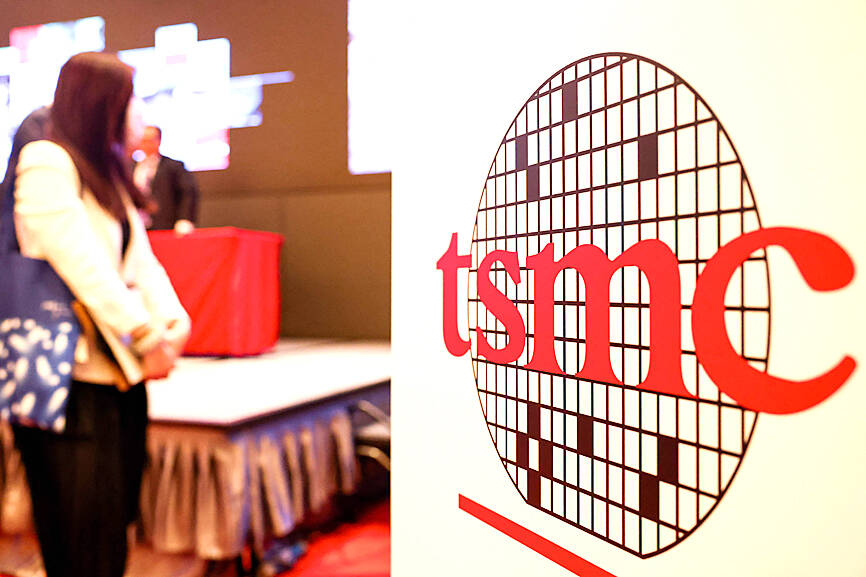
The logo of Taiwan Semiconductor Manufacturing Co is pictured ahead of the company’s annual shareholders’ meeting in Hsinchu on June 3 last year.
Photo: I-hwa Cheng, AFP
According to the report, the tax abatement would be a deciding factor in TSMC’s potential US$22.6 billion investment in a chip manufacturing facility in Brazos County.
The proposed facility would use TSMC’s 2-nanometer process, its most advanced technology in commercial production, or more advanced processes to manufacture chips for artificial intelligence (AI), high-performance computing and mobile devices, Reuters reported.
Citing TSMC’s application, Reuters said the facility could create up to 2,099 direct jobs over the next 40 years.
TSMC is developing its A14 process, with trial production scheduled for next year and mass production expected to begin in 2028.
Compared with its 2-nanometer process, A14 is expected to improve processing speed by 10 to 15 percent at the same power consumption or reduce power consumption by 25 to 30 percent at the same speed. The process is also expected to increase logic density by about 20 percent, TSMC said.
TSMC’s first fab in Arizona began commercial production in the fourth quarter of 2024 using its 4-nanometer process.
Construction of the company’s second Arizona fab has been completed, and equipment installation is under way. The facility is scheduled to begin mass production in the third quarter of next year using the more advanced 3-nanometer process.
KioskNews shows a cleaned-up reading view extracted from the publisher’s page — the original always lives on their site, not ours.