Commentary: When someone makes you feel unsafe in public, do you confront, film or walk away?

Think you’re being followed or watched by a stranger? Trust the warning signal but do not turn yourself into the investigator, says lawyer Gloria James.
New: You can now listen to articles.

This audio is generated by an AI tool.

06 Oct 2026 05:59AM
SINGAPORE: Two recent incidents in Singapore have sparked discussions about what people, especially women and younger people, should do when a stranger makes them feel unsafe.
In August, two girls alleged that a man repeatedly walked around them in a HDB estate in Sengkang, approached them and offered to pay them to do “something” for him. They told him to leave, but later saw him watching them from a car park and hiding behind pillars. One of the girls eventually confronted him and the pair chased him while filming as he ran away, according to a TikTok video.
In another case, a woman alleged that while she was sketching outdoors in Ang Mo Kio, an older man came close to her, hovered nearby and repeatedly looked at her. In a post on social media platform Reddit, the woman said she decided to confront the man who began shouting vulgarities. To which, she decided to respond loudly enough to “outcrazy” him.
Both incidents prompted discussions online, with many praising the ladies involved as brave for standing up for themselves. However, there were also others who cautioned that confronting strangers with unknown intentions could be dangerous.
These raise a practical question: What can you do when you feel threatened in public but do not yet know whether the stranger has committed an offence? Should you confront them, film the encounter or walk to a crowded place to seek help?
WHAT THE LAW SAYS ABOUT STALKING AND STARING
Context is everything. Someone walking behind you from an MRT station may simply be going the same way. The picture changes if the person follows after you change direction, waits when you stop, repeatedly reappears or continues watching as you try to leave.
Under the Protection from Harassment Act (POHA), unlawful stalking involves a “course of conduct” associated with stalking which causes harassment, alarm, distress or humiliation, where the accused intends that result or knows that the conduct is likely to have that effect.
Following someone, loitering near places the target frequents and keeping them under surveillance are expressly listed as examples.
Stalking need not take place over several days. A single occasion may qualify if the conduct is sufficiently protracted. In a 2020 case where the accused persons had followed National Environment Agency officers by vehicle for more than three hours, the High Court said the assessment is not merely a matter of counting minutes. Relevant considerations include the type, intensity and intrusiveness of the conduct and whether there is unreasonable persistence or continuity of purpose.
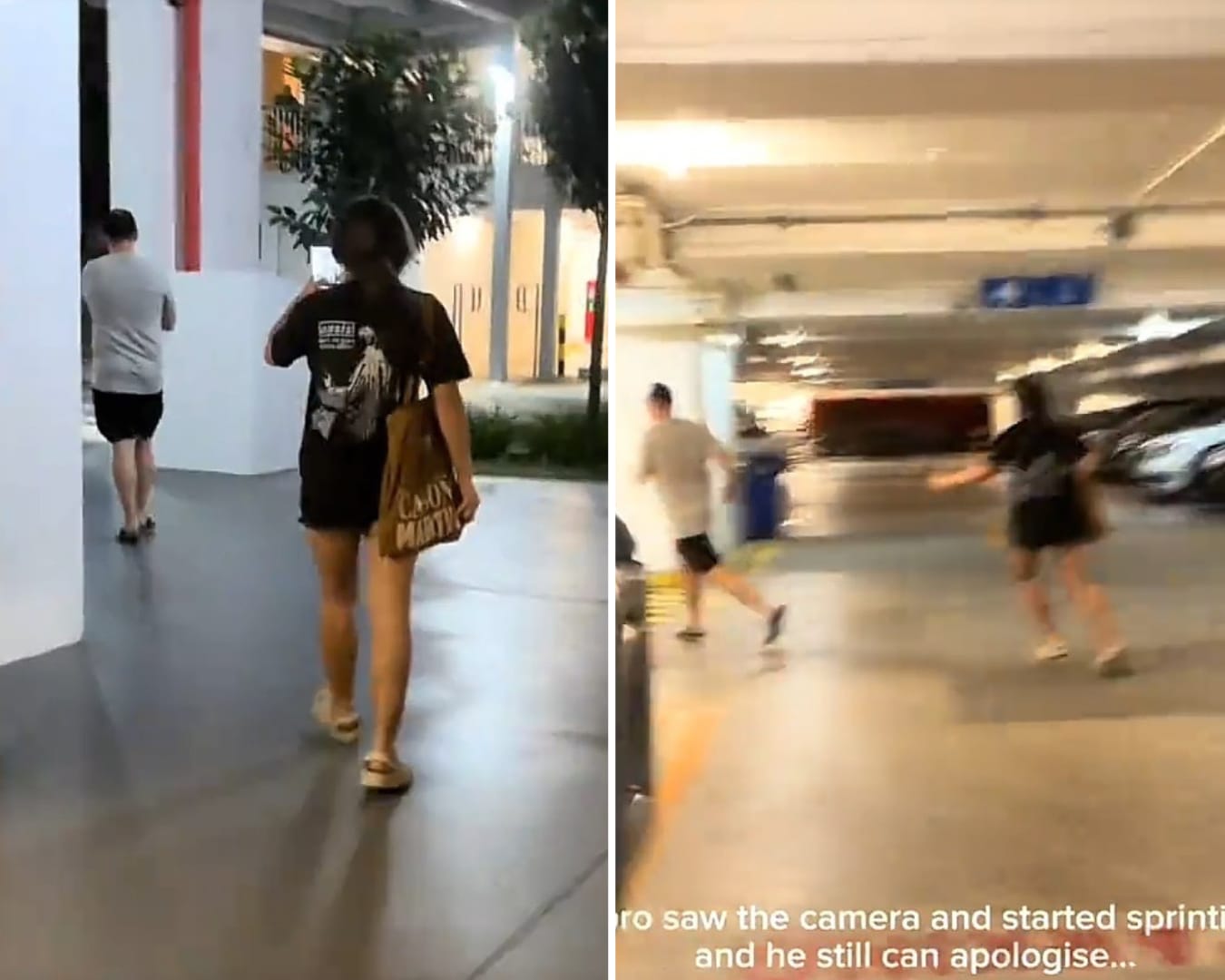
What about when someone stares “creepily” at you? There is no standalone offence of being “creepy” or simply looking at someone but staring may form a part of wider conduct. Under POHA, threatening, abusive, insulting, sexual or indecent words or behaviour can amount to an offence where the respective statutory requirements as to intention, effect and circumstances are satisfied.
A brief look is one thing. Hovering repeatedly nearby, following someone, making sexual gestures, refusing to leave them alone, or using threatening or abusive words may be another.
For both incidents, online accounts alone cannot establish whether an offence was committed. That said, one’s instinct that something is wrong may be enough reason to move away, seek help, call the police or even start filming.
SHOULD YOU FILM AN UNCOMFORTABLE SITUATION?
In this day and age, reaching for one’s phone may have become an instinctive response to an uncomfortable situation.
Filming can help – it is typically not against the law to take videos or photographs of another person in public without their consent – but it should not be the objective. A video may preserve what was said, how close someone came or whether a person continued staring or following after being told to stop.
This is evidence, but if getting a clear shot means approaching someone you fear or following him into an isolated place, the evidential benefit is not worth the added risk.
There is also a difference between recording for evidence to be submitted to the police and posting it online to go viral to “publicly shame” an individual.
Under POHA, a photograph or video can constitute a person’s “identity information”. Publishing it is not automatically doxxing, but it can engage POHA where the statutory elements are met. Publicly making serious allegations against an identifiable person may also lead to a risk of it being defamation if the allegation is unsupported or if there is no applicable defence available.
More practically, social media can turn uncertainty into certainty very quickly. For example, “I thought this man was following me” becomes “this man is a stalker”. Strangers may identify him, his workplace or even his family members, correctly or otherwise, and before long, an allegation can harden into an online verdict.
It is worth remembering that the police and the courts, rather than an online crowd, are better placed to determine whether an offence has in fact been committed.
SHOULD YOU CONFRONT THE PERSON?
What about confronting the person? There is no one fixed answer, but there is a difference between asserting a boundary and pursuing a stranger.
Saying “please stop following me” in a crowded station may draw attention and assistance. Chasing someone into a car park is a different story. In the Reddit post, the woman in the Ang Mo Kio incident also noted that while women must be prepared to defend themselves, confrontation should only be attempted in a public place with people around.
The police advise people who suspect they are being followed to remain calm and head to a crowded area or call the police. For emergencies, call 999 and you can also SMS 70999 when it is unsafe to speak.
Courage does not have to mean confrontation. Sometimes the sensible response is to call out the behaviour. Sometimes it is to enter a shop, approach other people, call the police or simply leave. The law can decide later whether the conduct amounted to stalking or harassment.
In the moment, the more important question is simpler: How do I get out of this safely? Trust the warning signal, but do not turn yourself into the investigator. The aim is not to win the encounter or prove your instincts right. It is to get home safely.
KioskNews shows a cleaned-up reading view extracted from the publisher’s page — the original always lives on their site, not ours.