US military bases are ‘ill-equipped’ to stop drone swarms, top commander reveals after Rubio's UAP warning
Laser weapons are moving beyond the lab and into military operations. Center for Strategic and International Studies missile defense expert Tom Karako breaks down what's changed, what lasers can actually do, and why they won't replace missiles.
NEWYou can now listen to Fox News articles!
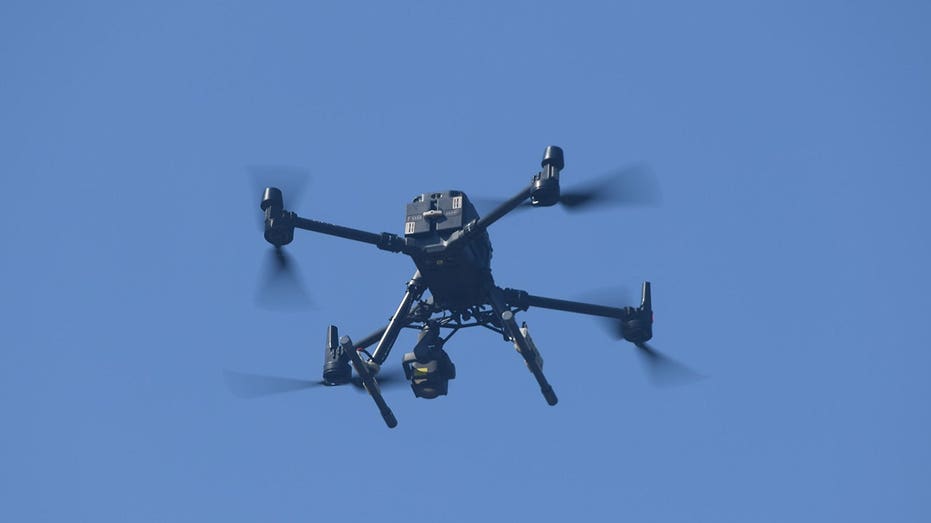
A top commander responsible for defending the U.S. homeland warned Thursday that American military bases are "ill-equipped" to repel a swarm of small attack drones.
The vulnerability that persists even as the Pentagon seeks billions for new counter-drone weapons, and Army Lt. Gen. Joseph Jarrard said the shortfall begins well before troops try to shoot down a drone.
Some bases do not have the sensors to spot and track an incoming swarm or the weapons to take it out, the deputy commander of U.S. Northern Command and vice commander of the American contingent at North American Aerospace Defense Command (NORAD).
"We don’t have the sensors, and depending on where that swarm is going to attack, it depends on whether we have any sensors at all, and also whether we’ve got any effectors to go after that problem," Jarrard said at the annual Space and Missile Defense Symposium.
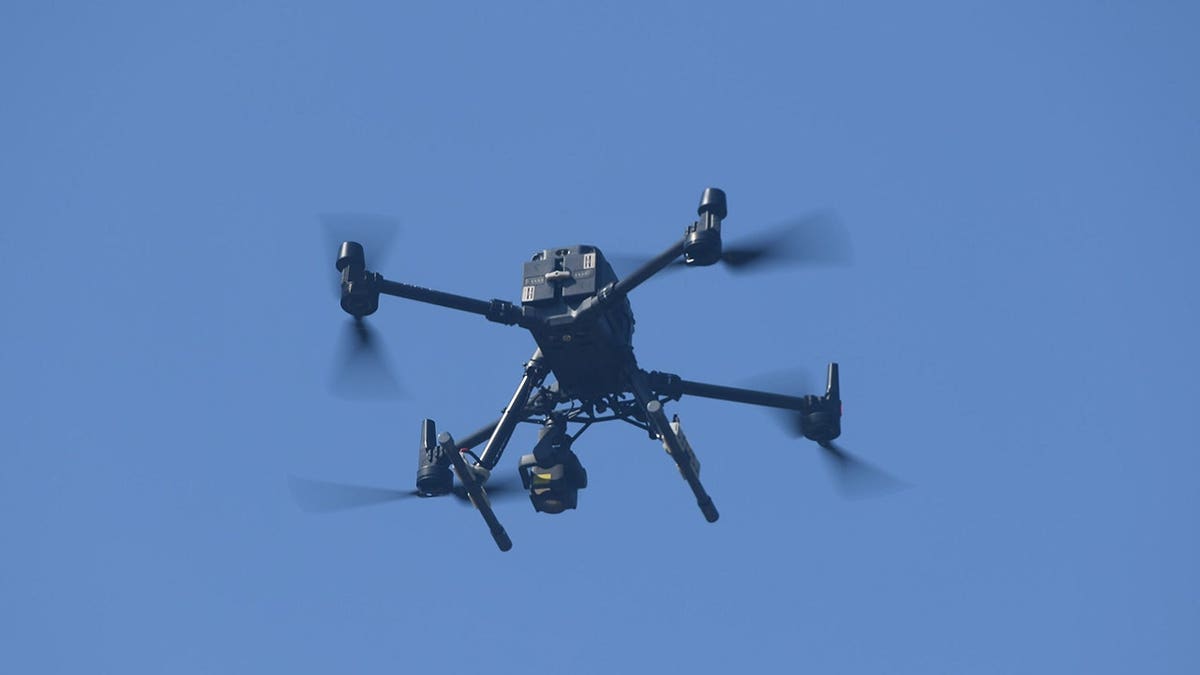
An industrial drone flies in the air on August 14, 2026 in Hangzhou, Zhejiang Province of China. US imposes up to 100% tariffs on imported drones within 21 days, citing national security concerns. (Photo by Long Wei/VCG via Getty Images)
Jarrard said NORTHCOM is folding counter-drone tactics into Operation Noble Eagle, the long-running U.S.-Canada homeland air-defense mission. For now, he said, NORAD is relying on radars already in its inventory while working to connect with local law enforcement and other agencies that operate detection systems beyond military installations.
"Detection is obviously the biggest issue, and so how we are able to detect is one of our biggest concerns right now," Jarrard said. "That’s where we’ve got to get to with respect to the interoperability between not just military systems, but also those that are protecting our cities, critical infrastructure, etc., that are off our installations."
Jarrard’s assessment offers a blunt measure of the gap between the Pentagon’s rapid counter-drone push and the protection available at installations today. Cheap, one-way attack drones have changed the battlefield calculus in Ukraine and the Middle East, where adversaries can threaten equipment, infrastructure and personnel without expending the missiles or aircraft traditionally associated with a strike on a military target.
"We are ill-equipped right now to handle something like that, and obviously we’ve seen it used," Jarrard told the audience. "We’re seeing it used on a daily basis around the world, and we’ve got to figure out how to mitigate that threat."
His warning echoed concerns raised in May by NORTHCOM commander Gen. Gregory Guillot, who said troops deployed along the southern border lacked adequate counter-drone tools. The Pentagon has since sought a record $21 billion for drones, counter-drone weapons, munitions and other related capabilities as it tries to close the gap.

Lieutenant General Joseph Jarrard is the Deputy Commander, United States Northern Command, and Vice Commander, United States Element, North American Aerospace Defense Command at Peterson Space Force Base, Colorado. (Department of War)
The warning also comes as President Donald Trump moves ahead with the Golden Dome plan, his broad homeland missile-defense initiative intended to protect the United States and critical infrastructure from ballistic, hypersonic and cruise missiles, as well as other advanced aerial threats.
The issue has resurfaced as it relates to the administration’s broader discussion of unidentified objects around U.S. military sites.
Earlier this week, Secretary of State Marco Rubio said the government should take seriously reports of objects flying over military installations — more recently called unidentified anomalous phenomena (UAPs) rather than unidentified foreign objects (UFOs).
"I don't know who it is. I don't know what it is, but there are things flying over our military installations, and they're not ours, and we should look into this, be serious about it," Rubio said while discussing UAPs in an interview with Katie Miller, wife of top White House aide Stephen Miller.
Rubio was not specifically referring to drone swarms, and Jarrard did not suggest that every unidentified object reported near a military site is a drone. Still, the two officials’ comments point to the same practical concern for U.S. forces: an aircraft does not need to be mysterious to present a danger.

Fort Bliss, a military base, sits in El Paso, Texas (Getty)
Jarrard, in his remarks, was describing a more immediate and localized vulnerability: the ability to detect and defeat low-cost drones flying toward a base before they can strike.
The military is pursuing several answers, from radio-frequency systems that can jam drone communications or interfere with satellite navigation to high-powered microwave weapons designed to disrupt the electronics of multiple nearby drones at once.
It is also moving closer to fielding high-energy lasers. Fox News Digital reported this month that the Army is nearing a contract award for the Enduring High Energy Laser, or E-HEL, program, which could become the service’s first permanent operational capability for a family of high-energy laser systems.

U.S. Army soldiers from the 18th Airborne Division walk out to a C-17 aircraft as they deploy to Europe on Thursday, Feb. 3, 2022 from Fort Bragg, N.C. President Joe Biden is ordering 2,000 U.S. troops to Poland and Germany amid the stalled talks with Russia over the Kremlin's military buildup on Ukraine's borders. (AP Photo/Chris Seward)
Army acquisition chief Lt. Gen. Frank Lozano said in July that the technology had shown "a lot of recent promise and capability" during testing at White Sands Missile Range in New Mexico.
A laser could allow troops to engage drones that have entered a defended area without relying solely on expensive missile interceptors, but it is not a complete solution: lasers are line-of-sight weapons, which limits their reach, and they must be integrated with the sensors, command-and-control networks and other systems Jarrard said are lacking at some locations.
CLICK HERE TO DOWNLOAD THE FOX NEWS APP
In an era when small drones can be cheap, expendable and deployed in numbers, the military must be able to identify the threat quickly and prevent it from reaching the installation it is meant to protect.
KioskNews shows a cleaned-up reading view extracted from the publisher’s page — the original always lives on their site, not ours.