Honeybees are barging aside wild pollinators in hunt for pollen and nectar, study finds
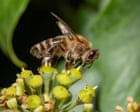
Honeybees are outcompeting wild pollinators for resources by aggressively bumping into them and chasing them away from flowers, research has shown.
The study, by researchers from Anglia Ruskin University, found that areas where there were higher concentrations of honeybees had fewer wild pollinators, such as bumblebees, solitary bees and hoverflies.
Honeybees were also most likely to instigate, and win, competitive interactions, pushing out rivals to collect more pollen and nectar.
The number of managed bees has risen in the UK, as campaigns to “save the bees” resonate with the public, leading to a boom in hobbyists setting up beehives. The number of registered beekeepers has more than doubled, from 19,000 in 2010 to 47,000 in 2025, according to the National Bee Unit.
However, there are growing concerns that this growth in managed honeybees is harming other, wild, pollinators including bumblebees, by increasing competition for food and passing on diseases, especially in areas where there are fewer flowers or an especially high density of hives.
To better understand the nature of this competition, the study in Cambridgeshire observed pollinators over a two-year period as they foraged on bramble and ivy in areas close to honeybee colonies. The study documented the outcomes of 300 interactions between flower visitors from five groups: honeybees, bumblebees, solitary bees, hoverflies and “other”, which included types of flower-visiting and pollinating flies, butterflies, beetles and wasps.
In each interaction, the study noted where an individual “won”, by gaining access to a resource, “lost”, or if a resource was shared. Honeybees won in most of the encounters across both plant species.
Past research has suggested that honeybees outcompete other pollinators indirectly, by taking up resources. However, the Cambridgeshire study provides evidence that they are posing a more direct form of competition, known as “interference competition”, where a species might attack or chase others away.
“That’s important because, of course, it means that the wild pollinators are facing a challenge from both those types of competition from honeybees,” said Victoria Buckle, lead author of the study and a PhD researcher at Anglia Ruskin University.
Honeybees were actively avoided by other flower visitors in 28.4% of interactions on bramble and 35.6% on ivy.
In competitive interactions won by a honeybee, the honeybee either displaced other flower visitors – for example, by landing on them or pushing them off flowers – or chased them away, in about 20% of cases.
Bumblebees were also observed displacing other pollinators, though Buckle believes this was probably not intentional, and was instead a reflection of their less coordinated movements as they fly through confined spaces.
“They bumble along the patch and then they’ll mistakenly bump into another pollinator and it just falls off a flower,” Buckle said. “With the honeybees, the aggression was more overt. You could tell that they’re specifically trying to move the other one off the flower.”
The reasons for honeybees’ aggressive behaviour is likely to relate to the way in which they organise their social groups, said Buckle, adding: “Some castes of bees can be guard bees, so they have that capacity within them to show threat and aggression, to guard their hives and to look after the brood.”
The only pollinator able to hold its own against honeybees was the ivy bee, which was first recorded in the UK in 2001 and feeds mainly on the nectar of ivy flowers. It was seen displacing and chasing honeybees.
The study also found that higher temperatures led to an increased number of competitive interactions, probably because nectar was drying up and plants were going into heat stress. Given that mean summer temperatures are predicted to rise by up to 4C in the UK by 2080, such competition is likely to become more frequent, said Buckle.
More research is needed to examine how wild pollinators can be better protected, she added.
“A lot of beekeepers are environmentally minded and they want to make sure that they’re not impinging or having an impact on other pollinators,” Buckle said. “This research is important because it helps guide our planning and best practices for conservation.”
KioskNews shows a cleaned-up reading view extracted from the publisher’s page — the original always lives on their site, not ours.