Takaichi has ‘timely’ talk with Trump about China ahead of his planned summit with Xi
Japanese Prime Minister Sanae Takaichi yesterday said she had a “timely” discussion about China with US President Donald Trump ahead of his planned summit with Chinese President Xi Jinping (習近平) today.
“Japan considers it important that US-China relations contribute to the stability of the international community, including Japan,” Takaichi told a news conference in New York after meeting Trump on the sidelines of the UN General Assembly.
She did not give details of what she and Trump discussed with regard to China, only saying they “conducted a timely exchange of views on various issues concerning China.”
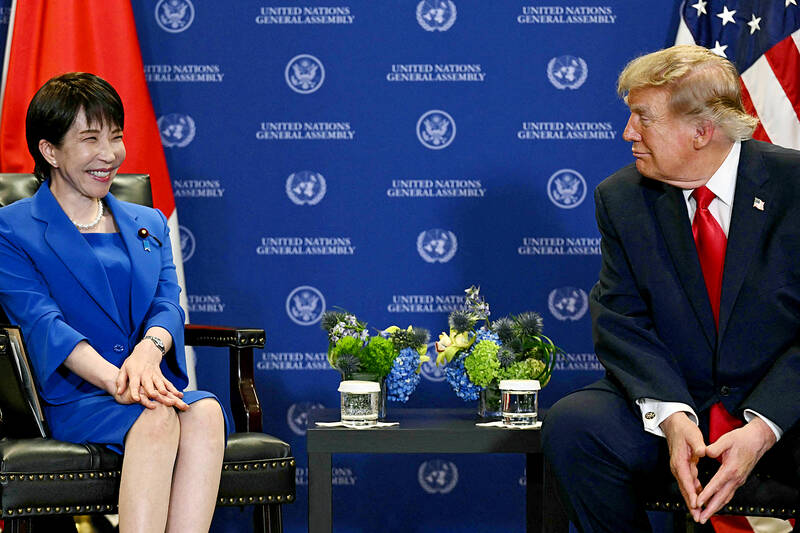
Japanese Prime Minister Sanae Takaichi, left, meets with US President Donald Trump on the sidelines of the UN General Assembly in New York on Tuesday.
Photo: AFP
Takaichi moved up her UN speech by two days to catch Trump ahead of his summit this week with Xi. Hours before she took the stage, Trump and Takaichi agreed to closely coordinate on China issues during a roughly 30-minute huddle.
Japan and other US allies in Asia are concerned that Trump could soften Washington’s support for Taiwan in return for an economic deal with Xi. Takaichi’s meeting with Trump was an opportunity for Japan to influence the president ahead of his sit-down with the Chinese leader.
Xi is expected to press Trump to halt arms sales to Taiwan when they meet, sources said earlier.
Takaichi also said her meeting with Trump demonstrated the strength of ties between the two countries against a worsening security backdrop in Asia.
“We are determined to make the Japan-US alliance even more unshakable,” she said.
In her maiden speech at the General Assembly on Tuesday, Takaichi urged the UN to remove references to Japan and Germany as “enemy states,” a classification China has seized on to criticize Tokyo after a breakdown in ties over Taiwan.
She called out clauses in the UN Charter still referring to the Axis powers of World War II as “enemy states,” despite a unanimous 2005 resolution to remove them.
A complicated amendment process has stood in the way of achieving that goal.
“In accordance with that resolution, these clauses should be removed without delay,” Takaichi said. “I make this point strongly, with pride in and respect for Japan’s honor after 70 years of making major contributions to the work of the UN.”
Takaichi was one of the last speakers on the opening day of the General Assembly, and the Chinese delegation remained to hear her remarks.
The charter has become a new point of tension between Tokyo and Beijing, as China continues to try and force Takaichi to retract remarks she made about Taiwan.
In November last year, she told Japanese lawmakers that a Chinese invasion of Taiwan would be an existential threat to Japan — implying Tokyo might support any collective effort to defend Taiwan.
In a Sept. 8 news conference, Chinese Ministry of Foreign Affairs spokeswoman Mao Ning (毛寧) said the “enemy state” clauses were “still valid today,” and characterized Japan as a continued threat to regional peace, repeating a view that Beijing has amplified since late last year.
“The Japanese side should use history as a mirror, make a clean break with militarism, and earn trust from its Asian neighbors and the rest of the world with concrete actions,” Mao said.
KioskNews shows a cleaned-up reading view extracted from the publisher’s page — the original always lives on their site, not ours.