It only takes three songs before every seat in the Palais is hastily abandoned
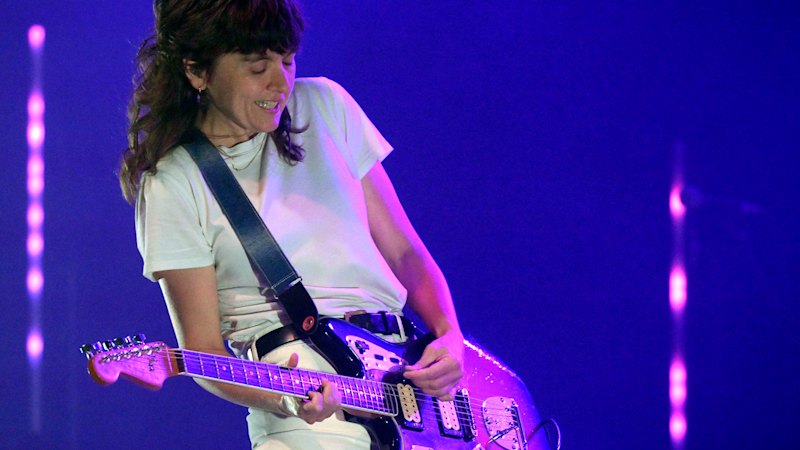
It takes three songs for Courtney Barnett’s Melbourne return to feel like 2017. The comical near-death experience of Avant Gardener was already an Aussie suburban classic when she played this esteemed venue nine years ago and again, every seat becomes a hastily abandoned inconvenience.
What’s changed? A slow churn of albums mapping the agonies of indecision, procrastination and rumination has culminated in the aptly titled Creature of Habit. “Feels like I’m going backwards, each day I preach my practice,” she rants in the opening blast of Stay In Your Lane.
The backwards bit is an illusion. There’s more grey hair out here now and more confidence on stage. But Barnett’s three-piece grunge attack does feel as casually comfortable as her white jeans and T-shirt. It’s as if the stasis anxiety in her songs is exorcised in the act of simply doing what she does.
The bashful grin no longer tries to contain itself as she strolls to the lip of the stage to strangle those raggedly torn chords from her guitar. Our silence is “intimidating”; she squirms after the relative gentility of Mantis. But there’s very little of it as she interleaves ancient favourites with all 10 tracks from the new LP.
Early EP tracks History Eraser and Canned Tomatoes (Whole) must feel like another lifetime to the singer, but from here, the consistency of her craft is striking. The same thread of restless, poetic self-examination is carried by a familiar racket conjured by unfussy bassist Bones Sloane and drummer Stella Mozgawa.
Barnett gives herself and her overdriven guitar room to breathe in the slowed coda of City Looks Pretty and other improvised breakdowns, and the noise default is leavened by the likes of singalong favourite Depreston. The solo spell of Mostly Patient stills the beer-hoisting crowd like magic.
The fact that any of the new songs might have fit neatly enough on her first album puts a lid on the evening’s surprises. But Barnett’s musical vocabulary is a reflection of an inner monologue that strives to accept what won’t change. “Reborn every morning, still somehow getting older,” she sings in a song called Another Beautiful Day. To her fans, the gift is in feeling the same. They’re still the kid in Elevator Operator and they know Nobody Really Cares If You Don’t Go To The Party like a thing only your best friend would tell you. Growing older hasn’t made any of us less ourselves. Some habits are just keepers.
Reviewed by Michael Dwyer
OPERA
La Bohème ★★★★
Opera Australia, The Regent Theatre, until November 18
Bohème is back, baby. And not the Gale Edwards production that returned in almost every Opera Australia season in the past 15 years, but a new, shiny successor.
Beloved by novices and veterans alike, Puccini’s La Bohème sits at the centre of basically every opera company worldwide. With Edwards’ loyal moneymaker put out to pasture, OA entrusted young Australian director Constantine Costi to make its golden goose anew. They could not have made a finer choice.
Costi has assembled a brilliant creative team in fellow thirty-somethings, Dann Barber (sets) and Sabina Myers (costumes). There are many jaw-droppingly stunning moments: from Rodolfo and Mimi singing literally suspended in mid-air to the sheer scale of Café Momus. Visually, it’s everything you ever wanted in an opera.
The sound, regrettably, was less convincing. At no fault of young British conductor Finnegan Downie Dear, who led with passionate precision, nor Orchestra Victoria, who dutifully acquiesced whenever Downie Dear gestured for them to effectively turn it down.
It’s the unforgiving acoustics of the Regent, where the orchestra is in front of the stage, rather than in the pit. But such is Bohème’s aforementioned perennial appeal, a revival – in another theatre – is not far away.
As bohemians Marcello, Colline and Schaunard, OA stalwarts Luke Gabbedy, David Parkin and Shane Lowrencev really do feel like old friends; their chemistry unforced.
Making her hometown OA debut, Alexandra Flood (Musetta) is now, deservedly, on a Siobhan Stagg-esque trajectory, beloved at home and overseas. Flood has dynamo stage presence and shimmering vocals with perfect pianissimo high notes.
Tenor Kang Wang has long been an excellent Rodolfo, and Russian Galina Cheplakova’s heartbreaking Mimi was flawless, with the most beautiful array of vocal colours.
This is what a national arts company should be doing, allowing inspired young Australian creatives to breathe new life into the classics. The art evolves and so too does our relationship with the piece. Costi’s Bohème will ensure that this tryst will endure.
Reviewed by Bridget Davies
The Booklist is a weekly newsletter for book lovers from Jason Steger. Get it delivered every Friday.
More:
KioskNews shows a cleaned-up reading view extracted from the publisher’s page — the original always lives on their site, not ours.