Bangladesh Flips Nuclear Switch, Gets Power From Russia-Made Atomic Plant
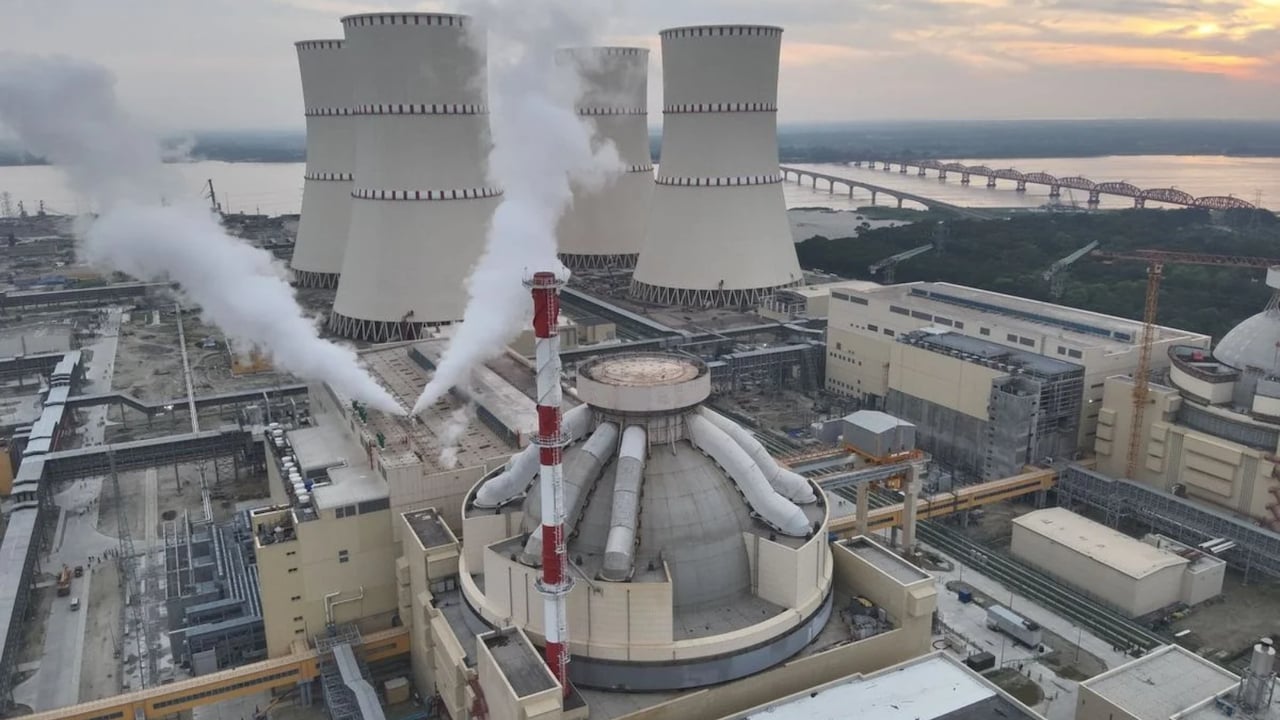
Bangladesh has entered a new chapter in its national development story. For the first time in its history, electricity generated from a functioning nuclear reactor flowed into the country's national grid. The achievement marks the arrival of Bangladesh as an atomic power-producing nation and places the youngest country in South Asia among a select group of nations that generate electricity from the atom.
On Monday, Unit 1 of the Rooppur Nuclear Power Plant was synchronised with Bangladesh's national electricity grid and supplied its first nuclear-generated power. For Bangladesh, this is much more than an engineering milestone. It is the moment when years of planning, billions of dollars of investment and extensive international cooperation translated into actual electricity reaching homes, industries and businesses.
The development comes barely a month after another historic milestone. On October 11, the reactor achieved first criticality and reached the Minimum Controlled Power level. In simple terms, a self-sustaining nuclear chain reaction was established in the reactor core for the first time. Nuclear scientists often describe this as the moment when a reactor truly comes alive or goes critical.
With grid connection now achieved, Bangladesh has effectively tasted electricity from a functional atomic power plant.
What makes the achievement particularly significant is that Bangladesh, which emerged as an independent nation only in 1971, has entered the nuclear era with one of the world's most advanced commercial reactor technologies. Rather than beginning with older reactor generations, Bangladesh has leapfrogged directly into the Generation III+ category of civilian nuclear power.
The Rooppur Nuclear Power Plant is located about 160 kilometres from Dhaka and less than 50 kilometres from India's border and consists of two Russian-designed VVER-1200 reactors. Each unit has a generating capacity of 1,200 MW, giving the site a total installed capacity of 2,400 MW. Once both reactors are operational, Rooppur will become the largest nuclear power station in South Asia in terms of unit size.
The reactors have been built by Russia's state nuclear corporation Rosatom under a general contract signed on December 25, 2015. The project traces its roots to February 2011, when Russia and Bangladesh signed an intergovernmental agreement for nuclear cooperation. The estimated project cost is about $12.65 billion, making it one of the largest infrastructure investments in Bangladesh's history.
Construction of Unit 1 began in November 2017, while Unit 2 followed in July 2018. The first electricity generated by Unit 1 reached the national grid when the reactor attained about 40 per cent of its rated power. The turbine generator produced approximately 370 MW of electricity during the synchronisation process. Engineers will now continue raising reactor power in stages before commercial operation begins.
The significance of Rooppur extends beyond Bangladesh because the VVER-1200 reactor technology is viewed as one of the most advanced large-scale reactor designs available today.
In many ways, the technology represents a step ahead of India's Kudankulam Nuclear Power Plant in Tamil Nadu. Kudankulam's six units are based on the earlier VVER-1000 design. While Kudankulam remains one of India's safest and most reliable nuclear stations, the VVER-1200 incorporates additional passive and active safety systems that were developed after studying global nuclear accidents including Fukushima in Japan.
The World Nuclear Association notes that the VVER-1200 belongs to the Generation III+ family of reactors and incorporates enhanced safety systems, double containment structures, passive heat removal systems and a core catcher designed to manage severe accident scenarios. Experts associated with the World Nuclear Association have repeatedly highlighted the VVER-1200 as among the most advanced commercially deployed light water reactors currently operating anywhere in the world.
For India, Bangladesh's achievement comes at an interesting moment.
India remains South Asia's largest producer of nuclear electricity. The country operates reactors at Tarapur, Rajasthan, Kakrapar, Kaiga, Narora, Kudankulam and several other locations. India's installed nuclear power capacity currently exceeds 8 GW and the government has announced an ambitious target of reaching 100 GW of nuclear generation capacity by 2047.
Achieving that goal will require unprecedented reactor construction, new financing models and policy reforms. Discussions continue around enabling provisions linked to the SHANTI Act and broader questions concerning India's nuclear liability framework. India is also examining pathways for greater participation by private industry in the nuclear sector.
Future imported reactors for India, including potential Russian projects, could incorporate technology similar to or derived from the advanced VVER-1200 platform now operating in Bangladesh.
Pakistan, meanwhile, has steadily expanded its own nuclear programme. The country currently operates reactors at Chashma and Karachi and has six operating nuclear power reactors generating approximately 3,500 MW of electricity. Much of Pakistan's recent nuclear expansion has relied on Chinese technology.
Yet despite India's larger programme and Pakistan's growing fleet, Bangladesh now possesses South Asia's newest and most modern large scale nuclear reactor.
That distinction carries strategic importance.
Bangladesh views nuclear power as a critical component of long term energy security. The country remains heavily dependent on imported fuels and is vulnerable to fluctuations in global energy markets. Nuclear power offers a source of stable, reliable and low carbon electricity that can operate continuously regardless of weather conditions.
The two Rooppur reactors are expected to operate for at least 60 years, with the potential for a 20 year life extension. Once both units enter full service, the plant will provide 2,400 MW of base load electricity and become a cornerstone of Bangladesh's energy system.
"The power start-up of Unit 1 of the Rooppur NPP is a landmark event for our countries. Bangladesh is receiving a reliable, stable, and environmentally friendly energy source, which will significantly reduce its national energy dependence on imported hydrocarbons. Nuclear power provides Bangladesh with access to advanced technologies and contributes to the development of engineering and scientific research. For Russia and Rosatom, the power start-up of Unit 1 of the Bangladesh NPP is yet another completed project that demonstrates our country's undisputed leadership in the global nuclear technology market," said Alexey Likhachev, Director General of the Rosatom State Corporation.
For Bangladesh, however, the larger story is national transformation.
Fifty five years after independence, the youngest nation in South Asia has successfully developed the regulatory framework, engineering capability, fuel management infrastructure and technical skills needed to operate an advanced nuclear power plant. The moment electricity from Rooppur entered the grid, Bangladesh crossed a historic threshold.
The country has not merely joined the global nuclear club. It has done so with one of the world's most modern reactors, placing itself at the forefront of South Asia's next generation nuclear power landscape.
KioskNews shows a cleaned-up reading view extracted from the publisher’s page — the original always lives on their site, not ours.