Ministry warns of rising nearsightedness in kids
HEALTHY EYES: Children should look at something at least 20 feet away for 20 seconds after 20 minutes of screen time, and spend 14 hours outdoors per week
By Hsu Li-chuan and Sam Garcia / Staff reporter, with staff writer


Last academic year, 45.13 percent of elementary-school students, or one in every 2.2 students, were nearsighted, Ministry of Education data showed.
The ministry made the comment amid growing concerns over the impact of digital learning tools on children’s eyesight, saying that almost every classroom is equipped with a digital display and nearly every student with a tablet.
The numbers in Kaohsiung were higher than the national average, with 45.91 percent of elementary-school students nearsighted, compared with 45.2 percent two years ago and 45.34 the year before that, the Kaohsiung Education Bureau said.
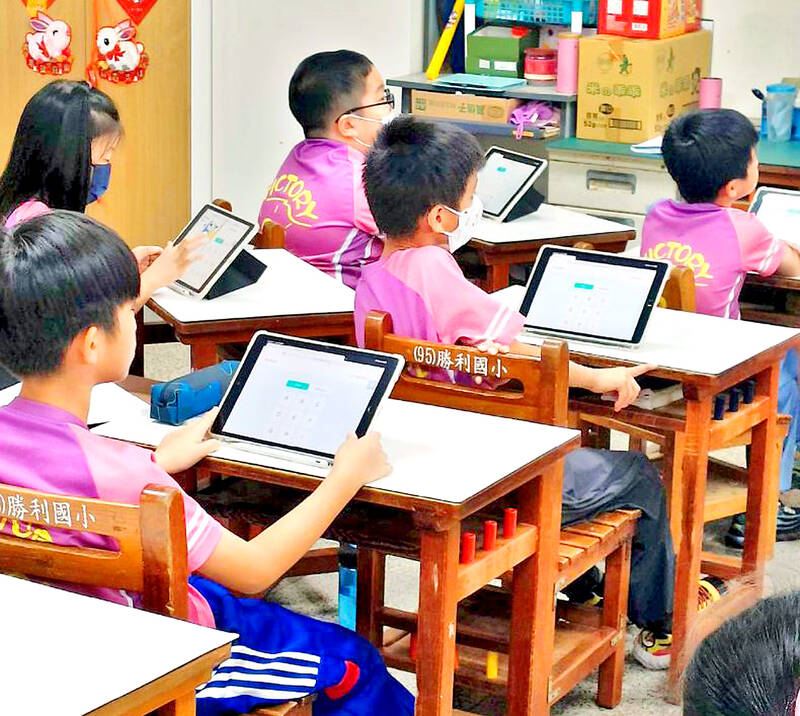
Pupils use iPads in class at the Sheng-Li Elementary School in Kaohsiung in an undated photograph.
Photo courtesy of the Kaohsiung Education Bureau
The rate had declined slightly each year before the COVID-19 pandemic, but rose again as students switched to online learning, said Yen Min-su (顏敏夙), director of the bureau’s physical education and healthcare division.
Preventive efforts should prioritize younger students, as children who are not nearsighted by the middle of elementary school are less likely to develop it later in life, Yen said.
As myopia is hereditary, the bureau is seeking central government subsidies to cover one annual registration fee for parents who take their children to ophthalmology clinics for dilating eye drops, she said.
The bureau said it is promoting eye-health education, vision screening and healthy use of digital devices.
Students should rest their eyes for 10 minutes for every 30 minutes of screen time and spend two hours outside every day, the bureau said, encouraging students to go outside during class breaks.
The bureau said it is intensifying digital device management on campuses by requiring schools to establish guidelines for device use, set up application procedures and limit screen time to help students develop healthy digital habits.
Protecting children’s vision requires parents, schools and medical professionals to work together, the bureau said, adding that prevention, early detection, follow ups and corrective measures are needed to help children properly care for their eyes in the digital age.
One mother surnamed Hsu (許) said she kept her child from using digital devices too early, but with tablets and digital lessons at school, they are no longer avoidable.
Her child, who is going into fourth grade, has vision of 0.9 in both eyes and the family’s strategy is to limit the child’s daily screen time, Hsu said.
Japan has the world’s most comprehensive strategy for protecting children’s vision, ophthalmologist Hung Chi-ting (洪啟庭) said, adding that 36.8 percent of elementary-school students in Tokyo are nearsighted.
In addition to annual school health checkups, Japan screens three-year-old children for vision problems so they can be detected and treated early, Hung said.
Children should limit screen time and follow the 20-20-20 rule: After 20 minutes of close-up work, look at something at least 20 feet (6 meters) away for at least 20 seconds, he said.
Kids should spend two hours outdoors every day, or at least 14 hours a week, and undergo their first comprehensive vision examination at age three or four, followed by regular checkups every six months, he added.
Changes in a child’s habits, such as moving closer to the TV or screen, squinting to see distant objects, frequent eye rubbing or blinking, headaches and difficulty concentrating, could be signs of myopia, Hung said, encouraging parents to have their child’s eyes checked if they notice these signs.
KioskNews shows a cleaned-up reading view extracted from the publisher’s page — the original always lives on their site, not ours.