Qalo SL-1 review: A barebones smart band that's priced like a flagship
Daniel Cooper for Engadget
RATING : 6.8 / 10
- Great battery life
- Subscription-free
- Works in tandem with Qalo smart rings
- Magnetic strap is cool, but not secure
- Too expensive
- No automatic workout detection
I've already made my feelings about screenless fitness trackers well known to everyone who'll listen. They're more about signaling to the in-crowd that you're a serious gym goer than a better alternative to a proper smartwatch. Still, that's a big enough market that plenty of companies are jostling for space alongside Whoop (and Fitbit, and Garmin). Take Qalo, a jewelry brand with a side hustle selling smart rings, which is now branching out with its own screenless band. The Qalo SL-1 is a subscription-free band which aggregates all of your vital signs into a single score.
If you're unfamiliar, Qalo sells silicon rings for folks who, for many reasons, can't or won't wear a metal ring. If you work in heavy industry, it's wise to swap your wedding band for something that won't cause you to lose a finger in an accident. They're also a great option for the gym or other physical activities, as well as for folks who experience finger-swelling.
Qalo has launched two generations of rings in the last few years, with some corners of the internet saying they're re-branded hardware from J-Style, a white-label wearables manufacturer. A representative of the company told me that the SL-1, however, is "built around QALO's own software, data and design."
It's worth understanding that if you own a Qalo smart ring, the SL-1 is complimentary with the rest of its ecosystem. So if you wear a ring during the day, but take it off for the gym, you can strap the band on your wrist or bicep and all of the data will aggregate to the same place.
At $199.95, Qalo is asking for the same sort of money as Garmin wants for its own smart band, the Cirqa. Which means there's an easy benchmark to see if this generic, first-generation hardware is capable of outperforming a wearables specialist with decades of experience.
Hardware
Daniel Cooper for Engadget
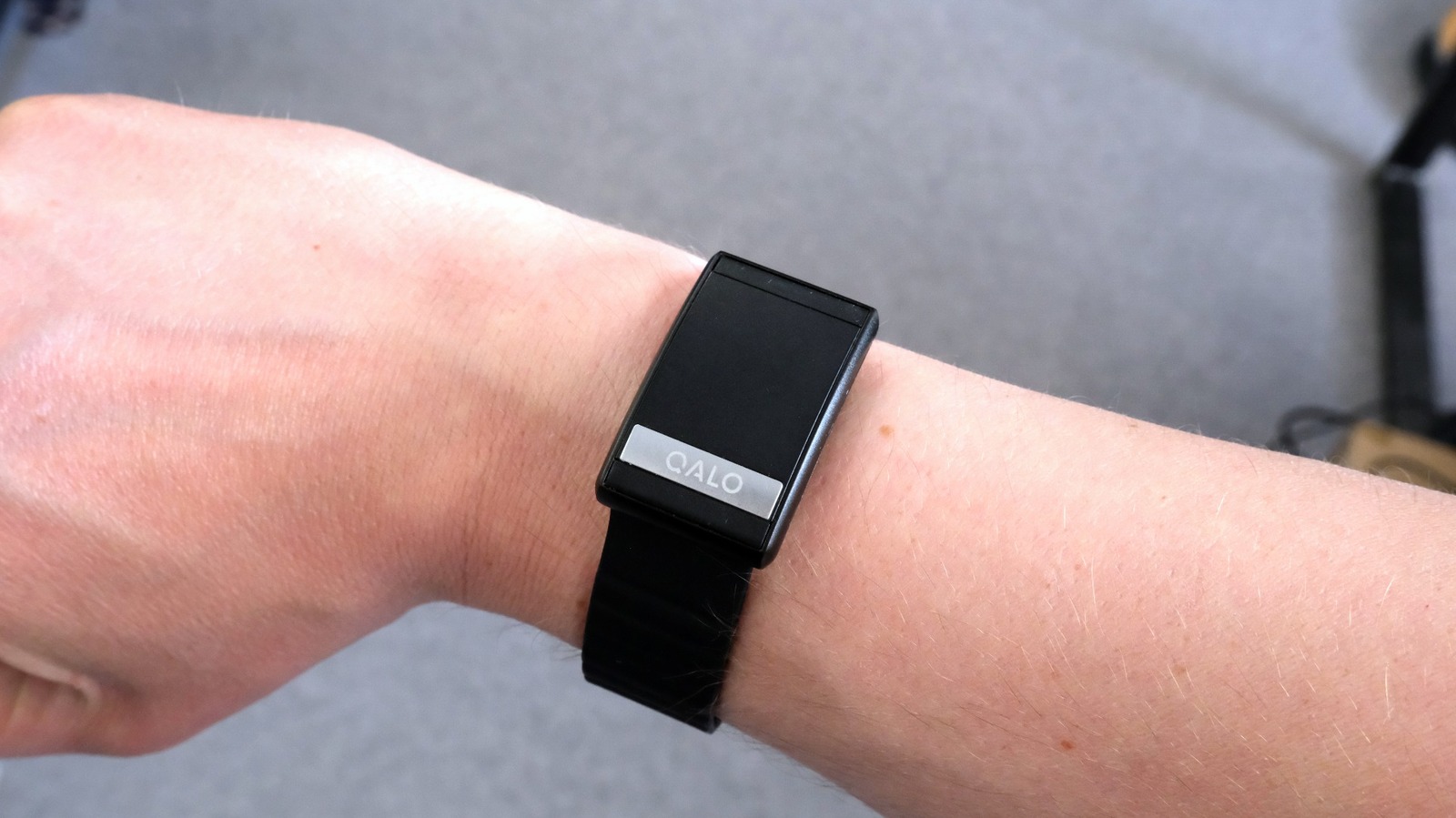
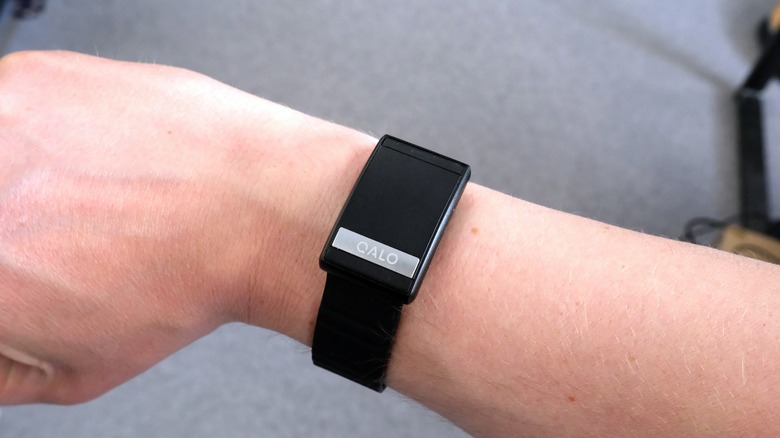
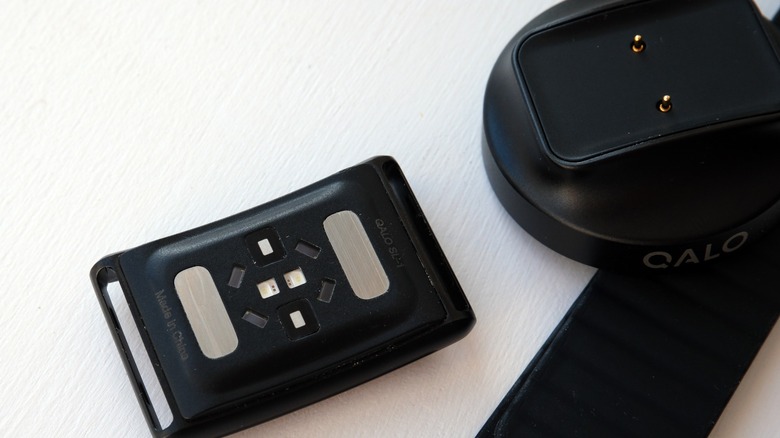
The Qalo SL-1 is a screenless fitness tracker which looks like someone described a Whoop over the phone. It's a little longer than a Whoop MG but, to my eye, has a more pronounced bend in its chassis, although that didn't seem to affect how it sat on my wrist. Take it out of the box and you'll first notice the silicon strap, which attaches to itself magnetically.
In that initial moment, the idea of a magnetically-attached watch strap looks and sounds like the coolest idea imaginable. It'll take you all of 30 seconds to realize why other watchmakers don't do the same thing with their own products. Because, as elegant as the magnetic strap is, it will get easily dislodged if your sleeve slides along at the wrong angle.
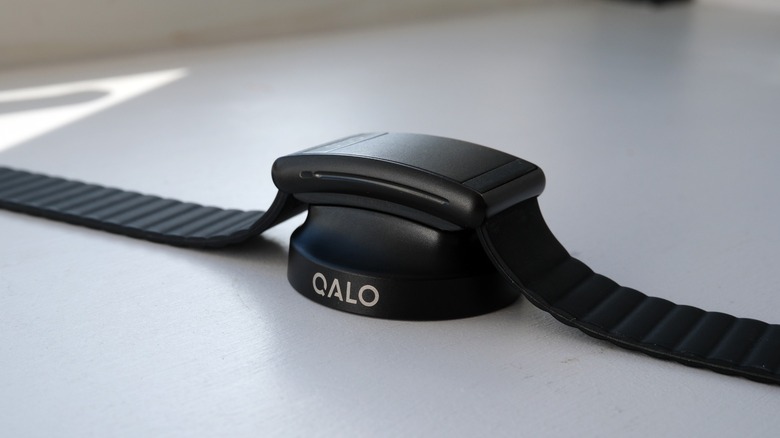
Qalo says the water-resistant band lasts for 12 days on a single charge, and will keep an eye on the usual set of vital signs. That includes activity, sleep, heart rate, SpO2, HRV, stress, temperature and menstrual cycle tracking. It ships with a magnetic USB-C charging cradle which I would describe as heavy for what it is.
In-use
Daniel Cooper for Engadget
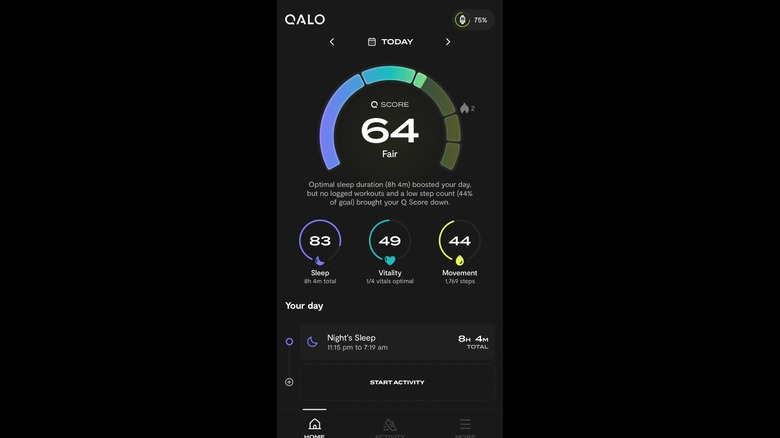
Like the devices it's competing with, the SL-1 collects a trove of data about you, but knows it's too much for you to take in. Consequently, it produces a Q Score, a single 1-100 metric telling you how well you're looking after yourself and how much fuel is in your tank. As you can see from the screenshot, the score is joined by three other metrics: Sleep, Movement, and Vitality. The latter aggregates your resting heart rate, resting HRV, blood oxygenation level and skin temperature.
Open the app each morning, and you'll get a pop-up telling you your Q Score for the previous day. Get enough sleep and exercise, and that figure will be high, and if you look after yourself for several days in a row, you'll get a streak encouraging you to keep it going.
Once dismissed, you'll be able to look at the home screen, which provides live updates on Q Score throughout the day. Annoyingly, its conclusions exist in a vacuum, and are written past-tense. Look at this first thing in the morning and you'll be told your score is low because you didn't log a workout and didn't walk enough. It's not a big deal in and of itself, unless you're really sensitive to being demoralized by your fitness wearable. But it's a sign the system does little beyond aggregating the data it's given, ignoring the broader context.
I'm also disappointed at the lack of automatic workout detection, at least for the basics, which should be a standard feature for any fitness band. The fact the SL-1 can't identify when I'm out for a walk and log that separately vexes, especially given the likelihood I'll forget to activate a workout. This omission may be easier to take if you couldn't get a product like Garmin's Cirqa for the same amount of money, which can do this.
Start an activity, and you'll get details on your heart rate zones, maximum and average HR, steps and calories burned. You'll even get your live heart rate and the zone you're in as a live activity on your phone's lock screen. You'll then get a breakdown of your heart rate zones and calories burned at the end of a workout, again much like you'll find on other devices.
One thing I cannot fault the SL-1 for is its battery life, and I suspect it'll make it at least past its 12-day promise. I've worn this thing a full week, and the battery is still reporting a charge level of 59 percent, which is worthy of praise in and of itself.
Wrap-up
Daniel Cooper for Engadget
One of the hard things about testing the Qalo SL-1 was the fact I don't think it did anything well enough to outperform its rivals. There's no single killer feature it offers that would compel me to recommend it over any other screenless fitness tracker out there. Instead, it feels like the unit you'd recommend to someone who simply wanted to dip a toe into this market. It's basic, simple, commitment-free and achieves its laudable if unexciting goal of ticking all of the boxes.
But this device costs the same as a Garmin Cirqa, a device I didn't think was all that amazing, but did a lot of these basics better. The Cirqa is at least equipped with the fundamentals you'd expect from a company of Garmin's size and experience. Take automatic activity tracking, for example, which I'd say isn't just nice to have but an essential feature for even those of us who are sub-weekend warriors.
If the SL-1 was cheaper, I'd have more positive things to say about it, because you could easily see it as a My First Whoop. But for this sort of money, I'd say there are better alternatives, even when you factor in additional subscription fees.
KioskNews shows a cleaned-up reading view extracted from the publisher’s page — the original always lives on their site, not ours.