The world needs more Geneva Conventions, come hell or high water — Phar Kim Beng and Shahiran Kamaruzaman
NOVEMBER 16 — The world is entering an era when the use of military force is increasingly treated as an instrument of first resort rather than the last. Yet the more wars proliferate, the more urgent it becomes to strengthen the international conventions that restrain them. The world does not need fewer Geneva Conventions. It needs more of them. Come hell or high water.
The four Geneva Conventions of 1949 emerged from the devastation of the Second World War. Their fundamental purpose was to establish that even warfare must have limits. Civilians must be protected. Prisoners of war must be treated humanely. The wounded and sick must receive medical care. Hospitals and humanitarian personnel must not become deliberate targets.
These are not optional expressions of goodwill. They are legal obligations rooted in international humanitarian law. Yet the conflicts of the twenty-first century have exposed how difficult it has become to enforce these obligations. From Ukraine to Gaza, from Sudan to the wider Middle East, civilian populations have endured enormous suffering. The destruction of essential infrastructure, displacement of communities and interruption of humanitarian assistance have raised profound questions about the effectiveness of existing international mechanisms.
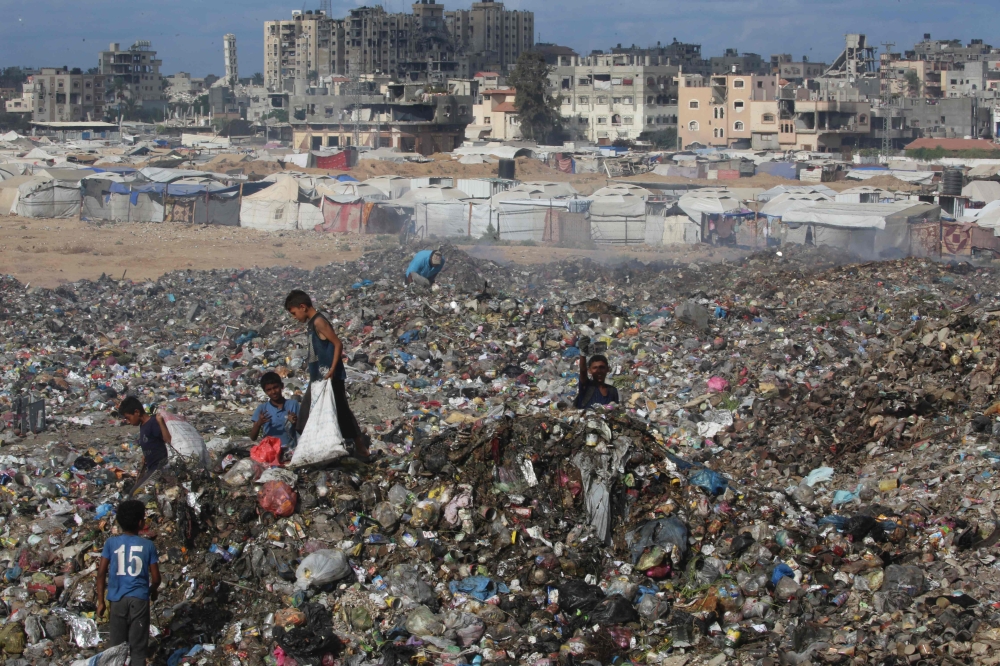
Displaced Palestinian children search of items that could be used as fuel for cooking amid a pile of garbage next to destroyed buildings at the Bureij camp for refugees in the central Gaza Strip October 6, 2025. — AFP pic
The problem is not necessarily that international humanitarian law has become obsolete. Rather, the mechanisms for ensuring compliance have not kept pace with the changing nature of warfare. The original Geneva Conventions were designed primarily around the realities of conventional warfare. Their Additional Protocols subsequently expanded protections, including those relating to civilians in international and certain non-international armed conflicts.
But warfare has changed dramatically.
Autonomous weapons, artificial intelligence, cyberattacks, drones and attacks against critical infrastructure have created new dimensions of vulnerability. A cyberattack against an electricity grid can disable hospitals without a single bomb being dropped. An attack against desalination facilities can deprive millions of people of drinking water. The disruption of maritime transportation through strategic waterways such as the Strait of Hormuz or the Red Sea can threaten food and energy security far beyond the immediate battlefield.
These developments require more than rhetorical reaffirmations of existing conventions. They require serious international negotiations on additional rules, clearer interpretations of existing obligations, stronger verification arrangements and credible enforcement mechanisms.
Artificial intelligence makes this particularly urgent. If military systems become increasingly autonomous, the question of human responsibility cannot be left unresolved. No government should be able to evade accountability merely because a military decision was delegated to an algorithm. The principle of meaningful human control over decisions involving lethal force deserves sustained international attention.
The history of international relations demonstrates that major wars often emerge not merely from disputes over territory or power, but from the gradual collapse of restraints on state behaviour. The First World War demonstrated the consequences of alliance commitments, militarisation and diplomatic failures. The Second World War demonstrated the catastrophic consequences of aggressive expansionism, racial supremacy and the systematic destruction of civilian populations.
The United Nations and the Geneva Conventions were among the institutional responses to these experiences. They were designed to prevent the recurrence of such catastrophes. Yet international institutions cannot survive on historical prestige alone. They must be strengthened by contemporary political commitments. The United States, China, Russia, the European Union and other major powers have particular responsibilities because their military capabilities and geopolitical influence affect the international system.
However, the development of humanitarian rules cannot become the exclusive preserve of the strongest states. The world cannot afford another arrangement resembling Yalta, where powerful governments negotiate the fate of smaller countries without their meaningful participation. Any renewed Geneva process must be inclusive.
For Asean, the strengthening of international humanitarian law is not an abstract diplomatic exercise. South-east Asia has experienced colonialism, occupation, revolutionary warfare, interstate conflicts and prolonged internal instability. Its member states understand the consequences of allowing military confrontation to overwhelm political dialogue. Asean has also spent decades developing institutions intended to encourage consultation, confidence-building and peaceful dispute resolution. These include the Asean Regional Forum, the East Asia Summit and the Asean Defence Ministers’ Meeting-Plus. Such institutions cannot replace the Geneva Conventions. But they can help build the political conditions necessary for their implementation.
Asean should therefore consider advancing a regional initiative supporting the modernisation and stronger enforcement of international humanitarian law. This initiative should involve not only the major powers but also smaller and medium-sized powers whose populations are frequently exposed to the consequences of conflicts they did not initiate. Indeed, the Indo-Pacific cannot be governed exclusively through military alliances and strategic competition. It requires a stronger architecture of humanitarian restraint. This is where Asean Will must become more important than diplomatic habit. Asean must demonstrate the collective determination to defend principles that protect civilians regardless of which major power is involved.
The moral foundations of humanitarian protection are not confined to Western international law. Islamic traditions of warfare contain important principles concerning the protection of non-combatants, the humane treatment of captives and restrictions on unnecessary destruction. Confucian political thought emphasises humane governance, moral responsibility and the obligation of rulers to exercise power with restraint. Western philosophical traditions, from Aristotle to the development of just-war thinking, have similarly examined the relationship between force, justice and political responsibility.
These traditions are not identical. Nor should their historical differences be overlooked. Nevertheless, they provide important intellectual resources for building a wider international consensus.
The Geneva Conventions should therefore be understood not as the exclusive achievement of any single civilisation, but as part of humanity’s continuing effort to limit cruelty. An international humanitarian order becomes stronger when its legitimacy is recognised across civilisations.
Military deterrence remains a feature of international relations. States will continue to maintain armed forces and defend their sovereignty. But military capabilities alone cannot produce a durable international order. The accumulation of weapons does not automatically generate political trust. Nor can military superiority resolve every historical grievance, territorial dispute or ideological disagreement.
Diplomacy is indispensable precisely because states disagree. International conventions provide a framework through which adversaries can establish minimum standards of conduct even when they cannot reach agreement on larger political questions. This is the enduring importance of Geneva. It is possible for governments to remain strategic competitors while accepting common humanitarian obligations. Indeed, the greater their rivalry, the more necessary these obligations become.
A renewed international initiative should concentrate on five priorities. First, strengthening compliance with existing Geneva Conventions, including independent investigation of alleged violations. Second, clarifying humanitarian protections in cyberwarfare and military applications of artificial intelligence. Third, reinforcing protections for hospitals, schools, water systems, electricity networks and other infrastructure essential to civilian survival. Fourth, improving humanitarian access and accountability in conflicts involving both states and non-state armed groups. Fifth, ensuring that smaller and medium-sized powers, regional organisations and representatives of affected populations participate meaningfully in the development of future rules.
Not every challenge requires an entirely new treaty. Some can be addressed through stronger implementation of existing law, additional protocols, interpretive agreements and institutional reforms. What matters is that international humanitarian protection does not remain static while the technologies and consequences of warfare continue to evolve.
The central challenge of our time is not merely the distribution of power among the United States, China, Russia and other major actors. It is whether international society can preserve a minimum standard of humanity amid intensifying geopolitical competition.
Without such standards, every conflict risks becoming a contest in which civilian suffering is treated as an unavoidable instrument of strategic pressure. That would be a dangerous regression.
The Geneva Conventions were created because earlier generations witnessed what happened when warfare was allowed to escape moral and legal restraints. Their achievement must not be squandered. The world needs more Geneva diplomacy, stronger humanitarian conventions and greater willingness to hold all parties accountable under international law. Malaysia and Asean should contribute to this effort by bringing together the major powers, smaller states, international organisations and civilisational traditions in a sustained dialogue.
The objective is not to abolish geopolitical competition overnight. It is to ensure that competition never becomes an excuse for abandoning humanity. Come hell or high water, the world needs more Geneva Conventions, not fewer. For when international humanitarian law collapses, it is not merely diplomacy that fails. It is civilisation itself.
* Phar Kim Beng, PhD, is Professor of Asean Studies at the International Islamic University of Malaysia and Director of the Institute of International and Asean Studies (IINTAS). Shahiran Kamaruzaman is an independent researcher.
** This is the personal opinion of the writers or publication and does not necessarily represent the views of Malay Mail.
KioskNews shows a cleaned-up reading view extracted from the publisher’s page — the original always lives on their site, not ours.