Tosca review – Axelle Fanyo and Christopher Purves shine in ENO’s reimagined Puccini
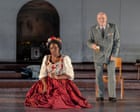
Four years since English National Opera unveiled its previous Tosca (a hyper-stylised affair directed by Christof Loy), the curtain goes up on another new production, this time by ENO’s artistic director Annilese Miskimmon. The appeal of Puccini’s work to any company – never mind one urgently committed to stabilising itself – is clear. Tosca is one of opera’s most bankable titles and a complex, compact drama about power with endless potential for contemporary “relevance”.
It’s also an opera rooted in the specifics of three real locations – at least according to the original text and stage directions. Where other operas’ settings are regularly reimagined, Tosca’s ultra-realism has proved exceptionally immovable. Miskimmon’s decision to strip Amanda Holden’s translation of all references to particular places and – still more unusual – to set the entire opera in a single space might thus have been a radical creative departure.
In practice, however, the curtain rises on what looks like a variation on the standard theme: a plain, mid-century modern church complete with Madonna and mural-in-progress, a troupe of cleaning ladies and a sacristan-cum-caretaker in dungarees. But a battered baby grand and the baffling arrival and immediate departure of a string quartet should, it seems, give the game away that (as per the programme) we are actually looking at a concert hall – albeit one in which the sacristan still pauses work to sing his Angelus.
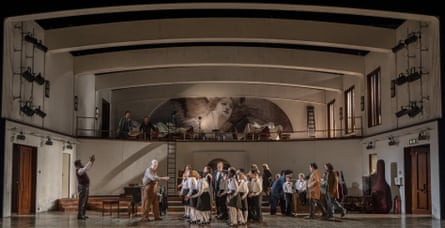
Among the various dramaturgical problems this approach unfortunately introduces, we lose Puccini’s visceral collision of church and state at the end of act one and his subtle layering of onstage and offstage worlds in act two. It’s hard to say what we gain instead beyond near-constant violence. Women are hauled around by their hair and the Marchioness Attavanti gets a cameo to scream through the Te Deum. Corpses accumulate on stage as Scarpia’s heavies amble around. Multiple musical instruments are smashed, the impact diminishing slightly each time.
There were moments when the sheer musical sumptuousness generated by the ENO orchestra under Ben Glassberg overwhelmed anything happening on stage, and when vicious snaps of brass conjured a real sense of terror. There were times when the chorus roared desperately into life, adults and children alike intensely engaged. There were others when Axelle Fanyo’s beauty of tone in the title role – covered and luxurious, served in a liquid torrent – rendered temporarily irrelevant the endless onstage foot traffic. Chaz’men Williams-Ali sounded uncomfortable as Cavaradossi, struggling to make an impact from the back, when pitted against onstage “offstage” musicians and alongside so many larger voices. But Christopher Purves was a terrific, brutish Scarpia – his posture as starched as his uniform, his baritone stark and chilly, his diction hard as nails. This is not, I’m afraid, a vintage Tosca – but Purves’s Scarpia just might be.
KioskNews shows a cleaned-up reading view extracted from the publisher’s page — the original always lives on their site, not ours.