Ice legends launch synchro9 worlds at home rink
British ice dance greats Jayne Torvill and Christopher Dean returned to the rink where their remarkable journey began to help launch the first Synchro9 World Championships, bringing a new Olympic discipline to the city that shaped their careers.
The inaugural championships take place from March 27 to April 4 at Nottingham’s Motorpoint Arena, the rink where Torvill and Dean teamed up as teenagers and where they performed their final show in July last year after skating together for 50 years.
“For us, this is where it all started,” Dean said. “A lot of the skaters will start their Olympic journey out of this competition. People that you will see here next year, you will see at the Olympics,” he said.
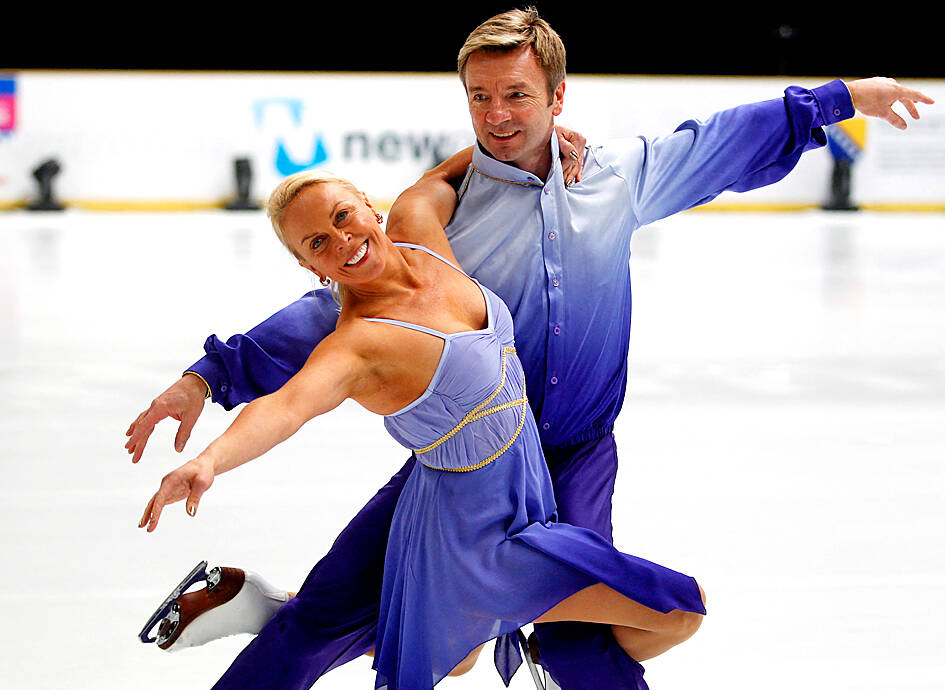
British ice skating pair Jayne Torvill and Christopher Dean perform during a rehearsal in Sarajevo on Feb. 13, 2014.
Photo: Reuters
Synchro9, which features nine-skater teams rather than the traditional synchronized skating teams of 16, is to make its debut at the Alpes 2030 Olympics and would also feature at the 2028 Youth Winter Olympics.
The International Skating Union hopes the new version of the 70-year-old discipline, featuring head-to-head knockout rounds and a draw for opponents similar to a soccer cup competition, would attract fresh audiences.
“This is a very unique opportunity for us, similar to one that was enjoyed by rugby when rugby sevens came around, when three on three basketball came around. This is going to be a completely different feel,” said Martyn Hindley, the International Skating Union’s head of corporate communications and public relations.
Dean said the condensed format should produce a more dynamic spectacle and offer new opportunities for female skaters in a sport where women have long outnumbered men.
“There are a lot of lady skaters in the world and fewer men,” he added.
Torvill laughed as she recalled the imbalance from their competitive days.
“The minute a guy came along, it was like, grab him,” she said.
The technical demands remain formidable in synchro9, with nine skaters required to perform in perfect unison.
“If one skater goes down, it’s like a pack of cards,” Dean said.
“They’re doing spins and turns that have to be in sync,” Torvill added. “That would really stand out if someone’s out of time,” she said.
British Ice Skating chief executive Maggie Still said the discipline could help broaden the sport’s appeal through its team format and athleticism.
“Our aim is to drive greater participation in sport,” Still said.
“What I’ve seen about synchro is it’s brilliant, it’s a team sport, it’s fun and you see lots of dynamism and great athleticism, power and grace,” she said.
Torvill and Dean, who initially combined skating with their day jobs — the former as an insurance clerk and the latter as a police officer — famously won Olympic gold in Sarajevo in 1984 with their stirring “Bolero” program.
They also claimed four world titles before ending their performing career with the farewell tour “Our Last Dance” last year.
Retirement has brought a slower pace.
Dean still works as a choreographer, but both remain closely connected to the rink where he once drove the Zamboni before dawn to clear the ice for training and where one of Britain’s most celebrated sporting partnerships was born.
“It does feel like our home,” Dean said. “It’s a cathedral, in a sense, of skating for us in Nottingham,” he added.
KioskNews shows a cleaned-up reading view extracted from the publisher’s page — the original always lives on their site, not ours.