Iconic penguin colony sees "population collapse," study finds
A remote island near Antarctica is no longer home to the world's largest penguin colony as climate-driven changes to ocean food chains likely devastated its once-thriving inhabitants and caused a "population collapse," researchers said Wednesday.
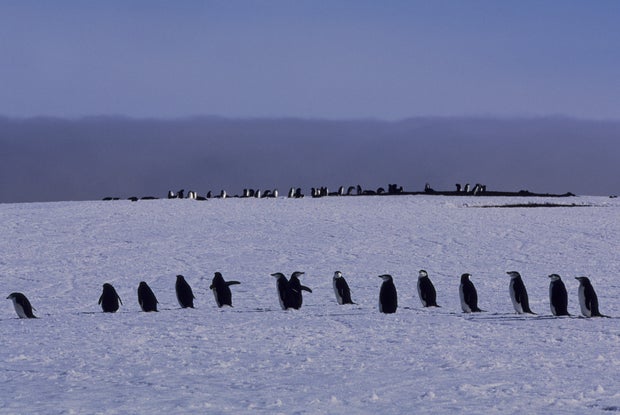
Drone and satellite images showed that the volcanic island of Zavodovski lost more than 680,000 — or nearly two-thirds — of its chinstrap penguins between 2011 and 2025, according to the British Antarctic Survey (BAS).
"That's a very rapid loss," Norman Ratcliffe, the lead author of the BAS study published in the journal Current Biology, told AFP.
The study's findings raise concerns that chinstrap populations across the South Sandwich Islands, which include Zavodovski and are home to 38% of the species, have fallen.
The scientists, who released video of their research, suggest that the "alarming declines" should lead to chinstrap penguins being redesignated as "endangered" by the International Union for Conservation of Nature (IUCN).
This would be a sharp downgrade from their "least concern" classification, which means they are not currently threatened with extinction.
Surveys in 2011 had concluded that chinstrap populations across the South Sandwich Islands were stable.
But their number on Zavodovski fell from around 1.09 million breeding individuals in January 2011 to 402,000 in 2025, or a 63% decline, according to the study.
The island is also home to a different species, macaroni penguins, whose population rose from around 338,000 in 2011 to 433,000 in 2025 -- and now outnumber chinstraps.
Together, chinstraps and macaronis now total more than 835,000 on Zavodovski.
The researchers said the Adelie penguins of Cape Adare, on the other side of Antarctica, are now the world's largest penguin colony, numbering more than one million as of 2018.
"Most striking change"
Zavodovski island's Mount Curry volcano erupted in 2016, sparking fears that it could wipe out its penguin population.
But the researchers found that the ash cloud was blown northeast over an area not inhabited by the flightless birds.
"The decline in chinstrap colony area was in progress prior to the eruption and continued at a constant rate thereafter," the study said.
"We don't think the volcano is implicated or it's not the main driver (of the population decline) because what we see is a linear decline in the chinstrap penguins," Ratcliffe told AFP.
Instead, the scientists linked the drop in chinstrap numbers to a reduction in the availability of krill -- the tiny shrimp-like creatures that are their main food source.
Warming ocean temperatures have pushed the crustaceans south toward colder waters, which chinstraps do not tolerate.
"We think that climate change operating through food webs is probably the main driver," Ratcliffe said.
The island's chinstrap population has been falling at a rate of 7% per year.
Macaroni penguins have increased in number over the same period as they eat a wider range of prey than chinstraps. Their survival also supports the idea that the volcanic eruption was not a factor in the chinstrap's demise.
"The observed numerical shift from chinstraps to macaronis on Zavodovski represents the most striking change in penguin community composition that has been observed at a single location in Antarctica to date," the study said.
"The most plausible explanation for the observed patterns of population change is that a climate-induced regime shift has occurred that has been detrimental to the maritime Antarctic chinstraps but has favored the subantarctic macaronis."
A study released earlier this year found that warming temperatures are forcing chinstrap, Adelie and gentoo penguins to breed earlier, posing a big problem for the species. The change in habits is setting up potential food problems for young chicks.
The new study comes about six months after the emperor penguin was declared an endangered species.
Researchers from the British Antarctic Survey and University of Southampton said last year that Antarctica's emperor penguin population may be declining faster than even the most pessimistic predictions. Images showed the species, recognizable by their height and yellow patches, declined in Antarctica by 22% between 2009 and 2024.
KioskNews shows a cleaned-up reading view extracted from the publisher’s page — the original always lives on their site, not ours.