No, ‘Mayday’s Ryan Reynolds and Kenneth Branagh Aren’t Just Pretending to Be Friends

Gabrielle Moss has been writing about pop culture for over a decade, for publications including The New Yorker, GQ.com, Slate, Bustle, New York Magazine, and many more. Her book,
"Paperback Crush: The Totally Radical History of '80s and '90s Teen Fiction," was released in 2018, and she was featured in the 2023 documentary "Judy Blume Forever."
Everyone knows that you don’t actually have to be buddies to make a good buddy movie. After all, Abbott and Costello famously made more than one film together after they stopped speaking. Gene Wilder and Richard Pryor never hung out when the cameras weren’t rolling. And at this point, Kim Cattrall is probably just as famous for trashing her former Sex and the City co-stars as she was for once playing their best friend. That’s why it’s called “acting,” right?
So there’s no reason to assume that the camaraderie fueling Mayday, Ryan Reynolds and Kenneth Branagh’s exuberant new ‘80s-throwback action-comedy on Apple TV, has anything to do with real life. The movie follows, in Reynolds’ own words, “a guy who lives in the woods like Ted Kaczynski, whose only movie that he watches over and over again is Top Gun on a bootleg VHS” — that would be Branagh’s Nikolai, a kind-hearted, Americana-obsessed ex-KGB agent living an isolated life in rural Russia. “And then as far as he's concerned, Maverick has just been shot out of the sky and falls down into his yard” — that would be Troy, Reynolds’ hotshot Navy pilot, whose plane crashes during a top-secret mission and suddenly has to make his way home through enemy territory during the final days of the Cold War.
The film follows their wild, Midnight Run-esque journey across the country as Nikolai tries to get Troy to safety, a trip that also becomes a journey toward seeing each other beyond the era’s Cold War stereotypes. It’s a warm, chemistry-filled performance, but again, there’s no reason to believe that the two men playing friends are actual friends. After all, Reynolds and Branagh are both pretty successful at this whole “acting” thing.
But when they sweep into a tiny conference room at Collider HQ in New York for an interview — Branagh, ever the director, trying to figure out exactly where everyone should sit and pouring us tiny cups of sparkling water, while Reynolds cracks wise (“you actually don’t want to put sparkling water in an IV drip…a lot of people don’t know that”) — it starts to feel like their on-screen chemistry exists in real life, too.
And then, there’s the story of their first meeting on the set of Mayday, which they tell in overlapping sentences, like college friends remembering an especially wacky evening in the dorms. Branagh remembers someone calling “cut” on a camera test when Reynolds immediately launched into a sentence “as if we were just picking up the sentence from the last conversation that we must have had.”
“I like to confuse my co-stars by beginning our first conversation, ‘And furthermore,’” Reynolds explains, to which Branagh responds, “And it worked.”
That instant familiarity never really went away. “I think people can tell that we love each other,” Reynolds says. “When we met, it felt like we had known each other for 20 years.”
So yes, Ryan Reynolds and Kenneth Branagh are definitely friends in real life. On a technical level, that doesn’t really change anything for you, the viewer (unless you made a bet about it on Kalshi, in which case: congratulations!). But their friendship also provides a window into what it actually takes to make an effective buddy movie. Because sure, you don’t need to be buddies. But you do need to feel love — for acting, for the particular conventions of buddy comedies, and for the art of wanting to make your co-star look better than you do.
“Every movie that works is a love story on some level,” says Reynolds. “I don't care if it's a romance or not. When they work, there's love baked into it somehow.”
Ryan Reynolds Knows the Secret to a Great Buddy Movie

Of course, if anyone is an expert in what makes buddy movies function, it might be Reynolds, our greatest living practitioner of the art form. Though 2016’s Deadpool — the film that earned him a Golden Globe nod and made him one of the most recognizable stars in the world — was more of a solo affair, Reynolds has long thrived in films where he shares the screen with another lead, whether he’s begrudgingly helping Sandra Bullock secure a green card in The Proposal, shooting it out alongside Samuel L. Jackson in action-comedy The Hitman’s Bodyguard, or creating a whole lot of timeline anomalies with Hugh Jackman in Deadpool & Wolverine.
“It’s the best because you get to work with the best. I've had the privilege of working with some of the best on earth,” says Reynolds. “I love that I get an audience of these people, and I get to be the audience with these people. And I think it's wonderful because each one brings out something completely different in their co-stars—”
“Sorry to interrupt,” Branagh interrupts, “but one of the key things in Deadpool and Wolverine, aside from its brilliance and the quick-fire wit and the intelligence and the deep cleverness on a sort of cosmic scale, is the you and the Hugh of it all. Just an obvious thing to say, but it’s just that takes it to —”
“And you can feel that these guys love each other,” Reynolds interrupts right back.
Beyond the more low-key things Reynolds and Branagh have in common (more on that later), they share an overarching philosophy of acting that’s more about teamwork than personal glory. “I remember seeing [The Hitman’s Bodyguard] not so long before this project came up,” Branagh says, “and saying to my wife on the way back from the pictures, ‘That kind of acting, that's very generous. Both of them, I know that they're constantly whinging at each other. But look at that — I feel the generosity of that.’ And I think that seems to be an audience’s response to a buddy comedy, if it's the real McCoy. Even if the characteristics are adversarial, they can smell it when actually the real thing is there.”
“You can tell when the characters in the scene are trying to win, and you can tell in the negative context when the actors are trying to win,” says Reynolds. “When the actors are trying to win the scene, it doesn't work. The characters are trying to win the scene, of course. But the actors need to be there to share and support and try to hit the ball back and forth with each other. You want to get a rally going. You don't want to get an ace.”
Watching something like 'Midnight Run,' for instance. You end up at the end bizarrely wanting to be their friend too.
“When that happens,” says Branagh, “that sort of fluidity…watching something like Midnight Run, for instance. You end up at the end bizarrely wanting to be their friend too. You somehow want to enter that circle of friendship, if you feel that it's real.”
On the set of Mayday, Reynolds and Branagh’s real-life connection fed directly into their on-screen generosity — in fact, one such moment is immortalized in the film, about 51 minutes in. During shooting, “we would always leave the trailer at the same time,” Branagh recalls.
“[Film sets] are military operations,” Reynolds cuts in. “Sometimes, you can work with someone where [the crew says] ‘Okay, we're ready on set,’ and you get to set, and you're like, ‘Where are the other people?’ They're still in their trailer. Still haven’t emerged. ‘Can someone pull them the fuck out?’ But Ken and I were just always right in lockstep.”
Branagh takes over: “The first day we were walking from the trailers like that, having a natter, and in the distance, you could see the boys” — Mayday directors Jonathan Goldstein and John Francis Daly. In the next scene, Reynolds and Branagh “were to walk up to a door in a Russian village, and the light was going,” Branagh recalls. So Goldstein and Daly wondered: instead of taking a beat and preparing as they normally did, would the actors be game to just continue their walk directly onto set, and shoot the scene right then? “So they turned over, and I'd switched into the Russian accent, and we switched into the scene. But really, it had been one organic and almost seamless development from a chat from the trailers.”
“They were just rolling as we just crested this little hill and kept walking,” Reynolds adds.
“It felt like there was a big neon light going on that just said, ‘No acting, no schmacting,’” says Branagh (“schmacting” means “overacting” — I had to look it up, too).
“It was very lucky,” says Reynolds. “I mean, that's something that doesn't always happen, because you can't manufacture chemistry.”
Kenneth Branagh Saw Reynolds’ “Beautiful Obsession” Up Close

Though hearing Branagh and Reynolds reminisce makes filming sound idyllic, the truth is that Reynolds was actually working a second job pretty much the entire time. Due to scheduling issues created by the 2023 SAG-AFTRA strike, Reynolds was still handling Deadpool & Wolverine’s edits and final touches throughout Mayday’s spring 2024 shoot.
“He was in the last throes of delivering the brilliance that is Deadpool and Wolverine,” Branagh recalls, “changing, working on it in some way, shape, or form every day.” Not that Reynolds was complaining about it — in Branagh’s recollection, his co-star usually spoke about it as if it were simply, “‘Oh yeah, it was the thing I had to do. Whatever’” — but the dual workload was noticeable.
A gift that the greats have in front of the lead is to be entirely and fully present in what you're doing. This genre, as well, seems to absolutely demand that.
Not necessarily in a bad way. “He was just always able and ready to patiently finish it. If there was an opportunity to make it a bit better, he did so with, I would say, a beautiful obsession, as opposed to a fatal fanaticism…He was ready to let it go, but only when it was as scrubbed up as it possibly could be. And that requires such balls and such sort of courage and such judgment, because you can get overinvolved.”
What impressed Branagh just as much as Reynolds’ work ethic was how, when the cameras rolled, Reynolds was somehow fully in 1980s Russia. “A gift that the greats have in front of the lead is to be entirely and fully present in what you're doing,” says Branagh. “This genre, as well, seems to absolutely demand that... This requires the audience to feel that affection, and if you're not there, if you're not present, you'll get rumbled, and it will be less. You will not have charm, that elusive quality that you can't fake.”
‘Mayday’ Literally Flips the Script for Reynolds and Branagh
Another way Reynolds and Branagh’s mutual admiration plays out on screen is in how it allows them to support each other while taking risks. Though both actors obviously have serious comedic chops, their respective Mayday roles push them out of their comfort zones (or, if you prefer, send them into the danger zone).
Branagh, more typically associated with highbrow fare like his Agatha Christie adaptations or Belfast, the semi-autobiographical 2021 drama that won him a Best Screenplay Oscar, leads many of the film’s comedic and action beats, playing Nikolai as a sweet, Springsteen-obsessed goofball who just so happens to be able to incapacitate a man with a billiard rack. It’s his first action-comedy in more than 25 years, since 1999’s Wild Wild West, and his first film ever in which he participates in highly choreographed, John Wick-style fight sequences.
He handles all of it not only with zest, but with shocking comfort — as Reynolds recalls thinking on set, the famous Shakespearean actor’s performance makes “it look like this is the trade he's plied since day one. It feels like he's only done buddy action comedies his whole life.”
“We've spent so much time on sets,” says Reynolds. “I remember I did this sort of math at one point — I'm almost 50 years old, and I've spent about 47,000 hours on film and TV sets. You’ve learned; you've seen failure in kaleidoscopic colors. You've seen success in kaleidoscopic colors. Both are teaching different things, the failure obviously teaching more, blah blah blah.
“That's a cliché. But you can really see that in Ken's work in this movie, because he has been in so many situations and he has such a nuanced and in-depth understanding of storytelling. But at the same time, he's doing something utterly vulnerable, which is stepping into a genre where he is the driving comedic force as well as the driving action here — he's really pushing the action in the movie.
I got a front row seat to Ken doing something that I've never seen him do — and I've seen him do some of the most incredible work you could imagine...
“I got a front row seat to Ken doing something that I've never seen him do — and I've seen him do some of the most incredible work you could imagine on stage, on screen, anywhere. And so there's a part of you that is understanding that this moment is such a privilege to watch. I get to watch him go. What fun, what a job! Like, that's considered a job somehow?”
Branagh’s fearless pivot toward a totally new type of acting at age 65 taught Reynolds that “you should always be striving toward that thing that must feel uncomfortable or must be unexpected, but that you're able to rise to that occasion just on your experience alone. You've got so many different quills to write with that you can't even imagine. So I watched him. I'm really inspired by that.”
That was a lesson Reynolds put into use in real time, because in Mayday, he takes his own unexpected swing: playing buttoned-up, patriotic Troy as the straight man. “I love buddy comedies,” says Reynolds, citing films like Beverly Hills Cop and Midnight Run, the latter of which Mayday seems to owe an especially strong debt. “What always made them real,” he notes, “was that pacing. You can't laugh the entire time. The closest proxy you can get is how a chef needs to work when he prepares a meal — you know, it could be the best dessert you've ever had in your life, but if the whole thing was just the dessert, you wouldn't enjoy it. You've got to have those peaks and valleys.”
Reynolds is happy to anchor the film through those peaks and valleys, letting Branagh fly free with his character’s high spirits.
“Not everybody wants to do that,” says Branagh, “and not everybody realizes as smartly as [Reynolds] does that, in something like this [film], watching a proper movie star and a great actor just react — watching them think, watching them process whatever madness they might have seen on the other side of the tennis court for a minute, either situationally or because of something Nikolai does — that that in itself is a strong and equal kind of contribution that is magnetic. It doesn't involve just the frenetic competition of verbal jousting.”
Okay, But What DO Reynolds and Branagh Have in Common?
Reynolds knows what you’re thinking. It’s not…weird, per se, but unexpected that he and Branagh have hit it off so well. “On paper, you'd think we couldn't be more disparate,” he says. “You just think, wow, these two have completely different backgrounds. But I was shocked at how much we have in common. There were so few things we couldn't talk about.”
So what do they have in common? Football, for one (that’d be soccer to us yanks), which they both follow passionately. Reynolds is famously a co-owner, alongside It’s Always Sunny in Philadelphia star Rob McElhenny, of Wales’ Wrexham A.F.C., as documented in their Emmy-winning docuseries Welcome to Wrexham; Branagh is known for supporting Tottenham Hotspur F.C.
Movies, for another: “You know, we can talk about old movies forever,” says Reynolds, “but we can also talk about silly movies that the film snob might go, ‘Oh, that's a dreadful piece of shit.’ You know, we'll find something in it that we love.”
“We both are happy not to talk, actually. As two people who've spent a lot of our time giving the old verbals, very happy not to talk, and to be intrigued by what other people do and how they feel,” says Branagh. “Often, I'll see Ryan, as it were, in repose, just occupied with something — you know, a person or a thing or I don't know, some kind of thought, some in-the-distance kind of thought.”
And in perhaps the only time in history anyone has likened Ryan Reynolds to Dame Judi Dench, Branagh reveals one more thing the two have in common: “You share this with Judi Dench actually, who once said to me — we'd had a bit of a bruising encounter with a slightly aggressive group of folk in some sort of crowd scenario. And she said, ‘Oh yes, a shame.’ I said, ‘I agree.’ She said, ‘Because I like meeting people.’ Which, given that she'd just been bished and bashed a little bit around with them…but she would not be put off by that. You like meeting people, and the presence thing is there.”
Mayday’s switcheroo — the famously funny guy playing the straight man, the famously highbrow actor fighting off a train car full of Soviet Army soldiers — seems less surprising after you spend some time around the actors, and find that each is actually more like the other than you’d guess. In a 30-minute conversation, Branagh twice breaks into (admittedly delightful) impressions — Winston Churchill and Orson Welles chewing out a bit-part actor on the set of A Touch of Evil, respectively. Reynolds is quieter than his brash characters, more likely to pull out a quote on the art of acting than make a sarcastic observation. Though each man has succeeded beyond most actors’ wildest dreams, Mayday gives them a chance to bust out of whatever categories the public has placed them in and, like their characters, try to break away to some place a little freer.
‘Mayday’s Cold War Comedy Isn’t About the Cold War At All

In fact, while Mayday is technically a historical film, its message is a very contemporary one about looking past our presumptions to find out who the people around us truly are.
“What I love about [the film] is that you have two people who have completely and totally mythologized each other before they've ever even met,” says Reynolds. “[Troy believes] ‘That's the Ruski, who's the enemy,’ and I'm the American who ostensibly should be the enemy. But the rug pull is that [Nikolai] is so much smarter than that. He loves [Troy] immediately. He worships the aspiration with which he comes from in America, but yet he still is savvy enough and smart enough to break down the larger mechanics of why America hates Russia or Russia hates America at this time.”
Speaking of Russians: Nikolai is the third major Russian character Branagh has played in the last 12 years, following Viktor Cherevin, an evil Russian oligarch who torments Chris Pine in 2014’s Jack Ryan: Shadow Recruit (which Branagh also directed) and Andrei Sator, an…evil Russian oligarch who’s literally trying to delete human existence in Christopher Nolan’s 2020 mind-bender Tenet. Nikolai is, of course, much kinder and gentler than either of these brutes. But seriously…what’s up with all the Russians?
“I think Ken might actually be Russia's cultural attaché,” jokes Reynolds.
For Branagh, our cultural obsession with Russia as a distant, malevolent place where a guy who wants to end the world might hail from is a fascinating well to draw from. “I think that maybe it indicates a culture or a kind of individual who we continue to be obsessed with, perhaps continue to know less about than we really think,” says Branagh. During the Iron Curtain era, Russians “were cast as our natural bogeyman foes, and I think we're still trying to understand.” For Westerners, it’s “as if [Russians] are some kind of brother that we have not found peace with yet, and so creatively, I think artists like to try and dive into that and see, is it an archetype from which we can learn something.”
This is the greatness of great art, isn’t it? The art that hides the art is always, for me, very, very interesting.
This is where Mayday’s story about the Cold War reveals itself to be about something larger. For Branagh, it becomes an investigation into “why do we have this problem with difference? Why do we need to express such extreme views about where we lay our allegiance or our loyalties? How can we find a useful gray area in which we can allow doubts and fears to be shared and perhaps empathized with and even dare we say understood?”
“I think that there's a quality to the ‘80s that has not really diminished or changed,” says Reynolds. “There's still kind of a march forward with this lazy-lidded certainty about right and wrong and lack of nuance. And if you look at these movies back then, when we were at Cold War with Russia, nobody thinks why… a movie like Top Gun is not going to get into the nuance of why.”
This might make Mayday sound like an ultra-serious treatise on politics and cultural difference, which it absolutely is not; it is a comedy in which Reynolds and Branagh discuss politics and cultural difference while hiding in a wine cupboard as a high-ranking Russian government official gets into some comedic sexual hijinks. Moments like this made Branagh think, “But we're in a buddy action comedy. How did the boys manage to squirrel that in there?”
“Out of the two guys in the film, I would consider you the foremost expert on Shakespeare, if you don't mind,” Reynolds tells Branagh. “But isn't that what he does? He smuggles messages into popular works?”
“This is the greatness of great art, isn’t it?” says Branagh. “The art that hides the art is always, for me, very, very interesting. And what [Goldstein and Daley] brought to bear was a love of this genre. You can't fake that. They absolutely adore how those movies were put together and found it a perfect vehicle. I think they're always looking, and their films are really an example of this, of finding a genre or a vehicle that is familiar enough to the audience to perhaps have them enter with a sort of populist ticket, and then they get to play inside there.”
The Good Stuff Is Still Ahead for Branagh and Reynolds

At the end of a buddy movie, no matter what happens on the journey, the two protagonists have to move on with their lives. And so will Reynolds and Branagh. Branagh will star in next year’s remake of The Thomas Crown Affair alongside Michael B. Jordan; meanwhile, there’s been fevered speculation about whether Reynolds will appear in the upcoming Avengers: Doomsday.
But like the journey in any good buddy movie, their experience on the set of Mayday has changed them, too. “Halfway into shooting, I'm just sitting there going, ‘This is insane that somebody can be, you know, at this stage in their career, having done all the things that he's done, 7 Academy Award nominations in different categories, crazy feats,” says Reynolds. “But here he is, being revelatory again, and that's a hard thing to find revelation again, when the bar for you — not by you, but for you — has been set at an almost impossible height. And then somehow you find a way to get that pole vault out and hurdle it, you know. To me, those are the goods. That's the good stuff, as Cary Grant would say. That is the good stuff.”
Mayday is now streaming on Apple TV.
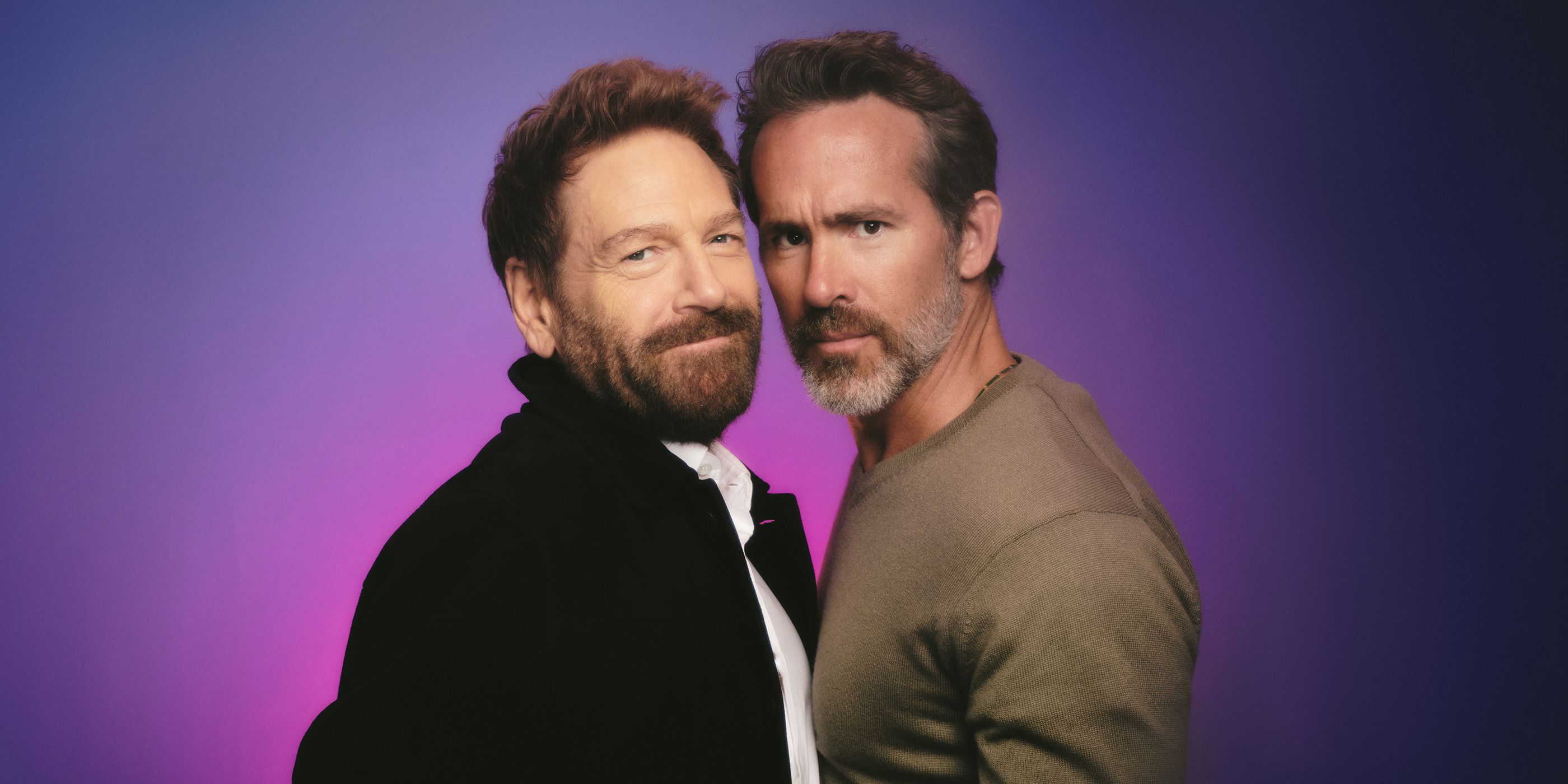
Photography: Stephanie Diani | Photographer Assistant: Casey Mathewson | Location: Collider HQ, New York City
Glam Credits:
- Ryan Reynolds — Stylist: Chloe Harstein | Groomer: Lori Hamlin Penske
- Kenneth Branagh — Stylist: Tom O’Dell | Groomer: Sussy Campos
KioskNews shows a cleaned-up reading view extracted from the publisher’s page — the original always lives on their site, not ours.