Sarawak steps up monitoring of orangutans as haze and heat persist
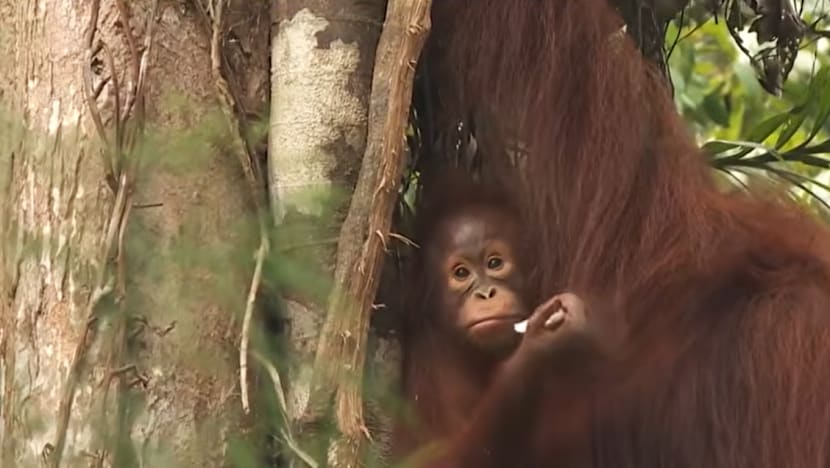
KUCHING: Wildlife authorities in Sarawak are stepping up monitoring of orangutans as haze blankets parts of the state, although rangers say the primates have so far shown no sudden changes in their health or behaviour.
At the Semenggoh Wildlife Centre near Kuching, rangers have increased surveillance in recent weeks, including using drones to monitor hotspots and assess how persistent haze and hot weather could be affecting the animals.
The more than 600-hectare park is home to about 29 semi-wild orangutans aged between three and 55. The tree-dwelling animals roam freely in the forest.
RAINFOREST CANOPY OFFERS SOME PROTECTION
Smoke, mainly from forest fires in neighbouring West Kalimantan, has caused air quality to deteriorate across parts of Sarawak.
But conditions within Semenggoh's rainforest appear to offer the orangutans some protection, with the thick canopy keeping temperatures cooler and filtering some of the haze.
Ranger Chad Bready, who has worked at Semenggoh for seven years, said the heat and haze have been more intense this year.
“So far, Semenggoh is under control. We have to monitor every day to see the health of the orangutans,” he said.
"The orangutans are very important, they are our icons. We have to take care of them.”
He said the animals also adapt to the heat, staying lower beneath the canopy during the day, where it is cooler, before moving higher at night.
Orangutans, whose name means “people of the forest” in Malay and Indonesian, are found in the wild only on the islands of Borneo and Sumatra.
They are also a major draw for Sarawak's ecotourism industry.
TOURISM FEELS IMPACT OF HAZE
At Semenggoh, fruit and other food, including coconuts, bananas, sweet potatoes and sugar cane, are placed on feeding platforms twice a day, giving visitors a chance to see orangutans emerge from the forest.
For British tourist Kenn Brooks, the encounter fulfilled a long-held ambition.
“This is one of the bucket list things,” he said, adding that he and his wife wanted to make the trip while they were still fit and healthy enough to do so.
The hot and hazy conditions have, however, kept some visitors away, with the centre seeing smaller crowds.
Sarawak Tourism Minister Abdul Karim Rahman Hamzah said conditions in forested areas could be more comfortable than in Kuching city because of the dense tree cover.
While it remains unclear how much the haze is affecting the orangutans, he said fewer visitors could also give the animals more space.
For now, the orangutans appear to be coping with the conditions, but rangers say they will continue to keep a close watch for as long as the haze persists.
KioskNews shows a cleaned-up reading view extracted from the publisher’s page — the original always lives on their site, not ours.