Placing biofuels at the heart of Indonesia's energy sovereignty drive
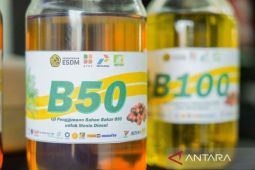
Semarang (ANTARA) - Under President Prabowo Subianto's administration, Indonesia is increasingly embracing a vision of breaking free from its reliance on imported energy and achieving long-sought self-sufficiency.
As he approaches his second year in office, the president has kept both the narrative and the policy drive behind that ambition firmly in the spotlight. As a result, the government has rolled out a range of measures since October 2024.
The push for energy security has clearly reflected the government's efforts to reduce the heavy burden of energy imports on Indonesia's fiscal posture, as the country continues facing substantial annual demand for fuel, which reaches 38.1 million kiloliters of gasoline and 40.6 million kiloliters of diesel.
Gasoline accounts for the largest share of fuel imports, with 23.83 million kiloliters sourced from abroad, primarily from Singapore and Malaysia, while domestic production stands at only 14.27 million kiloliters.
Although Indonesia consumes more diesel than gasoline, it has made significant progress in reducing diesel imports. Imported diesel now accounts for just 6.26 percent of total supply, thanks to the B40 policy requiring a 40 percent palm oil blend in diesel fuel.
Not content to stop there, the government has moved forward with the more ambitious B50 program, which is expected to save up to Rp170 trillion (around US$9.5 billion) in foreign exchange annually and eventually eliminate diesel imports altogether.
Despite the sharp decline in diesel imports, Indonesia cannot afford to overlook the risks of supply disruptions stemming from geopolitical tensions and the rupiah's depreciation against the US dollar.
Developments across Europe offer Indonesia a reminder of how quickly energy security can come under pressure. In France, for example, President Emmanuel Macron has urged state institutions to take all necessary measures to address a fuel crisis triggered by soaring energy prices linked to the conflict affecting the Strait of Hormuz, a strategic chokepoint for global oil shipments.
French motorists are reportedly paying 2.30 euros per liter of diesel, while gasoline costs 2.10 euros per liter. Both prices represent an increase of around 30 percent. The alarming situation prompted Macron to call for a relaxation of fuel specifications to give local refineries greater flexibility to raise output by as much as 20 percent.
Indonesia is endowed with abundant natural resources that could help it weather turbulence in global energy markets. Beneath its soil and across its seas lies a diverse array of resources capable of serving as alternative energy sources at a time when many countries remain vulnerable to external shocks.
Long recognized as the world's leading palm oil producer, Indonesia is now seeking to extract broader value from the commodity than simply exporting it. The B50 program embodies that ambition, dovetailing with the energy security agenda and the government's downstreaming push to turn natural resources into higher-value products.
As recently reported by Energy and Mineral Resources Minister Bahlil Lahadalia, the B50 program has logged 1,000 hours of mining trials, during which engine filters remained usable for up to 500 operating hours, double their usual replacement cycle.
Equally encouraging results emerged from vehicle trials, with some cars covering up to 50,000 kilometers before requiring a filter replacement. Even older vehicles recorded 37,000 kilometers before a replacement was needed. Both figures far exceeded the standard replacement interval of 10,000 kilometers.
While the B50 program targets diesel imports, policymakers are increasingly looking to bioethanol blends to curb Indonesia's reliance on imported gasoline. The government is gearing up to introduce E10 and E20 fuel blends, which would require gasoline to contain 10 percent and 20 percent bioethanol, respectively.
Under the current roadmap, Indonesia is targeting the rollout of E10 as early as 2027, with the policy expected to reduce gasoline imports by 3.9 million kiloliters. The projected reduction could rise to eight million kiloliters in a later phase with the implementation of E20.
In fact, the government is already looking beyond E20. At the far end of the roadmap lies E50, a target that, when paired with the B50 program, could save Indonesia up to US$30 billion in foreign exchange each year over the next decade.
Indonesia is turning to its vast agricultural resources to make the bioethanol strategy a success, with plans to significantly increase the production of sugarcane, cassava, and corn, the key feedstocks for the biofuel.
Agriculture Minister Andi Amran Sulaiman said at least two million hectares of land across the country would need to be cultivated to support the effort.
To that end, he convened leaders from 44 districts across several provinces for a coordination meeting in Jakarta, urging them to align their plans and prepare land for integrated bioethanol sites combining feedstock plantations with processing facilities.
The initiative, he said, is aimed at creating a more supportive ecosystem for the agricultural sector to play a larger role in strengthening Indonesia's energy security.
For now, the strategy begins with prioritizing the use of available land, including released areas and zones deemed suitable for the cultivation of energy crops.
Looking ahead, the dream of achieving energy sovereignty no longer appears beyond reach. If the current initiatives deliver on their promise, Indonesia could move closer to standing on its own feet, free from the vulnerabilities associated with dependence on imported energy.
In an era likely to remain marked by global uncertainty, energy self-sufficiency may well emerge as one of the country's most notable feats.
Related news: Indonesia pushes B50, E20 to cut fuel imports
Related news: Biofuels: Indonesia's strategic shield against energy volatility
Related news: Ministry: Biofuels to cut emissions by 39.7 mln tons
Translator: Teguh Wibowo, Tegar Nurfitra
Editor: Azis Kurmala
Copyright © ANTARA 2026
KioskNews shows a cleaned-up reading view extracted from the publisher’s page — the original always lives on their site, not ours.