77 Years Later, the Most Chilling Final Line in Sci-Fi History Is Still Powerful

David is a Senior Editor at Collider focused primarily on Lists. His professional journey began in the mid-2010s as a Marketing specialist before embarking on his writing career in the 2020s. At Collider, David started as a Senior Writer in late 2022 and has been a Senior Editor since mid-2023. He is in charge of ideating compelling and engaging List articles by working closely with writers, both Senior and Junior, as well as other editors. Occasionally, David also reviews movies and TV shows and writes episode recaps. Currently, David is also writing his second novel, a psychological horror satire that will, hopefully, be picked up for publication sometime next year.
Sign in to your Collider account
Science fiction is still one of the most popular genres across all media. Countless movies and TV shows come out every year, reinterpreting it in new and decidedly modern ways. However, it's perhaps in literature that sci-fi is most enduring, with more freedom to explore and defy its boundaries than any other medium. Many of the genre's greatest masterpieces originated as books, and what remains one of the most seminal and eerily prophetic of all time, George Orwell's 1984, came out 77 years ago.
Deservedly, 1984 has now become an outright institution of sci-fi, influencing countless stories in the years since and predicting a future that, while far bleaker and more unforgiving, is remarkably similar to many things that are actually happening right now. It also contributed greatly to language, introducing terms like "thoughtcrime" and "doublethink" into our lexicon. Indeed, it's perhaps in its writing that 1984 is most triumphant, featuring some genuinely thought-provoking and visceral lines that stay with you long after you finish reading. In fact, 1984 might just have the best final line in sci-fi history, four words that pack an incredible emotional punch and leave a mark on the reader.
What Is '1984' About?
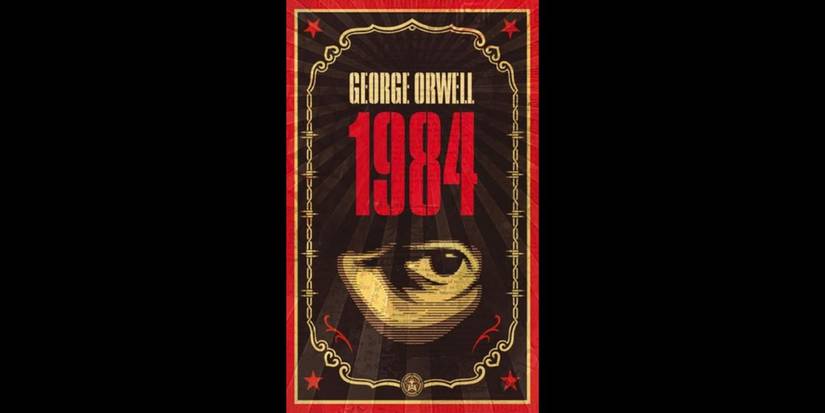
Orwell's 1984 takes place at an uncertain point in the future (widely presumed to be the same as the title) controlled by the totalitarian state Oceania, with places like the UK becoming its colonies. Oceania is ruled by Big Brother, whose intense cult of personality is overseen, encouraged, and safeguarded by the Thought Police. Propaganda, global mass surveillance, and history revisionism and denialism are used by the Thought Police to keep Big Brother in power and the masses subdued. In turn, Oceania is administered by several ministries, including the Ministry of Love (or Miniluv in the novel's "Newspeak"), the Ministry of Peace (Minipax), and the Ministry of Plenty (Miniplenty). "Big Brother is watching" is the slogan they employ both to cement the leader's influence and control and to keep the population in check.
The protagonist is Winston Smith, an employee of the Ministry of Truth in London, whose work is to rewrite historical records to better conform to Oceania's new guidelines. Secretly, he hates both Big Brother and Oceania, and dreams of rebellion, writing his thoughts in a diary. Things change when he meets Julia, a fellow ministry worker with whom he begins a clandestine sexual affair, ultimately leading to love, making them criminals, as Oceania only allows love for Big Brother. As their connection deepens, Winston learns more about Big Brother's political rival, Emmanuel Goldstein, and learns from a book Goldstein wrote how the Party keeps its power through a state of perpetual war.
What Is the Final Line in '1984'?

1984 has one of the bleakest third acts in literary history. Months into their affair, Winston and Julia are captured by the Thought Police, imprisoned at Miniluv, and subjected to months of intense torture and reconditioning. O'Brien, a member of the Inner Party whom Winston suspected to be a spy and who ultimately turns out to be an undercover member of the Thought Police, reveals that the Brotherhood, the supposed underground movement against Big Brother, might not be real at all, and that the Goldstein book was actually written by himself and other members of the Party. As the final torture, Winston is taken to Room 101 and threatened with flesh-eating rats. Finally, Winston succumbs to despair, asks for the torture to be given to Julia instead, and falls in line.
The book ends with a final meeting between Winston and Julia, both hollow shells of their former selves. They confess their mutual betrayal and admit that no feelings of love, or any kind, for that matter, exist between them anymore. As Winston watches news about yet another purported victory in Oceania's perpetual state of conflict, he proves the effectiveness of his re-education by accepting his genuine love for the oppressive state. "He loved Big Brother" are the words that conclude 1984, ending the whole ordeal on such a depressing and defeatist note that one can't help but sit there, assimilating what one just read and trying to make sense of it.
Collider Exclusive · Sci-Fi Survival Quiz Which Sci-Fi World Would You Survive? The Matrix · Mad Max · Blade Runner · Dune · Star Wars
Five universes. Five completely different ways the future went wrong — or sideways, or up in flames. Only one of them is the world your instincts were built for. Eight questions will figure out which dystopia, galaxy, or desert wasteland you'd actually make it out of alive.
💊The Matrix
🔥Mad Max
🌧️Blade Runner
🏜️Dune
🚀Star Wars
01
You sense something is deeply wrong with the world around you. What do you do? The first instinct is often the truest one.
02
In a world of scarcity, what resource do you guard most fiercely? What we protect reveals what we believe survival actually requires.
03
What kind of threat keeps you up at night? Fear is useful data — if you're honest about what you're actually afraid of.
04
How do you deal with authority you don't trust? Every dystopia has a power structure. Your approach to it determines everything.
05
Which environment could you actually endure long-term? Survival isn't just tactical — it's physical, psychological, and very much about where you are.
06
Who do you want in your corner when things fall apart? The company you keep is the clearest signal of who you actually are.
07
Where do you draw the line — if you draw one at all? Every survivor eventually faces a moment that tests what they're actually made of.
08
What would actually make survival worth it? Staying alive is one thing. Having a reason to is another.
Your Fate Has Been Calculated You'd Survive In…
Your answers point to the world your instincts were built for. This is the universe your temperament, your survival instincts, and your particular brand of stubbornness were made for.
The Matrix
You took the red pill a long time ago — probably before anyone offered it to you. You're a systems thinker who can't help but notice the seams in things.
- You're drawn to understanding how the system works before figuring out how to break it.
- You'd find the Resistance, or it would find you — your instinct for spotting constructed realities is the machines' worst nightmare.
- You function best when you have access to information and the freedom to act on it.
- The Matrix built an airtight prison. You'd be the one probing the walls for the door.
Mad Max
The wasteland doesn't reward the clever or the well-connected — it rewards those who are hard to kill and harder to break. That's you.
- You don't need comfort, community, or a cause larger than the next horizon.
- You need a vehicle, a clear threat, and enough fuel to outrun it — and you're good at all three.
- You are unsentimental enough to survive that world, and decent enough — just barely — to be something more than another raider.
- In the wasteland, that distinction is everything.
Blade Runner
You'd survive here because you know how to exist in moral grey areas without losing yourself completely.
- You read people accurately, keep your circle small, and ask the questions others prefer not to answer.
- In a city where humanity is a legal designation rather than a feeling, you hold onto something that keeps you functional.
- You're not a hero. But you're not lost, either.
- In Blade Runner's world, that distinction is everything.
Dune
Arrakis is the most hostile environment in the known universe — and you are precisely the kind of person it rewards.
- Patience, discipline, and political awareness are your core strengths — and on Arrakis, they're survival tools.
- You understand that the long game matters more than any single victory.
- Others come to Dune and are consumed by it. You'd learn its logic and earn its respect.
- In time, you wouldn't just survive Arrakis — you'd begin to reshape it.
Star Wars
The galaxy far, far away is vast, loud, and in a constant state of violent political upheaval — and you wouldn't have it any other way.
- You find meaning in being part of something larger than yourself — a cause, a crew, a rebellion.
- You'd gravitate toward the Rebellion, or the fringes, or whatever pocket of the galaxy still believes the Empire's grip can be broken.
- You fight — not because you have to, but because standing aside isn't something you're capable of.
- In Star Wars, that willingness is what makes all the difference.
Why Is '1984's Final Line So Powerful?

"He loved Big Brother" is such a simply constructed line, but the punch that it packs is almost indescribable. It represents the complete eradication of will, the victory over individuality, and the psychological deconstruction of one of the few subversive elements living in Oceania. Winston was not a rebel per se, but his desire to overthrow Big Brother was real, and in his small ways, he was actively defying the system. His reconditioning breaks him not only mentally and emotionally but spiritually, too, convincing him that there is no escape because there shouldn't be.
Terrifyingly, it also shows the true extent of the Thought Police's cruelty and effectiveness. Winston truly means it when he says he loves Big Brother. What we have here is a complete surrendering of the self, torture so intense that it single-handedly rewired Winston's brain, driving him to the edge of despondency and convincing him that the intense feelings he once harbored for his oppressor are the result of absolute love rather than anything remotely similar to sedition.
Unhappy endings are not a rarity in media. In fact, they might be among the most iconic, simply because of the intense, visceral reaction they provoke. Yet, there's something particularly and intentionally jarring about this particular line. Orwell's 1984 ends in crushing, overwhelming defeat: there's no hope, no lesson learned, no reprieve, only the certainty that Big Brother is always watching, and no one can avoid his gaze: totalitarianism wins because it has finally achieved its ultimate state. Even O'Brien admits to Winston that the Party has no grander plan or ambition other than the accumulation of power, might for might's sake. It's a dastardly evil idea, especially because you can see echoes of it in real life, albeit less extravagantly. And while we're far away from the bleak future 1984 paints, there is always a chance we, too, might end up loving Big Brother, and that's a far scarier idea than anything that fiction could come up with.
KioskNews shows a cleaned-up reading view extracted from the publisher’s page — the original always lives on their site, not ours.