Pay $8,000 or go uninsured: premiums far outpace inflation, putting many Australians in an impossible position

The cost of home insurance has surged at twice the pace of inflation over the past five years, leaving homeowners like Matthew with an impossible choice: pay up to $8,000 a year for a policy or go uninsured.
For Matthew, who lives in regional Victoria and asked to be identified by his first name only, skyrocketing premiums have turned basic coverage into an unaffordable luxury, especially after his insurer denied a previous claim and cancelled his policy.
“Because I have both a cancellation and a claim history, I’m looking at anywhere between $6,000 to $8,000 for a policy with full coverage, which I simply can’t afford,” he says. “In any other industry, it would be called fraud.”
For homeowners like Matthew, whose claim history or exposure to natural disasters puts them in the highest-risk brackets, premium hikes are particularly punishing. Yet the surge is hitting the entire market.
Guardian analysis shows the overall cost of insurance has increased by twice as much as the cost of living over the past five years. Overall inflation has climbed by 23% since December 2021 and insurance premiums surged by 46% over the same period.
While the insurance industry says the rising cost of goods and services is a key reason it needs to increase premium prices for customers, inflation and corresponding cost-of-living struggles mean some customers are downgrading their coverage or forgoing insurance altogether.
High insurance premiums aren’t just straining household budgets, they are actively fuelling inflation and keeping upward pressure on interest rates. Yet while politicians routinely scrutinise grocery and power bills, insurance costs rarely attract the same attention.
“On the one hand, inflation pushes up insurance costs,” says Associate Prof Fei Huang, from the University of New South Wales business school. “On the other … rising insurance prices also contribute directly to measured inflation.”
Huang says people may be dropping their coverage to reduce the pressure on their budgets, even if being underinsured put them in a vulnerable long-term position.
She says insurers across all industries should be more transparent, pointing to a recent Asic review of car insurers that found none explained to customers how they calculated premiums, affecting their ability to shop around.
“Customers may face increasing insurance prices, but not understand why the prices are increasing or what actions can they take to reduce the price,” Huang says.
Big profits despite increased costs
The Insurance Council of Australia (ICA) says it supports giving consumers clear information about premium changes and has been engaging with the federal government on pricing transparency reforms.
“However, transparency will not reduce premiums because it does not change the risk a home faces or what it costs to repair or rebuild,” an ICA spokesperson says.
The ICA says higher insurance premiums are “a result of inflation, not the cause of it”, with increases in building costs, extreme weather and state-based taxes being some of the main drivers.
“The only sustainable path to lower premiums is investment in climate risk mitigation, stronger homes and better land-use planning,” it says.
Sally Tindall, the data insights director at financial comparison website Canstar, says the inflation of medical costs, electricity and business expenses are also contributing to increased premiums, along with the increased frequency of natural disasters.
In August, the Suncorp chief executive officer, Steve Johnston, said his insurance company had exceeded its $1.77bn budget for “natural hazards” by $254m in the 2025-26 financial year, and paid out more than $10bn in claims.
Nevertheless, insurance companies are making a lot of money. Suncorp reported a net profit after tax of $1.03bn in the last financial year. It and the other big publicly listed insurers have fared better than the broader share market.
Shares in Suncorp, which owns AAMI and Apia, have risen by 17.11% this year. Over the same period, shares in the Sydney-headquartered multinational insurer QBE – which made US$2.13bn (A$3.01bn) in net profit in 2025 – have lifted by 35.14%.
Shares in IAG, which describes itself as Australia’s largest general insurer and owns NRMA among other brands, have jumped by 14.29%. In the 12 months to June, the company recorded a $1.02bn net profit after tax. By comparison, the benchmark ASX 200 has risen by a modest 3.99% this year.
At the same time, on average, insurance policies have become more expensive. Home insurance premiums alone have increased by more than 50% on average in the past five years across Australia, according to the consumer group Choice.
IAG, QBE and Suncorp say they recognise Australians are under cost-of-living pressures.
An IAG spokesperson says it offers support for customers facing financial vulnerability, but a “financially strong and sustainable insurance sector plays a critical role in helping individuals and businesses manage the risks they face, including the rising impacts of extreme weather”.
after newsletter promotion
A spokesperson for Suncorp says it remains focused on “disciplined pricing and efficient claims management”, adding governments should “reduce insurance taxes and invest in resilience” to reduce the underlying risk.
A QBE spokesperson says improving insurance affordability requires “insurers, governments, industries, and communities to work together” and should include greater investment in disaster resilience.
People reducing coverage to cope
Tyrone Shandiman, the chair of the Australian Consumers Insurance Lobby, says that price increases have peaked, and premiums should start to come down or at least increase more in line with inflation.
Across Australia, average home insurance premiums for new policies increased by $101, or 4%, from 2025 to 2026, according to Canstar. Average comprehensive car insurance premiums increased by $111, or 5%. Despite these increases returning near the rate of inflation, they come on top of previous large increases and the cost is not going backwards.
The insurance consultancy Finity says that while industry-wide premium growth has slowed, premiums are not necessarily falling.
Shandiman acknowledges there are people who can’t afford insurance, and who are choosing to forgo it for other expenses.
“If you’ve got to choose between putting food on the table and insuring your house … people are going to choose putting food on the table,” he says.
Brendan Ross, a senior policy officer at the Consumer Action Law Centre, says insurance is becoming even more unaffordable and difficult to access in certain areas due to climate change, and the associated increased risk of natural disasters.
“If you’re underinsured and something happens, you’re not covered for it basically – that’s when that stress and potential consumer harm really becomes prevalent,” he says. “That can have a real impact on people.”
Ross points to modelling by the insurance regulator Apra which estimated one in four households would be underinsured by 2050, up from one in seven households in 2026.
Canstar research has found people are already reducing their coverage to cope with the expense. While more people hold health insurance, for example, there are fewer people with top-tier coverage.
In February, when Canstar surveyed 2,254 privately insured Australians, 17% said they planned to reduce or remove their extras cover, 13% planned to remove or reduce their hospital cover, and 13% planned to downgrade their level of coverage.
Almost two years ago, a parliamentary inquiry into the impact of climate change on insurance premiums recommended insurance companies be forced to disclose insurance premium calculations amid a surge in the cost of household policies.
The inquiry, which was chaired by the Greens, heard from people all over the country who raised concerns about the rising cost of insurance premiums. The government is yet to respond to the report.
The Greens want the government to mandate transparency around how premiums are calculated, with the Australian Competition and Consumer Commission monitoring and publicly reporting on insurance prices.
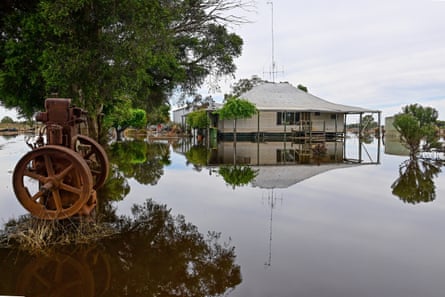
In the meantime, Matthew remains sceptical of insurers’ claims after his home in Kerang, a town in northern Victoria, was flooded in December 2023. He says the disaster has left him with a damage bill of $150,000 and no help from his insurer.
He is dubious that insurance companies need to increase their premiums by so much because of inflation.
“If you increase a policy or a premium by 20% or 30% or 40%, you are creating the inflation,” he says. “You’re not increasing because of it. You are the cause of it.”
KioskNews shows a cleaned-up reading view extracted from the publisher’s page — the original always lives on their site, not ours.