IBM to offer access to a dual-processor quantum system in 2027
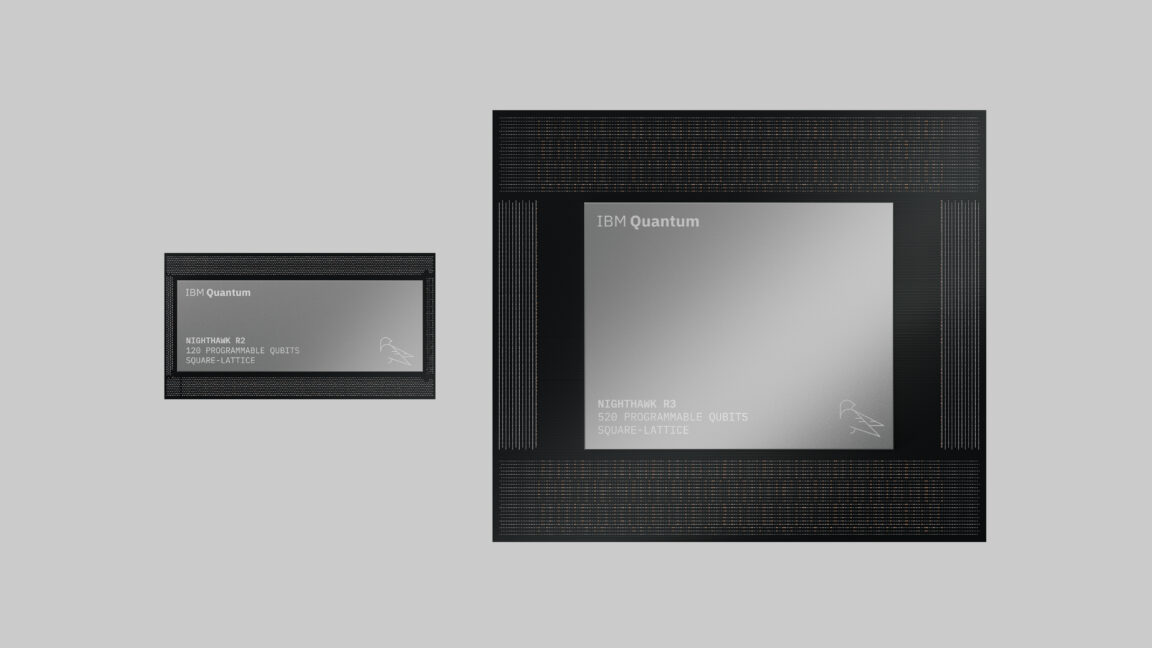
The previous roadmap called for each generation to boost that number, with 2027’s version expected to hit 10,000 gate operations while keeping the 120 hardware qubit count. But rather than boosting the number of qubits in the processor, it would raise qubit counts by chaining multiple chips together. That’s something that it will eventually have to do to offer a useful number of error-corrected qubits as well. In fact, the company’s most recent roadmap called for linking three Nighthawk processors together in 2026 to create a 360-qubit machine.
It doesn’t look like that’s happening this year. Instead, this year’s Nighthawk r2, released in September, is being offered as a single chip. But IBM is saying it provides a big performance boost compared to r1.
The main reason for the boost is that IBM has dedicated a lot of hardware to resetting qubits to the ground state. This includes physical qubits that aren’t used for computation—the company says there are 458 physical qubits, but only 120 are programmable.
“This is an extra physical qubit that we include on the chip for each programmable qubit that lets us quickly remove the energy from one of our programmable qubits, returning it to the ground state,” Oliver Dial, a VP of Quantum Systems, said. “That capability lets our users run circuits on this chip faster than was ever before possible.”
This isn’t necessary for every operation, but it apparently speeds things up considerably—IBM is reporting up to a 19-fold acceleration of some operations.
(The devices at issue here are physically identical to the programmable qubits but cannot be used as qubits, so the terminology is a bit odd; in some cases, IBM refers to them as “dissipative reset gadgets.”)
Connections
The plan for Nighthawk r3 in 2027 is apparently to retain that performance-enhancing technology and combine it with other hardware improvements to further boost the number of operations that can be performed without errors becoming too likely. It will also significantly increase the qubit count, with a target of 520 programmable qubits. Assuming the ratio of programmable qubits to reset devices remains the same as in the r2, that would suggest the company will be making a chip with roughly 2,000 individual qubit-like devices. That’s about double the size of the largest quantum processor the company has offered to date.
KioskNews shows a cleaned-up reading view extracted from the publisher’s page — the original always lives on their site, not ours.